Intermediate
Prepare and test your skills
Intermediate
Prepare and test your skills
Path-Based Major Versioning for REST APIs
Free sample question, answered and explained below. The Professional Cloud Architect practice bank has 2,335 more like it. Try 10 free: instant score, no account.
An enterprise development team is preparing to release major architectural updates to a mission-critical REST API deployed on Google Cloud. The update introduces backward-incompatible changes to several request and response schemas.
The operations and API governance teams have established the following requirements:
- Existing client applications must continue operating without service disruption or forced immediate client code upgrades.
- The team must monitor real-time traffic and operational metrics per API version to determine when client migration completes.
- Infrastructure costs and routing complexity must be minimized by avoiding redundant backend infrastructure.
Which API lifecycle and versioning strategy should you recommend?
Explanations
Provision a new Google Cloud project with separate load balancers and isolated gateway proxies for /v2, leaving /v1 in the original project to isolate telemetry until decommissioning
Provision a new Google Cloud project with separate load balancers and isolated gateway proxies for /v2, leaving /v1 in the original project to isolate telemetry until decommissioning
What Multi-Project API Isolation Is
This approach deploys each API major version into a completely separate Google Cloud project, provisioning independent Virtual Private Cloud (VPC) networks, load balancers, and gateway instances for every version release.
Why It Doesn't Meet the Requirement
- Excessive operational overhead: Managing separate cloud projects, IAM policies, and infrastructure stacks for each major API release creates administrative sprawl.
- Increased infrastructure cost: Violates the constraint to avoid superfluous backends and infrastructure resources by running parallel environments.
- Fragmented operational visibility: Splitting versions across different projects fragments unified telemetry dashboards, requiring multi-project metric aggregation rather than native single-pane version filtering.
Key Limitations
- Requires separate domain names or complex external routing layers to direct requests between projects.
- Duplicates baseline cloud infrastructure costs (load balancers, proxy runtime instances, static IP allocations).
- Increases deployment pipeline complexity across multiple project targets.
This Answer Would Be Correct If
The two API versions had strict security compliance boundaries requiring complete infrastructure isolation, separate billing accounts, or distinct organizational ownership.
Increment the patch version number in the OpenAPI configuration while maintaining identical URIs, using custom HTTP request headers to route traffic conditionally between legacy and updated backend microservices
Increment the patch version number in the OpenAPI configuration while maintaining identical URIs, using custom HTTP request headers to route traffic conditionally between legacy and updated backend microservices
What Header-Based Routing with Patch Increments Is
Semantic patch versioning represents internal bug fixes that carry no interface or schema changes. Header-based routing inspects custom HTTP headers (such as X-API-Version) to direct incoming traffic to different backend microservices behind a single endpoint URI.
Why It Doesn't Meet the Requirement
- Misalignment with semantic versioning: Patch versions are not intended for breaking changes; using them for incompatible schemas violates API design standards.
- Forces client-side modifications: Legacy clients would fail unless they were previously engineered to transmit dynamic version headers, violating the zero-disruption requirement.
- Cache inefficiencies: Content delivery networks (CDNs) and intermediary HTTP proxies often struggle to cache requests accurately when URI endpoints are identical and differences rely entirely on custom headers.
Key Limitations
- Does not provide explicit, readable contract separation in OpenAPI definitions.
- Requires complex conditional routing policies within the API gateway layer.
- Interferes with standard RESTful URL addressability and client SDK generation tools.
This Answer Would Be Correct If
The team were implementing an internal A/B experiment or canary deployment for bug fixes where interface contracts remained 100% identical.
Implement the breaking changes under a new major version base path (e.g., /v2) alongside /v1 in a unified backend service, deploy separate OpenAPI configurations for both versions, and monitor per-version traffic in service analytics until /v1 can be safely retired
Implement the breaking changes under a new major version base path (e.g., /v2) alongside /v1 in a unified backend service, deploy separate OpenAPI configurations for both versions, and monitor per-version traffic in service analytics until /v1 can be safely retired
What Major Versioning with Multi-Version Path Routing Is
Major API versioning via path prefixes (such as /v1 and /v2) is the standard practice for introducing backward-incompatible (breaking) changes in RESTful architectures. By maintaining distinct OpenAPI specifications or API proxies for each major version while implementing them concurrently within a single backend service, organizations can serve multiple API generations simultaneously without duplicating hosting infrastructure.
Multi-Version Path Routing on One Backend
System Architecture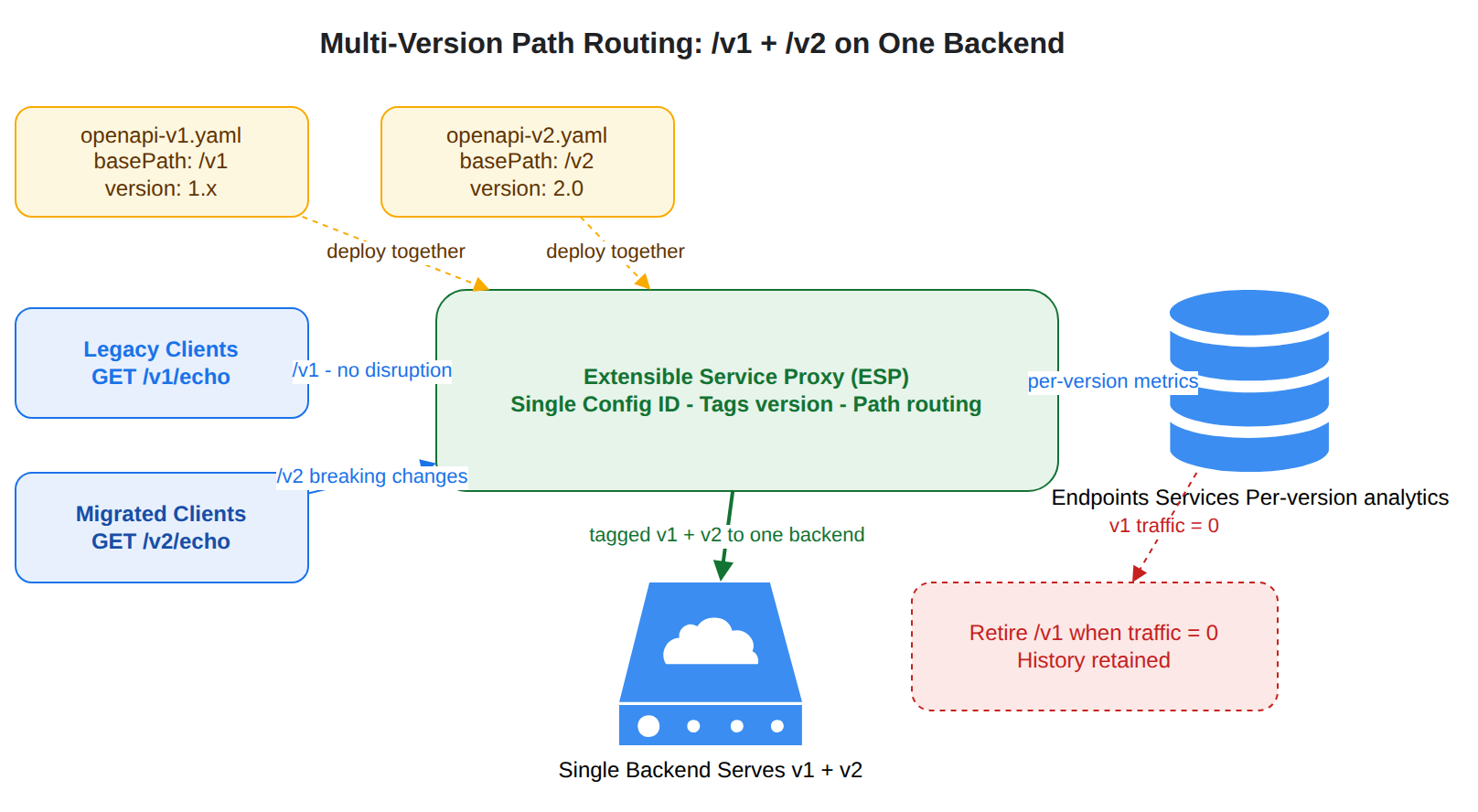
How It Meets the Requirements
- Zero disruption for existing clients: Existing consumers continue making requests to the
/v1endpoints without failing due to unexpected schema modifications. Consumers migrate to the/v2base path on their own development timelines. - Operational visibility and migration monitoring: API management proxies and gateway analytics tag incoming requests with the respective major version. Dashboards display separated metrics and aggregate totals for each version, allowing operations teams to observe traffic decay on
/v1and verify when active requests reach zero. - Cost and management optimization: Supporting both major versions in a single backend implementation avoids running superfluous backends or duplicated container clusters, keeping operational overhead and resource costs minimal.
Key Advantages
- Clear semantic boundaries: Distinct base paths (
/v1,/v2) provide explicit contracts for consumer integration. - Granular analytics: Enables clear visibility into adoption rates, error codes, and latency distributions broken down by API version.
- Predictable deprecation: Provides concrete telemetry to establish graceful API decommissioning and retirement schedules.
- Unified routing: Eliminates the need for complex DNS-level splits or separate runtime deployments.
Why This Is Optimal
This architecture balances seamless developer transition with operational simplicity. It allows development teams to release breaking innovations without impacting existing clients while giving operations clear observability to govern the API lifecycle safely.
Increment the minor version number in the existing OpenAPI configuration file (e.g., 1.1), redeploy the API over the /v1 base path, and rely on API gateway request-transformation policies to adapt breaking payload structures dynamically
Increment the minor version number in the existing OpenAPI configuration file (e.g., 1.1), redeploy the API over the /v1 base path, and rely on API gateway request-transformation policies to adapt breaking payload structures dynamically
What In-Place Minor Version Increments Do
Incrementing a minor version (e.g., from 1.0 to 1.1) is intended strictly for backward-compatible updates, such as adding new optional fields or introducing new non-breaking API methods. In this pattern, the base path remains unchanged (such as /v1), and the updated configuration overwrites the active deployment.
Why It Doesn't Meet the Requirement
- Client contract violations: Breaking changes deployed directly onto an existing active endpoint will immediately disrupt client applications expecting previous schemas.
- Maintenance complexity of transformations: Relying on gateway policies to rewrite incompatible payloads introduces latency, potential edge-case failures, and brittle transformation logic.
- Lost visibility into client versions: Because all requests hit the same
/v1path, API telemetry cannot reliably differentiate between migrated clients and legacy clients.
Key Limitations
- Overwriting active major versions causes immediate runtime failures for legacy consumers.
- Minor version bumps do not support running concurrent legacy and new interface contracts simultaneously on the same route.
- Payload transformation policies at the proxy layer add unnecessary computational overhead.
This Answer Would Be Correct If
The team were adding purely non-breaking changes, such as introducing a new optional query parameter or an additional GET endpoint, where existing clients require no modifications.
Try 10 interactive questions like this one, free
Answer them yourself and get your score the moment you finish. No account needed.
Full access includes
- 2,335 practice questions across all 6 exam domains
- Every answer explained: why it is right, and why the others are not
- Scout, an AI tutor that answers your follow-up questions
- Readiness tracking by domain, so you know when to book the exam
Related questions
Keep the momentum going with these hand-picked practice scenarios
IntermediateProfessional Cloud Architect
Apigee Cloud Armor reCAPTCHA WAAP Architecture
API management best practices (e.g., Apigee)
IntermediateProfessional Cloud Architect
Apigee API Mediation and Response Caching
API management best practices (e.g., Apigee)
IntermediateProfessional Cloud Architect
Pub/Sub Emulator PUBSUB_EMULATOR_HOST
Cloud Emulators (e.g., Bigtable, Spanner, Pub/Sub, and Firestore)
IntermediateProfessional Cloud Architect
MIG Instance Flexibility with Spot VMs
Choosing compute resources (e.g., spot VMs, custom machine types, and specialized workload)
IntermediateProfessional Cloud Architect
Vertex AI Pipelines Lineage Tracking
Using Vertex AI pipelines to automate and orchestrate the ML lifecycle
FundamentalGenerative AI Leader
Temperature and Top-P Sampling
Identifying how sampling parameters and settings are used to control the behavior of gen AI models (e.g., token count, temperature, top-p [nucleus sampling], safety settings, and output length)
Last updated