Fundamental
Prepare and test your skills
Fundamental
Prepare and test your skills
Grounding Generative AI with Live Structured Data
Free sample question, answered and explained below. The Generative AI Leader practice bank has 2,191 more like it. Try 10 free: instant score, no account.
An enterprise is designing a generative AI customer support solution. The organization maintains diverse data assets across its environment:
- Unstructured data: Knowledge base articles, user manuals, and policy documents
- Semi-structured data: Tagged chat logs and JSON-formatted customer feedback
- Structured data: Relational database tables containing live customer account balances, order statuses, and transaction histories
To ensure responses are factually accurate, up-to-date, and free from hallucinations, the engineering team needs to incorporate the live account and transaction records into the AI workflow.
How should the organization utilize this structured data to produce contextually accurate, real-time responses?
Explanations
Fine-tune the base model weights continuously by submitting live transactional database dumps into offline supervised training pipelines.
Fine-tune the base model weights continuously by submitting live transactional database dumps into offline supervised training pipelines.
What Model Fine-Tuning Is
Fine-tuning (or model tuning) is the process of updating an existing foundation model's internal mathematical parameters (weights) using a specialized, curated dataset. It is primarily utilized to adapt a model's style, tone, domain terminology, or task alignment (such as following specialized medical, legal, or coding instructions).
Why It Doesn't Meet the Requirement
- Ineffective for Volatile Data: Fine-tuning modifies neural network weights to learn patterns and stylistic conventions, not to act as a reliable, real-time lookup database for fast-moving transactional records.
- Operational Overhead and Delay: Continuously executing fine-tuning pipelines whenever an order status updates or an account balance changes creates an unsustainable, high-latency operational loop.
- Catastrophic Forgetting Risk: Continually updating model parameters on small batches of transactional records can degrade the model's general reasoning and linguistic abilities.
Key Characteristics and Limitations
- Weight Modification: Changes how the model behaves rather than providing external facts at inference time.
- High Inference Inaccuracy: Neural weights cannot guarantee exact numerical recall, leading to hallucinations when reciting account figures.
- Data Governance Challenges: Ingesting sensitive personal financial data directly into model weights makes selective data erasure and compliance (e.g., GDPR right-to-be-forgotten) extraordinarily difficult.
This Answer Would Be Correct If
- The organization wanted the model to adhere to a specific corporate brand voice, master complex internal acronyms, or output responses in an exact custom JSON syntax consistently.
Convert the relational database schema into static few-shot prompt examples to permanently store customer balances in the prompt template.
Convert the relational database schema into static few-shot prompt examples to permanently store customer balances in the prompt template.
What Few-Shot Prompting Is
Few-shot prompting is an in-context learning technique where a prompt includes a small number of illustrative input-output examples. These examples demonstrate the desired formatting, tone, scope, and pattern of responses to the model during a single inference call without changing underlying model parameters.
Why It Doesn't Meet the Requirement
- Static Context: Hardcoding customer balance records or schemas into static prompt templates means the data does not update when transactions occur in production.
- Context Window Exhaustion: Relational database schemas and customer records for an entire enterprise exceed prompt token limits and consume excessive inference bandwidth.
- No Live Retrieval: Few-shot examples guide formatting behavior (e.g., showing the model how to formulate a polite answer); they do not establish a dynamic connection to external transactional databases.
Key Characteristics and Limitations
- Ephemeral Effect: In-context few-shot examples only influence the immediate API request and do not permanently store knowledge in the base model.
- Pattern Guidance Focus: Designed to demonstrate output structure rather than supply a persistent data repository.
- Privacy and Security Risks: Embedding broad customer records into shared prompt templates exposes confidential information across unrelated user sessions.
This Answer Would Be Correct If
- The team needed to provide the model with 2–3 sample question-and-answer pairs demonstrating how to politely address a customer inquiry using hypothetical, non-confidential placeholder data.
Pre-train a proprietary foundation model from scratch using the relational database records as the core training corpus.
Pre-train a proprietary foundation model from scratch using the relational database records as the core training corpus.
What Pre-Training from Scratch Is
Pre-training is the foundational stage of model development where a neural network processes massive, diverse datasets—often measured in hundreds of billions or trillions of tokens—to learn broad language syntax, semantic relationships, world knowledge, and general reasoning capabilities.
Why It Doesn't Meet the Requirement
- Data Type Mismatch: Relational tables and structured database rows lack the rich linguistic variety and grammatical context necessary for pre-training a natural language foundation model.
- Static Knowledge Limitation: Pre-training permanently freezes knowledge at the point of training data ingestion. As soon as account balances or order statuses change in production, the newly trained model's internal parameters become instantly obsolete.
- Enormous Computational Cost: Training a foundation model from scratch requires extensive compute infrastructure, specialized engineering expertise, and millions of dollars, which is entirely disproportionate for accessing transactional data.
Key Characteristics and Limitations
- High Latency and Expense: Pre-training takes weeks or months to complete on large-scale GPU/TPU clusters.
- Prone to Temporal Drift: Does not support real-time data updates or live query execution.
- Cannot Guarantee Numerical Exactness: Base models generate text probabilistically and frequently misstate numerical values stored in weights.
This Answer Would Be Correct If
- The organization needed to build an entirely new general-purpose base model possessing foundational understanding across specialized languages or domain vocabularies absent from existing commercial models.
Ground the generative AI model dynamically at inference time by retrieving real-world structured data to contextualize prompt responses.
Ground the generative AI model dynamically at inference time by retrieving real-world structured data to contextualize prompt responses.
What Grounding with Structured Data Is
Grounding is the practice of connecting a generative AI model to verifiable, external data sources—such as structured databases, APIs, or enterprise data repositories—at query time. Instead of relying purely on static knowledge internalized during prior training, the system retrieves relevant live facts and injects them directly into the context window for the model to reference during text generation.
How It Meets the Business Requirements
- Real-Time Accuracy: Structured transactional databases store fluctuating data such as order statuses and account balances. Grounding allows the AI application to query these live records dynamically via SQL connectors or APIs.
- Preventing Hallucinations: Foundation models generate plausible-sounding text based on statistical token patterns. Supplying exact, structured records inside the prompt context ensures the model derives its answers from factual enterprise data rather than statistical guessing.
- Optimized Context Generation: The generative model uses its natural language capabilities to interpret the user's intent and format the retrieved structured data into a coherent, customer-friendly response.
Key Advantages and Capabilities
- Eliminates Model Retraining: Retaining transactional accuracy does not require expensive, time-consuming model fine-tuning or continuous retraining cycles.
- Maintains Data Governance: Access controls, column-level security, and role-based permissions can be enforced at the database retrieval layer before data reaches the model.
- Traceability and Auditability: Grounded outputs can cite the exact structured database record or transaction identifier used to construct the answer.
- Multimodal and Cross-Data Synergy: Combines unstructured knowledge comprehension (understanding user queries) with structured data precision (exact balance numbers).
Why This Is Optimal
Grounding is the industry standard for integrating rapidly changing business facts. While unstructured data is ideal for teaching broad language patterns during pre-training and semi-structured data is frequently used for fine-tuning task-specific formatting, structured enterprise data is most effectively utilized through real-time retrieval and grounding.
Real-Time Grounding Flow with Structured Data
Process Flow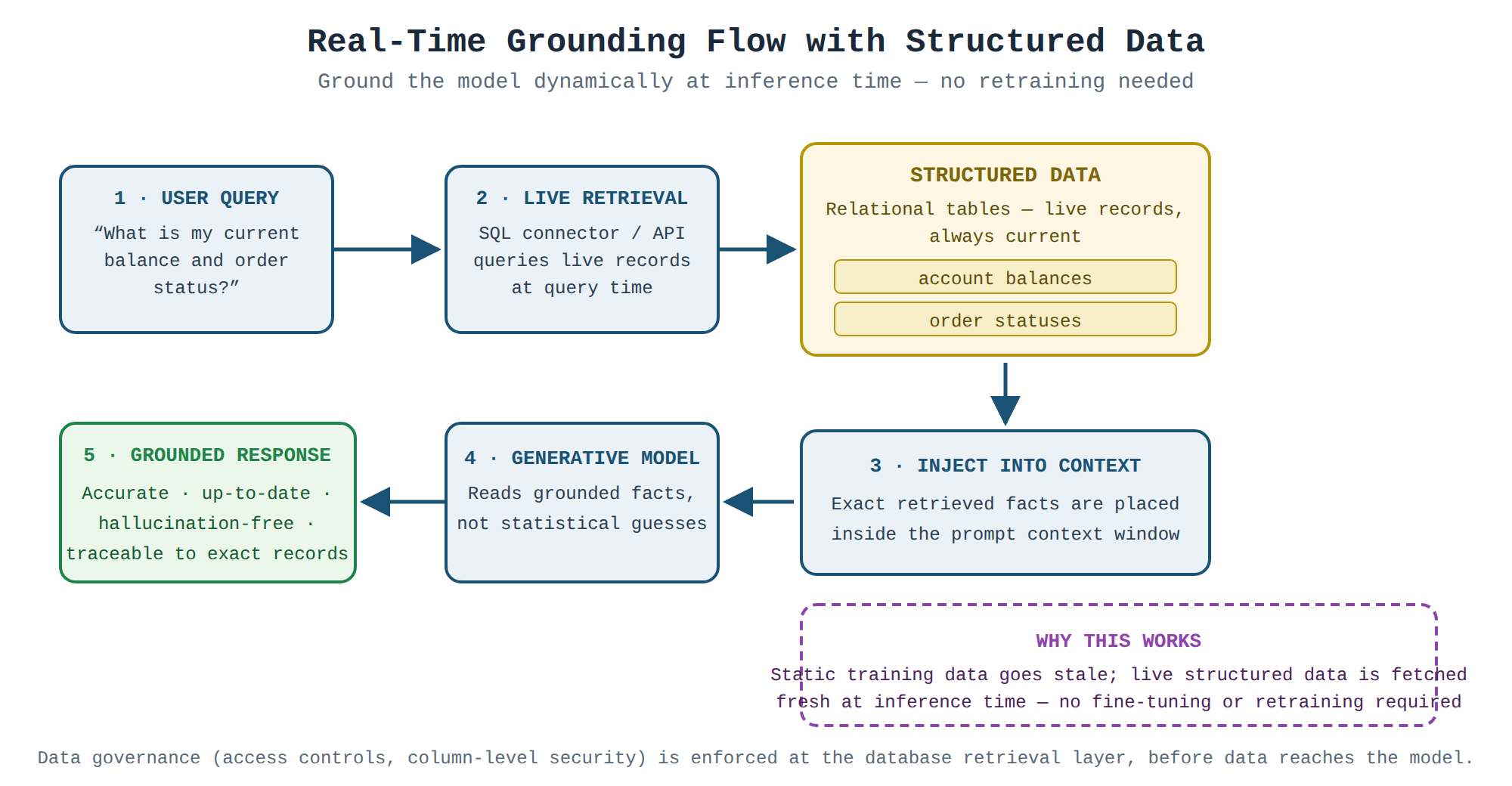
Try 10 interactive questions like this one, free
Answer them yourself and get your score the moment you finish. No account needed.
Full access includes
- 2,191 practice questions across all 4 exam domains
- Every answer explained: why it is right, and why the others are not
- Scout, an AI tutor that answers your follow-up questions
- Readiness tracking by domain, so you know when to book the exam
Related questions
Keep the momentum going with these hand-picked practice scenarios
FundamentalGenerative AI Leader
Retrieval-Augmented Generation (RAG)
Describing how various data types are used in gen AI and the business implications
FundamentalGenerative AI Leader
Customer Data Model Training Exclusion
Describing how various data types are used in gen AI and the business implications
FundamentalGenerative AI Leader
Vertex AI AutoML
Describing how Google Cloud's AI platform democratizes AI development (e.g., low-code and no-code tools, pre-trained models, APIs)
FundamentalGenerative AI Leader
Vertex AI Search Grounding
Recognizing the functionality, use cases, and business benefits of Google Cloud's external search offerings (e.g., Vertex AI Search, Google Search)
FundamentalGenerative AI Leader
Multimodal Generative AI Personalization
Identifying business use cases where gen AI can create, summarize, discover, and automate (e.g., text generation, image generation, code generation, video generation, data analysis, and personalized user experience)
AdvancedProfessional Data Engineer
Dataplex Lake Zone Asset Governance
Managing the lake (configuring data discovery, access, and cost controls)
Last updated