Fundamental
Prepare and test your skills
Fundamental
Prepare and test your skills
ReAct Prompting Combines Reasoning With Tool Actions
Free sample question, answered and explained below. The Generative AI Leader practice bank has 2,191 more like it. Try 10 free: instant score, no account.
An enterprise is building an intelligent customer service assistant using generative AI on Google Cloud. The assistant must handle complex customer billing inquiries that require performing step-by-step reasoning, executing queries against an external billing database API to fetch real-time transaction records, and evaluating the retrieved data before formulating a response.
Which advanced prompting technique is best suited for combining multi-step reasoning with external tool execution?
Explanations
Few-shot prompting
Few-shot prompting
What Few-Shot Prompting Is
Few-shot prompting is an in-context learning technique where several input-output example pairs are included in the prompt to demonstrate the desired format, style, or task execution before the actual query.
Why It Doesn't Meet the Requirement
- Does not manage dynamic tool interactions: While few-shot prompting teaches the model expected output formats through static examples, it does not provide an interactive framework for executing API requests and consuming live responses.
- Insufficient for dynamic environments: Providing static billing examples does not equip the model to autonomously query live customer accounts and dynamically adapt its reasoning based on retrieved data.
- Context window consumption: Adding multiple comprehensive billing scenarios consumes significant token capacity without establishing real-time database connectivity.
Key Characteristics and Limitations
- Pattern demonstration: Guides output formatting and domain adaptation using static demonstration pairs.
- Closed-context boundary: Operates strictly within the provided prompt and cannot retrieve dynamic external state on its own.
- Static outputs: Produces responses based on learned patterns rather than executing actions against live enterprise APIs.
This Answer Would Be Correct If
- The requirement was to standardize the formatting or tone of billing explanation emails based on historical sample templates.
- The model needed to learn a custom categorization taxonomy for billing issues using 3-5 reference examples.
Additional Context
While ReAct agents can utilize few-shot examples to learn how to interact with tools, few-shot prompting on its own refers to static demonstration examples rather than an action-oriented agent framework.
Zero-shot prompting
Zero-shot prompting
What Zero-Shot Prompting Is
Zero-shot prompting is the practice of presenting a model with an instruction or task description directly without providing any demonstration examples, intermediate reasoning instructions, or external tool integrations.
Why It Doesn't Meet the Requirement
- Lacks structured reasoning: Direct zero-shot prompts do not prompt the model to break down multi-stage logic into structured intermediate steps, increasing error rates on complex problems.
- No mechanism for API actions: Zero-shot prompting alone does not establish the thought-action-observation structure needed to interface with external billing databases.
- Low precision for complex tasks: Complex billing analysis requires dynamic lookup and verification, which simple zero-shot prompts cannot coordinate reliably.
Key Characteristics and Limitations
- Minimal context overhead: Uses minimal prompt tokens since no examples or structured reasoning frameworks are provided.
- Prone to calculation errors: Models attempting multi-step math or logic in a single direct forward pass often suffer from logical breakdowns.
- Static execution: Relies exclusively on static weights without interacting with third-party APIs or live endpoints.
This Answer Would Be Correct If
- The task was straightforward, such as classifying customer sentiment, translating text, or summarizing an already provided document.
- The organization wanted the lowest possible prompt token cost for simple, non-analytical requests.
Additional Context
Zero-shot prompting is effective for baseline tasks, but as task complexity increases to include external tools and multi-step deduction, structured prompting frameworks like ReAct become necessary.
Standard Chain-of-Thought (CoT) prompting
Standard Chain-of-Thought (CoT) prompting
What Chain-of-Thought Prompting Is
Chain-of-Thought (CoT) prompting is a technique that encourages large language models to break down complex problems into a sequential series of intermediate reasoning steps before arriving at a final answer.
Why It Doesn't Meet the Requirement
- No external action loop: While standard Chain-of-Thought prompting excels at internal logical deduction and arithmetic reasoning, it operates entirely within the model's static internal knowledge.
- Inability to fetch real-time data: Standard CoT cannot autonomously call external APIs, query live billing databases, or receive environmental feedback during execution.
- Hallucination risk on dynamic data: Without access to live records, CoT will attempt to deduce or fabricate customer billing data rather than retrieving actual transaction logs.
Key Characteristics and Limitations
- Internal reasoning focus: Generates step-by-step thoughts solely from pre-trained weights and the prompt context.
- Static knowledge constraint: Cannot access real-time information or perform state-changing operations in external software.
- One-way output generation: Produces a linear stream of thoughts leading to an answer without pausing to query external tools.
This Answer Would Be Correct If
- The billing inquiry was entirely self-contained within the prompt text (e.g., word math problems or policy interpretation) with no requirement to query live APIs or databases.
- The task required only internal reasoning without integration into external enterprise tools.
Additional Context
Chain-of-Thought prompting forms the foundation of ReAct's "Reasoning" component, but ReAct extends CoT by coupling those reasoning traces with dynamic "Action" invocations.
ReAct (Reasoning and Acting) prompting
ReAct (Reasoning and Acting) prompting
What ReAct Prompting Is
ReAct (Reasoning and Acting) is an advanced prompting framework that synergizes reasoning traces and task-specific actions in large language models. Rather than operating purely in isolation or generating answers without verification, ReAct enables models to alternate between thinking (reasoning) about what to do next and executing (acting) concrete operations such as interacting with external APIs, databases, or search tools.
How It Meets the Scenario Requirements
- Multi-step reasoning requirement: ReAct generates intermediate reasoning steps that help the model break down complex billing logic, update action plans, and track progress toward resolving the inquiry.
- External tool execution requirement: ReAct explicitly integrates action steps where the model calls external APIs (such as querying real-time customer account balances and transaction histories) and incorporates the returned observations into its subsequent reasoning cycles.
- High precision and reduced hallucination: By grounding each reasoning step with real-time data retrieved from external systems, the model minimizes inaccuracies in dynamic financial calculations.
Key Advantages and Capabilities
- Interleaved Thought-Action-Observation loop: Facilitates dynamic problem solving where external feedback refines the model's analytical path.
- Explainability and auditability: Produces clear human-readable traces showing why a tool was invoked and how the result influenced the final decision.
- Tool and API interoperability: Bridges the gap between static model weights and dynamic cloud services and enterprise backends.
- Error recovery: Allows the model to inspect unexpected tool outputs, re-evaluate assumptions, and try alternative queries if needed.
ReAct: Thought-Action-Observation Loop
Sequence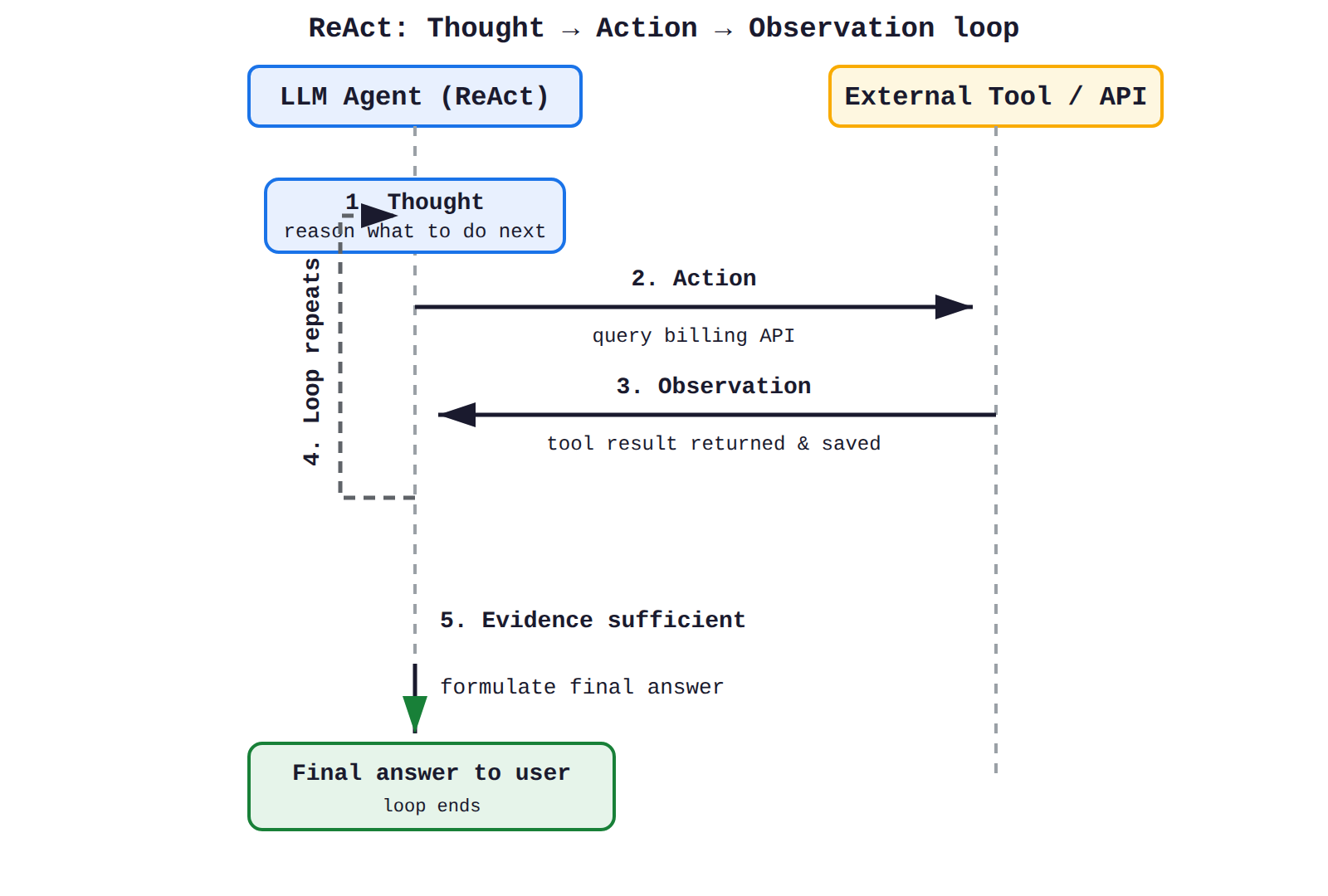
Try 10 interactive questions like this one, free
Answer them yourself and get your score the moment you finish. No account needed.
Full access includes
- 2,191 practice questions across all 4 exam domains
- Every answer explained: why it is right, and why the others are not
- Scout, an AI tutor that answers your follow-up questions
- Readiness tracking by domain, so you know when to book the exam
Related questions
Keep the momentum going with these hand-picked practice scenarios
FundamentalGenerative AI Leader
Chain-of-Thought Prompting
Identifying advanced prompting techniques and when to use them (e.g., chain-of-thought prompting, ReAct prompting)
FundamentalGenerative AI Leader
Fine-Tuning Data and Model Artifact Security
Identifying how to choose the appropriate foundation model for a business use case (e.g., modality, context window, security, availability and reliability, cost, performance, fine-tuning, and customization)
FundamentalGenerative AI Leader
Vertex AI Model Registry and Model Monitoring
Identifying the stages of the machine learning lifecycle; data ingestion, data preparation, model training, model deployment, and model management; and the Google Cloud tools for each stage
FundamentalGenerative AI Leader
Terraform for Vertex AI Infrastructure as Code
Describing how Google Cloud has an enterprise-ready AI platform (e.g., responsible, secure, private, reliable, scalable)
FundamentalGenerative AI Leader
Sensitive Data Protection and IAM Least Privilege
Explaining security throughout the ML lifecycle
FundamentalAssociate Data Practitioner
BigQuery Dataset Prerequisite
Plan a standard ML project (e.g., data collection, model training, model evaluation, prediction)
Last updated