Fundamental
Prepare and test your skills
Fundamental
Prepare and test your skills
Grounding Responses in Authoritative Enterprise Sources
Free sample question, answered and explained below. The Generative AI Leader practice bank has 2,191 more like it. Try 10 free: instant score, no account.
An enterprise is developing an internal generative AI assistant to help customer support agents answer questions about corporate policies and benefits. During testing, the team observes that the base model occasionally generates convincing but completely inaccurate statements and fails to incorporate policy guidelines updated earlier this week.
The engineering team needs to tether the model's responses to authoritative corporate documents, enable auditability through citations, and reduce inaccurate generations.
Which technique should the team implement?
Explanations
Grounding
Grounding
What Grounding Is
In generative AI, grounding is the process of connecting a model's output to verifiable, authoritative sources of information. Rather than forcing a model to rely solely on the static knowledge embedded in its parameters during pre-training, grounding tethers the generated responses directly to specified data repositories, such as enterprise file stores, internal databases, or live search indexes.
How It Meets the Requirements
- Anchors responses to authoritative data: Grounding supplies the model with relevant excerpts from company policy manuals at query time, ensuring answers reflect real enterprise facts.
- Reduces hallucinations: When a large language model is constrained to generate answers based strictly on retrieved reference data, the likelihood of inventing non-factual content is drastically minimized.
- Provides auditability: Grounding systems generate grounding support metadata, including citations and references that show exactly which source chunk supports each claim in the response.
- Enables data freshness: Because grounding retrieves information dynamically from live repositories, recent policy revisions are incorporated immediately without requiring model retraining.
Grounding: Retrieval to Generation Flow
Process Flow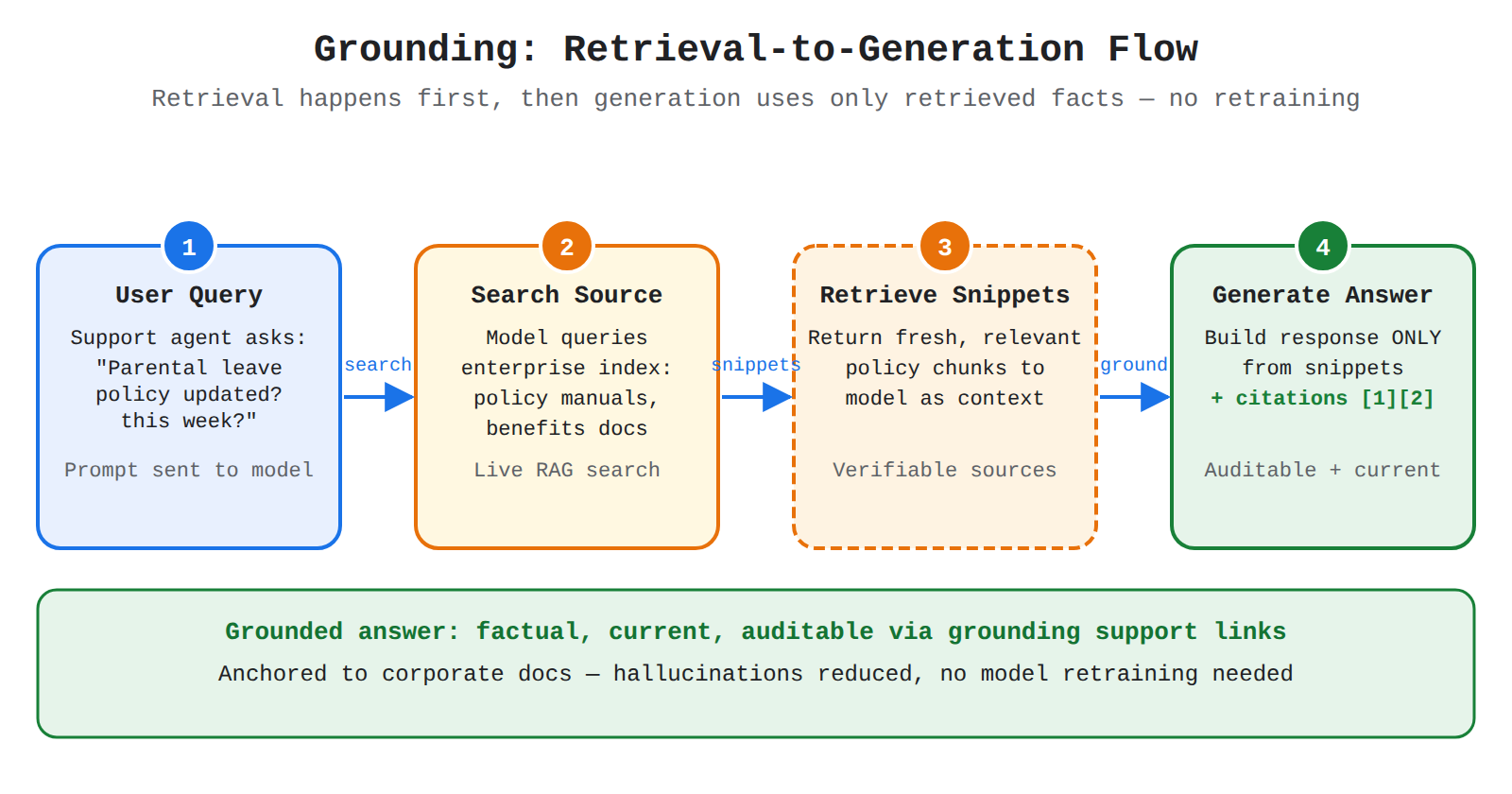
Key Advantages and Capabilities
- Fact-based precision: Ensures critical enterprise answers are dependable and trustworthy.
- Auditable citations: Allows end users to click through to underlying policy documents to verify statements independently.
- Cost efficiency: Keeps the model up to date dynamically without the high computational expense of retraining or parameter fine-tuning.
- Access control: Can integrate with enterprise search tools to ensure responses only pull from documents the querying user is authorized to see.
Why This Is Optimal
Grounding is specifically designed to solve the twin challenges of hallucinations and outdated static knowledge. By supplying factual reference material directly to the model during inference, it guarantees reliable, auditable, and current answers.
Foundation model pre-training
Foundation model pre-training
What Foundation Model Pre-Training Is
Foundation model pre-training is the initial, computationally massive phase of building an AI model from scratch. During pre-training, a deep neural network processes hundreds of billions or trillions of tokens across diverse text, code, and multimodal datasets to learn fundamental grammar, reasoning patterns, and general world knowledge.
Why It Doesn't Meet the Requirement
Pre-training is not a mechanism for connecting a model to verifiable operational documents. Building a foundation model requires millions of dollars in compute infrastructure, specialized machine learning teams, and months of training time. Furthermore, pre-training results in a static snapshot of data with an explicit knowledge cutoff date, meaning it cannot reflect recent policy changes and remains prone to producing statistical hallucinations.
Key Characteristics and Limitations
- Extremely resource-intensive: Demands vast compute clusters (hundreds of GPUs/TPUs) and enormous operational investment.
- Static knowledge representation: The resulting model has no knowledge of events or policy changes occurring after the training cutoff.
- Absence of citations: The model predicts likely tokens statistically; it cannot point users to verifiable source URLs or enterprise documents.
- Broad, generalist scope: Designed to establish general cognitive capabilities rather than ground queries on private internal manuals.
This Answer Would Be Correct If
The company were a frontier AI laboratory developing an entirely new foundational model architecture from raw web-scale corpora.
Additional Context
Enterprise solutions rarely train foundational models from scratch. Instead, they consume existing foundation models and apply grounding to supply proprietary context securely.
Parameter-efficient fine-tuning (PEFT)
Parameter-efficient fine-tuning (PEFT)
What Parameter-Efficient Fine-Tuning (PEFT) Is
Parameter-efficient fine-tuning (PEFT) is an adaptation method that customizes a pre-trained foundation model for specific tasks or styles by updating only a small percentage of its weights or training small modular adapter layers (such as Low-Rank Adaptation or LoRA), leaving the core model weights frozen.
Why It Doesn't Meet the Requirement
While PEFT effectively trains a model to adopt a specific tone, formatting style, or domain vocabulary, it does not anchor responses to verifiable reference sources in real time. Model weights cannot be updated every day or week as company policies change. More importantly, fine-tuning modifies internal parametric memory, which does not eliminate hallucinations and cannot dynamically provide auditable citations linking back to original corporate documents.
Key Characteristics and Limitations
- Alters internal weights: Focuses on task behavior and formatting rather than real-time information lookup.
- Bound to static training dates: Information absorbed during fine-tuning becomes outdated the moment internal policies are modified.
- Lacks auditability: Cannot inherently provide line-by-line citation metadata pointing to external source documents.
- Persistent hallucination risk: A fine-tuned model can still invent plausible-sounding facts when prompted with queries outside its training examples.
This Answer Would Be Correct If
The organization wanted to train the assistant to follow a highly specialized conversational style, adhere to a strict structured output schema (like JSON), or perform classification without needing external fact retrieval.
Additional Context
A common industry best practice is to pair fine-tuning for style and syntax with grounding for factual accuracy and verification.
Model quantization
Model quantization
What Model Quantization Is
Model quantization is a post-training compression technique used to make large language models smaller and faster. It converts model weights and activation tensors from high-precision numerical formats (such as 16-bit or 32-bit floating-point numbers) into lower-precision representations (such as 8-bit or 4-bit integers).
Why It Doesn't Meet the Requirement
Quantization addresses computational efficiency and hardware constraints, not factual accuracy or source verification. Compressing weight parameters does not provide the model with access to recent policy updates, does not supply external reference documents, and does not provide an audit trail of citations. In fact, if applied too aggressively, quantization can slightly degrade reasoning fidelity without mitigating hallucinations.
Key Characteristics and Limitations
- Optimizes hardware consumption: Lowers GPU memory (VRAM) requirements and accelerates inference throughput.
- No external retrieval: Does not connect the model to company databases, search APIs, or document indexes.
- No citation capabilities: Lacks any mechanism to verify claims against external facts or deliver audit trails.
- Retains existing knowledge limits: Operates strictly on the pre-existing, static parameters of the base model.
This Answer Would Be Correct If
The team needed to run the virtual assistant on low-cost hardware or edge devices with restricted memory capacity while minimizing latency.
Additional Context
Quantization is an infrastructure and deployment optimization strategy, whereas grounding is an architectural technique for factual accuracy and verification.
Try 10 interactive questions like this one, free
Answer them yourself and get your score the moment you finish. No account needed.
Full access includes
- 2,191 practice questions across all 4 exam domains
- Every answer explained: why it is right, and why the others are not
- Scout, an AI tutor that answers your follow-up questions
- Readiness tracking by domain, so you know when to book the exam
Related questions
Keep the momentum going with these hand-picked practice scenarios
FundamentalGenerative AI Leader
Grounding First-Party vs Third-Party vs World Data
Describing the concept of grounding in LLMs and differentiating between grounding with first-party enterprise data, third-party data, and world data
FundamentalGenerative AI Leader
BigQuery Vertex AI Looker Integration
Recognizing the advantages of Google's comprehensive AI ecosystem (e.g., integration of gen AI across Google products and services)
FundamentalGenerative AI Leader
AI ML Generative AI Hierarchy
Defining core gen AI concepts (e.g., artificial intelligence, natural language processing, machine learning, generative AI, foundation models, multimodal foundation models, diffusion models, prompt tuning, prompt engineering, large language models)
FundamentalGenerative AI Leader
Google Veo Video Generation Model
Veo
FundamentalGenerative AI Leader
Knowledge Cutoff and Data Dependency
Identifying common limitations of foundation models (e.g., data dependency, the knowledge cutoff, bias, fairness, hallucinations, edge cases)
IntermediateProfessional Cloud Architect
Cloud DLP De-Identification Transformations
Commercial (e.g., sensitive data such as credit card information handling and personally identifiable information [PII])
Last updated