Simulation
Shared responsibility across IaaS, PaaS, and SaaS
Pick a service model and a security layer to see who secures it.
Try the scenario
Shared responsibility across IaaS, PaaS, and SaaS
Change the inputs and watch how the outcome changes.
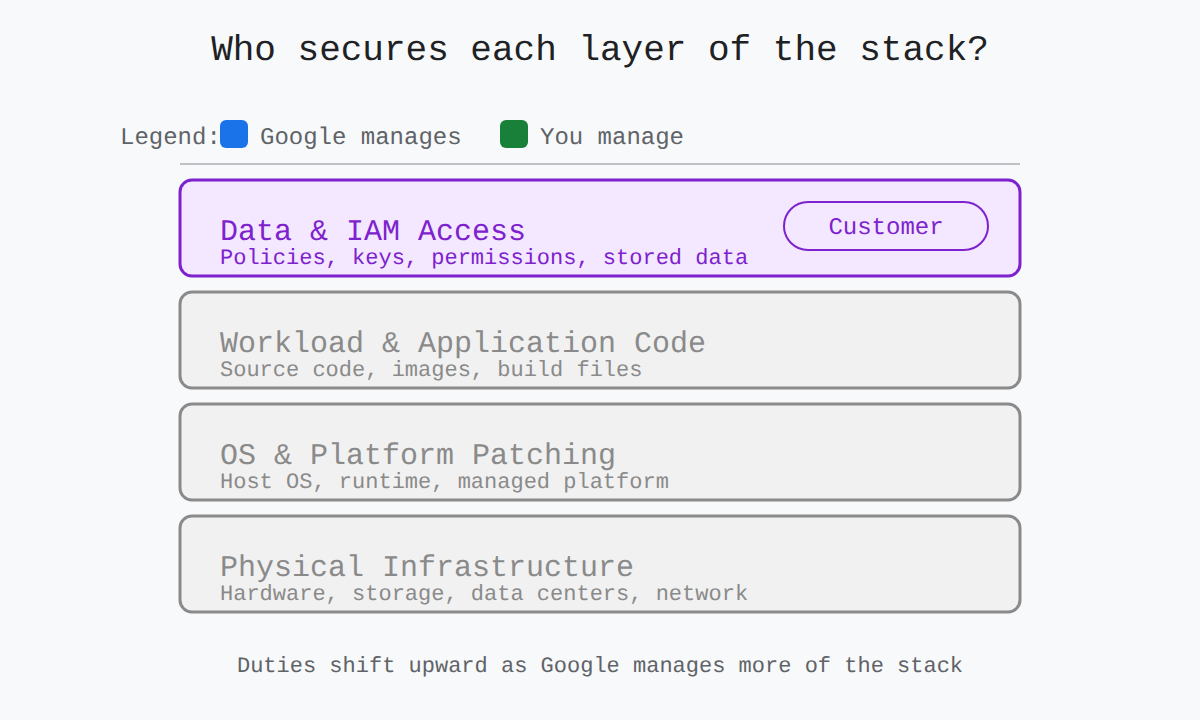
Pick a service model and a security layer to see who secures it.
Every outcome
Succeeds
6 outcomesCustomer-owned data and access, in every model
You are always responsible for securing your data and its access and usage — including IAM policies, keys, and permissions — whether you use IaaS, PaaS, or SaaS. Google secures the infrastructure underneath, but only you decide who can reach your data.
Starting scenarioEvery input at its default
Google secures physical infrastructure in every model
In IaaS, PaaS, and SaaS alike, Google is always responsible for securing the underlying infrastructure — hardware, storage, data centers, and the core network. You never manage physical security for provider infrastructure.
What changed
- Security layerData & IAM AccesstoPhysical Infrastructure
IaaS: you own OS hardening and patching
In infrastructure as a service, Google manages only the hardware, storage, and network. Everything above — including the guest operating system and its hardening and patching — is your responsibility, so you evaluate images and keep them up to date.
What changed
- Security layerData & IAM AccesstoOS & Platform Patching
PaaS/SaaS: Google patches the platform
With PaaS or SaaS, Google manages the service itself and its underlying infrastructure, including the operating system, control plane, and automated patching. This layer moved to Google because you changed the service model from IaaS, where the OS was yours to harden.
What changed
- Service modelIaaS (e.g., Compute Engine)toPaaS (e.g., App Engine, GKE)
- Security layerData & IAM AccesstoOS & Platform Patching
IaaS/PaaS: you secure your workload code
In IaaS and PaaS, the customer secures application source code, container images, build files, and tokens, along with vulnerability scanning and deployment policies like Binary Authorization. Google secures the platform the code runs on, but not the code you bring.
What changed
- Security layerData & IAM AccesstoWorkload & Application Code
SaaS: Google manages the whole application
In software as a service, Google is responsible for the security of everything except the data and its access and usage — including the application itself. This layer moved to Google because you changed the service model from IaaS or PaaS, where you secured your own code and images.
What changed
- Service modelIaaS (e.g., Compute Engine)toSaaS (e.g., Google Workspace)
- Security layerData & IAM AccesstoWorkload & Application Code
In the Domain
Shared Responsibility Across IaaS, PaaS, and SaaS
Shared responsibility across IaaS, PaaS, and SaaS moves the security boundary with how much Google manages. Google always secures the underlying network and infrastructure, while the customer always secures access policies and stored data. In software as a service, Google owns most layers but the customer still controls data and access.
| Service model | Google Cloud manages | Customer manages |
|---|---|---|
| IaaS | Hardware, storage, and network | Everything above, including data and access |
| PaaS | Service and infrastructure, including control plane and patching | Data, access, code, images, and IAM configuration |
| SaaS | Everything except data and its access and usage | Data and its access and usage |
Domain 1 of 3
Trust and security in the cloud
Read the Domain summaryPractice this Domain
135 practice questions
Practice this DomainMore from this Domain
Last updated