Simulation
Choosing a Real-Time Pipeline Architecture on Google Cloud
Change the workload source and processing requirement to see which ingestion path fits.
Try the scenario
Choosing a Real-Time Pipeline Architecture on Google Cloud
Change the inputs and watch how the outcome changes.
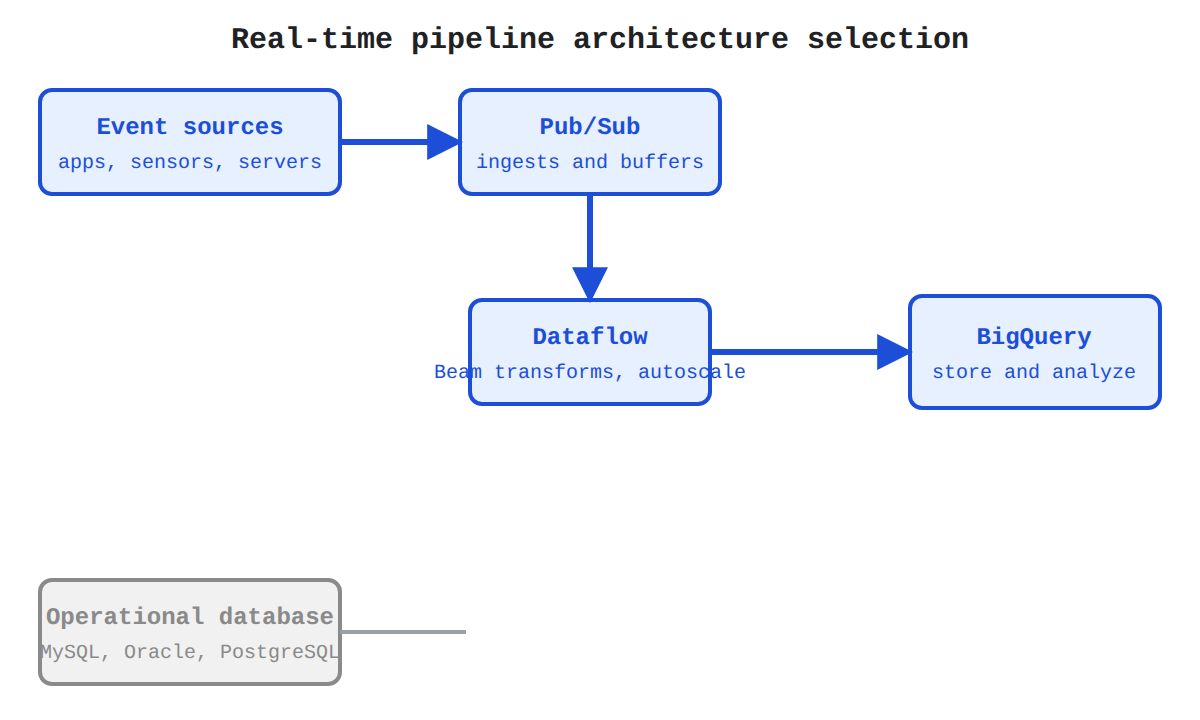
Change the workload source and processing requirement to see which ingestion path fits.
Every outcome
Succeeds
4 outcomesFull Pub/Sub + Dataflow pipeline
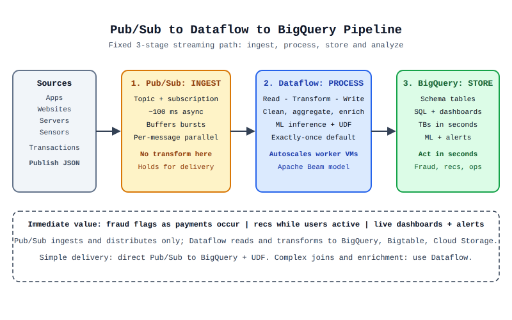
With an event stream that needs complex transforms, Pub/Sub ingests and buffers asynchronous bursts from many producers, and Dataflow autoscales worker VMs to run Apache Beam filtering, aggregation, joins, or ML inference before writing to BigQuery. This is the exam's choice when the stream needs real processing before loading.
Starting scenarioEvery input at its default
Direct Pub/Sub → BigQuery subscription
Because the requirement changed to a direct load with at most a simple UDF, the stream bypasses Dataflow entirely: a Pub/Sub BigQuery subscription streams events straight into BigQuery tables. This minimizes operational complexity and latency when no complex transforms, joins, or enrichment are needed.
What changed
- Processing requirementComplex transforms, joins, or MLtoDirect load or simple UDF
Direct Datastream CDC replication
The workload source changed from an event stream to operational database changes, and the load is direct, so Datastream is the fit: its serverless change data capture captures ongoing row-level changes and replicates them straight into BigQuery with minimal latency, with no intermediate processing tier.
What changed
- Workload sourceApp and sensor event streamtoOperational database changes
- Processing requirementComplex transforms, joins, or MLtoDirect load or simple UDF
Datastream staging with Dataflow loading
Database changes still come from Datastream CDC, but the complex-processing requirement routes them through Cloud Storage first: Datastream writes the change event stream as Avro or JSON files, then Dataflow templates load, enrich, and transform that data before analytics delivery — the documented Datastream-plus-Dataflow pattern.
What changed
- Workload sourceApp and sensor event streamtoOperational database changes
In the Domain
Event Pipeline from Pub/Sub Through Dataflow to BigQuery
Exam tip: Choose a direct Pub/Sub BigQuery subscription with a UDF for simple delivery to BigQuery, and choose a Dataflow pipeline when the stream needs complex transforms, joins, or enrichment before loading.
Domain 3 of 3
Making Data Useful and Accessible
Read the Domain summaryPractice this Domain
137 practice questions
Practice this DomainMore from this Domain
Last updated