Simulation
Fixed CapEx vs Cloud Consumption: Match Capacity to Demand
Move the demand slider and switch hosting models to see how fixed on-premises capacity compares with autoscaling on Google Cloud.
Try the scenario
Fixed CapEx vs Cloud Consumption: Match Capacity to Demand
Change the inputs and watch how the outcome changes.
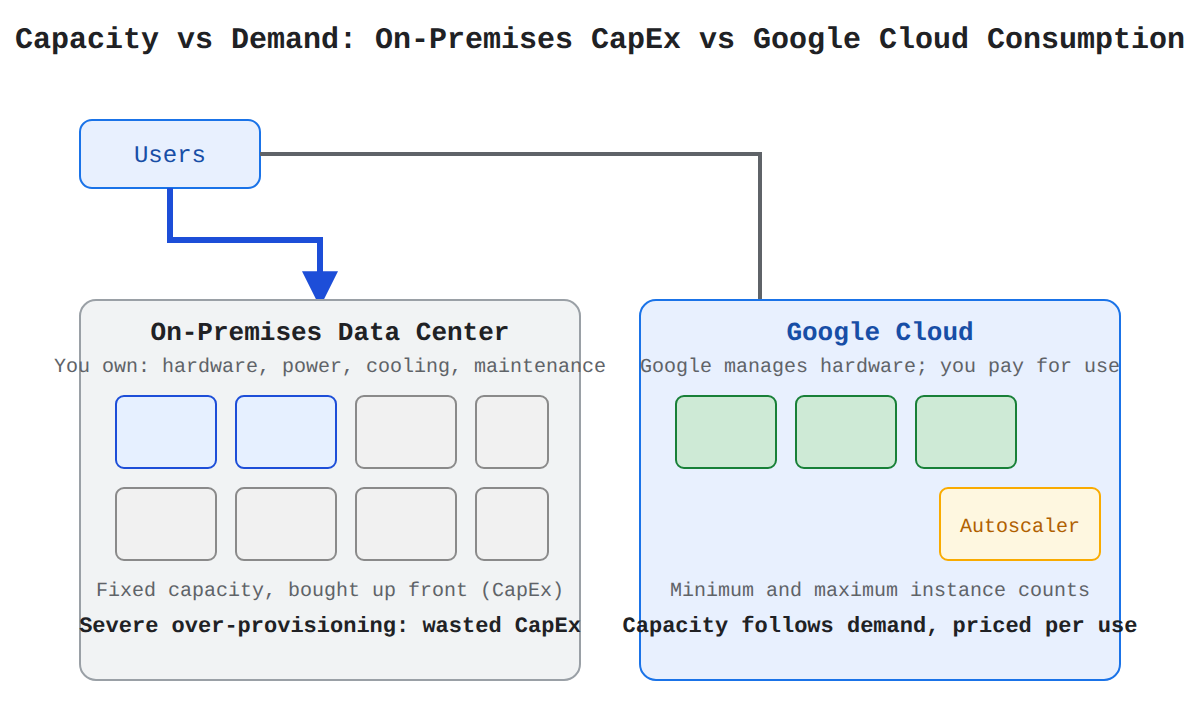
Move the demand slider and switch hosting models to see how fixed on-premises capacity compares with autoscaling on Google Cloud.
Every outcome
Succeeds
5 outcomesOff-peak on-premises: paid capacity sits idle
In an on-premises data center, hardware, power, cooling, maintenance, and support were all bought up front as capital expenditure. At off-peak demand almost every server is idle, but the full cost of the fixed capacity is still yours, so most of the investment is wasted.
Starting scenarioEvery input at its default
Steady load on-premises: headroom stays idle
With the hosting model set to on-premises and a steady baseline, most servers carry regular load. The remaining headroom bought for peaks still sits idle and unrecoverable, so part of the capital expenditure continues to be wasted.
What changed
- Workload demandIdle / Off-PeaktoSteady Baseline
Off-peak on Google Cloud: scale down, pay only for use
With the hosting model set to Google Cloud and off-peak demand, autoscaling scales compute down to the policy minimum, so there is no idle capacity to pay for. Physical infrastructure is offloaded to Google, and consumption-based pricing bills only what is actually used.
What changed
- Hosting modelOn-Premises Data CentertoGoogle Cloud
Steady load on Google Cloud: right-sized allocation
With the hosting model set to Google Cloud and a steady baseline, the autoscaling group runs a right-sized set of instances matched to actual demand. You are billed only for the resources actively consumed, with no idle headroom cost.
What changed
- Hosting modelOn-Premises Data CentertoGoogle Cloud
- Workload demandIdle / Off-PeaktoSteady Baseline
Traffic surge on Google Cloud: autoscaling absorbs the spike
With the hosting model set to Google Cloud and a traffic surge, autoscaling automatically adds instances within the policy maximum to absorb the spike, and you are billed only for the burst duration. When traffic falls again, Cloud Run or a managed instance group scales instances back down to reduce costs.
What changed
- Hosting modelOn-Premises Data CentertoGoogle Cloud
- Workload demandIdle / Off-PeaktoTraffic Surge
Fails
1 outcomeTraffic surge on-premises: fixed capacity bottlenecks
With the hosting model set to on-premises and a traffic surge, demand exceeds the fixed hardware capacity. New servers cannot be provisioned instantly, so the workload bottlenecks and performance and user experience degrade.
What changed
- Workload demandIdle / Off-PeaktoTraffic Surge
In the Domain
Consumption-Based Pricing Replaces Upfront Capital Costs
Consumption-based pricing means an organization pays for the Google Cloud resources it actually consumes rather than paying for fixed capacity in advance. In an on-premises data center, routers, switches, cabling, power, cooling, maintenance, and support require large upfront and ongoing costs. In Google Cloud, many costs become usage-based, so organizations can avoid paying for idle capacity and adjust spending when demand changes.
Domain 1 of 9
Explain why and how the cloud is revolutionizing businesses.
Read the Domain summaryPractice this Domain
27 practice questions
Practice this DomainMore from this Domain
Last updated