Fundamental
Prepare and test your skills

Fundamental
Prepare and test your skills
Business Value from Custom AutoML Models
AutoML-driven insights are the business results an organization gets when it trains custom machine learning models on its own data and uses those models in real work. The value shows up as better strategic decisions, more efficient operations, and improved customer interactions. Realizing that value depends on trustworthy reusable data, metrics tied to business goals, repeated improvement, and the ability to run models reliably at scale.
Turn Organizational Data into Reusable, Governed Assets
A data governance framework is the set of policies, procedures, and roles that manages data through its lifecycle, and it is the foundation for cost-effective AI at scale. Google Cloud implements governance with Knowledge Catalog, an intelligent data fabric that unifies distributed data without moving it into one place. Knowledge Catalog organizes data into logical lakes and zones, controls access through Google Groups and catalog roles, and automates data-quality checks. Its catalog automatically ingests metadata from supported Google Cloud sources, while teams create custom entries for outside sources.
BigQuery sharing lets teams exchange curated data securely across the organization. Data exchanges hold curated assets as listings, and data clean rooms allow controlled collaboration on sensitive data with external partners. Reuse lowers cost and speeds up development: publishing data products, storing tabular features in Agent Platform Feature Store, and managing unstructured data with BigQuery object tables and signed URLs all reduce repeated data engineering. Reused datasets and features can then support many projects, so teams spend less time rebuilding pipelines and more time improving models.
Measure Business Value with Metrics Tied to Business Goals
Business value from custom machine learning is measured by connecting each model directly to a business goal and tracking return on investment. Industry metrics connect model output to outcomes the business already tracks. For example, retail measures revenue lift and churn, healthcare measures patient time and patient outcomes, and finance measures fraud reduction.
Project metrics depend on the type of AI and are tracked with Experiments and evaluation on Gemini Enterprise Agent Platform:
- Predictive AI: accuracy and precision
- Generative AI: adoption, satisfaction, and content quality
- Computer vision AI: accuracy
The link from model to goal is what makes value visible: accuracy alone means little until it is tied to less churn, faster care, or fewer fraud losses. That is why teams select metrics before scaling a pilot into production.
Exam tip: Predictive and computer vision models are judged on accuracy, plus precision for predictive, while generative models are judged on adoption, satisfaction, and content quality.
Improve Value Through an Iterative Optimization Cycle
The iterative optimization cycle is the repeating process that turns a pilot project into lasting business value. Value is first tested in a small pilot that validates the return on investment hypothesis, then improved through four ordered steps:
Iterative Optimization Cycle in 4 Steps
Process Flow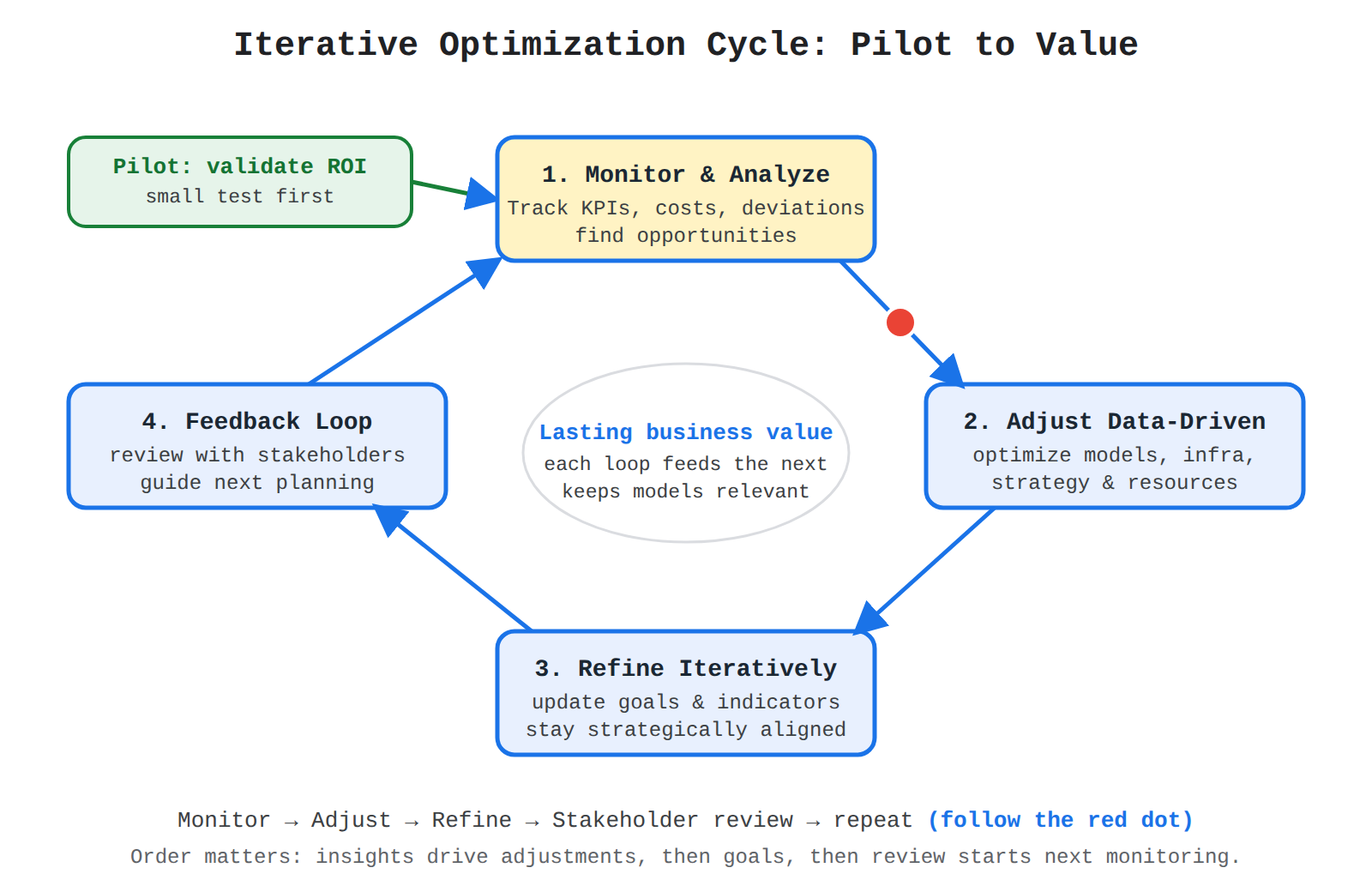
Four boxes in a diamond loop show Monitor, Adjust, Refine, and Feedback Review in order; a dot travels clockwise around the loop while each step highlights in sequence.
- Monitor continuously and analyze data: Track key performance indicators and costs to find deviations and opportunities.
- Make data-driven adjustments: Optimize strategies, models, infrastructure, and resource allocation based on those insights.
- Refine iteratively: Update business objectives and indicators as needs evolve to stay strategically aligned.
- Establish a feedback loop: Review performance, costs, and value with stakeholders to guide future planning.
Each cycle feeds the next, so monitoring leads to adjustment, adjustment leads to refined goals, and stakeholder review starts the next round of monitoring. This loop keeps models relevant as data and business needs change.
Deploy Models at Scale with MLOps
Deploying trained models at scale means running them reliably in production while controlling cost. Machine learning operations (MLOps) is the set of practices that automates the machine learning lifecycle from development through deployment and monitoring. To use MLOps for cost efficiency, an organization first identifies the main cost drivers in its lifecycle, then prioritizes the MLOps features that address the largest drivers.
Common MLOps practices that reduce cost include:
- Version control: Tools like Git track code, data, and model versions for reproducibility and collaboration and prevent costly rework.
- Continuous integration and continuous delivery (CI/CD): Cloud Build and Artifact Registry automate building, testing, and deployment to reduce manual work.
- Observability: Cloud Monitoring and Cloud Logging track production performance, identify issues, and trigger alerts for early action.
- Model retraining: Agent Platform Pipelines retrains models on schedule or when performance drops to keep them accurate.
- Automated testing and evaluation: Agent Platform standardizes evaluation and catches errors early to reduce manual testing.
For serving, models run on scalable platforms such as Gemini Enterprise Agent Platform Inference, GPUs on GKE, or TPUs on GKE. Autoscaling changes the number of replicas based on request rate, latency, and resource use, while load balancing spreads traffic evenly across replicas for high availability.
Control Cost and Prove ROI
Cost visibility is part of proving value because every insight has a price. FinOps principles require each AI project to estimate costs, measure actual costs through its lifecycle, and assign clear owners for costs and benefits. Organizing resources into organizations, folders, and projects that mirror the company, plus consistent labels for project, team, environment, model name, dataset, use case, and performance requirements, makes detailed cost analysis possible.
Billing tools turn that structure into insight:
- Export billing data to BigQuery to query costs for training, tuning, or inference.
- Use BigQuery analytics to detect cost anomalies or spending spikes.
- Use the anomaly detection dashboard in Cloud Billing to identify unexpected costs.
- Use cost allocation to distribute costs across teams based on resource use.
- Explore prebuilt Cloud Billing reports to find spending patterns.
Starting small controls cost during experimentation. Training on a representative sample first, experimenting in Agent Platform Workbench notebooks, starting with simpler or pre-trained models from Model Garden, and using BigQuery ML (opens in a new tab) for structured data all reduce compute, storage, and processing time. BigQuery ML is especially useful because it lets SQL users create and run models directly in BigQuery without moving data, which lowers complexity and speeds the path to production.
Managed machine learning services on Google Cloud automate large parts of model building so organizations can train custom models on their own data without deep programming expertise. Teams reuse prepared datasets and features, run training through managed pipelines, and start from pre-trained models that are tuned for a specific need. This lowers technical barriers while still allowing tailored solutions for different business problems.
Lowering Technical Barriers with BigQuery ML
BigQuery ML (opens in a new tab) is a Google Cloud capability that lets people create and run machine learning models with GoogleSQL queries or the Cloud console, with models stored in BigQuery datasets like tables and views. Normal machine learning on large datasets requires extensive programming and framework knowledge, which limits the work to specialists and excludes analysts who understand the data. BigQuery ML removes that barrier by letting SQL practitioners use existing SQL tools and skills to build models, evaluate them, and generate results from large language models and Cloud AI APIs.
BigQuery ML brings machine learning to the data instead of moving data to machine learning. Because data stays in the warehouse, fewer tools are needed and models reach production faster without moving and reformatting large datasets for Python frameworks. Teams can use BigQuery ML through the console UI, console query editor, bq command-line tool, BigQuery REST API, integrated Colab Enterprise notebooks, or external tools such as Jupyter notebooks and business intelligence platforms.
Reusing Datasets and Features Across Projects
Reusing datasets and features across projects avoids repeated data engineering, which accelerates development, lowers infrastructure cost, and frees resources for other work. Agent Platform Feature Store is a centralized repository for organizing, storing, and serving machine learning features for online and offline use. Agent Platform datasets let teams create and manage datasets centrally to reduce duplication, and those datasets can be discovered through Knowledge Catalog.
Data practitioners can also publish data products that are found and used through Knowledge Catalog and BigQuery sharing. Unstructured data can be stored in Cloud Storage and governed with BigQuery object tables and signed URLs, while vector embeddings can be managed by including metadata in Vector Search indexes. The flow is consistent: data is published once in a governed store, discovered by other teams, and reused in many models without rebuilding the same preparation work.
Automating Training Pipelines and Model Management
Agent Platform Pipelines and Kubeflow Pipelines create and orchestrate pipelines for data transformation, model training, model deployment, and pipeline versioning. These tools define dependencies between steps, manage data flow, and automate execution so the same workflow runs the same way each time. Automation makes results reproducible and reduces manual errors across projects.
Pipeline management depends on three practices:
- Versioning: Store Kubeflow pipeline templates in a repository in Artifact Registry to track pipeline and component versions for reproducibility and auditability.
- Reusability: Store pipeline templates in Cloud Storage and share them across the organization.
- Monitoring: Use Cloud Logging and Cloud Monitoring to watch pipeline execution and fix issues.
Model Registry on Agent Platform stores, manages, and deploys trained models for reuse in later pipelines or for online prediction. Custom containers package training code and dependencies into containers stored in Artifact Registry, which gives consistent training environments across pipelines and projects.
Starting from Pre-Trained Models and Fine-Tuning
Starting from pre-trained models avoids the high compute cost and time of training complex deep-learning models from scratch. Pre-trained models were already trained on vast datasets, so teams adapt them instead of rebuilding them. Model Garden collects pre-trained models for image classification, object detection, and natural language processing, grouped into Google models such as Gemini and Imagen, open models such as Gemma and Llama, and third-party models from partners such as Anthropic.
Google Cloud AI APIs add capabilities without building models from scratch:
- Cloud Vision API derives insights from images for analysis, moderation, and data entry.
- Cloud Natural Language API analyzes text structure and meaning for feedback analysis and categorization.
- Speech-to-Text API converts audio to text across many languages and dialects.
- Video Intelligence API identifies objects, scenes, and actions in video.
- Document AI API extracts, classifies, and understands document data.
- Dialogflow API builds conversational interfaces such as chatbots and voice assistants.
- Gemini API provides access to Google's most capable general-purpose AI model.
To reduce tuning cost further, fine-tuning adapts a pre-trained model to a specific dataset. Learning transfer uses knowledge from a pre-trained model for a new task, which requires less data and compute time than starting from scratch.
Evaluating and Tuning Models
Model evaluation and tuning aims to reduce time to production and the resources needed for continuous training and monitoring. Projects should start with small experiments before scaling up, tracking metadata such as dataset version, model parameters, and model type. Experiments on Agent Platform and evaluation on Agent Platform track project-specific metrics, while industry metrics tie results to business outcomes like retail revenue lift, healthcare patient outcomes, and finance fraud reduction.
Metrics differ by model type:
- Predictive AI: accuracy and precision.
- Generative AI: adoption, satisfaction, and content quality.
- Computer vision AI: accuracy.
Value improves through a fixed order: first monitor indicators and costs to find deviations, then make data-driven adjustments to strategies and infrastructure, then refine objectives as needs evolve, and finally review results with stakeholders to plan future work. This cycle delivers better performance with fewer expensive iterations.
Choosing Between Managed and Configurable Platforms
The AI infrastructure spectrum on Google Cloud runs from fully managed to fully configurable, and the right choice depends on needed control, flexibility, and management effort. Google Kubernetes Engine (GKE) (opens in a new tab) provides deep control and portability, Agent Platform provides a fully managed end-to-end platform, and Cloud Run provides serverless container serving.
| Platform | Best for |
|---|---|
| Google Kubernetes Engine (GKE) | Deep control, portability, custom pipelines, kernel-level customization, large-scale training and low-latency inference, and cost efficiency at scale with Spot VMs and Flex-start VMs |
| Agent Platform (Vertex AI) | Fully managed end-to-end development that offloads infrastructure work, suited to MLOps and rapid time-to-value |
| Cloud Run | Serverless containerized inference that can scale to zero, suited to event-driven apps and cost-effective serving of smaller models |
GKE supports AI work through flexible GPU and TPU accelerators, the GKE Inference Gateway for model-aware routing and load balancing, faster startup nodes that cut GPU node startup times by up to 80%, Kueue for job queueing and quota management, and the Ray on GKE add-on for scaling distributed Python workloads. Traffic flows from users to the gateway, the gateway routes to model replicas, and autoscaling adds or removes replicas as demand changes.
Exam tip: BigQuery ML brings machine learning to the data so models train inside BigQuery with SQL, while GKE is the choice when a team needs deep infrastructure control and custom pipelines.
Organization-specific data is an organization's own proprietary historical records, such as customer purchases, product images, sales history, and support interactions. Training a custom machine learning model on this data teaches the model the patterns of that specific business, so predictions reflect real customers, products, and operations. This relevance improves decisions, increases efficiency, and creates better customer experiences than a generic model alone.
Why Proprietary Data Makes Predictions More Relevant
Proprietary data makes predictions more relevant because the model learns directly from the organization's past outcomes instead of from public examples. A pre-trained model provides general capability, while a custom model trained on historical business data learns what churn, fraud, demand, or a defect looks like for that organization. Training data flows from the organization's warehouse and storage systems to the model, and predictions then flow back to business teams and applications that act on them.
Because BigQuery ML (opens in a new tab) brings machine learning to the data inside the warehouse, teams do not have to move and reformat large datasets to gain this relevance. The data stays where it is governed, the model trains next to it, and the results return to the systems that need them. This short path preserves context and reduces engineering work.
Types of Data Suited for Custom Training
Data suited for custom training is historical data where past examples show the correct outcome the model should predict. Traditional predictive models work especially well with structured records and images that capture repeated business events.
- Tabular customer and sales records: Rows with features such as purchase history, house features and location, or account activity support classification, regression, and segmentation.
- Product and operational images: Sets of labeled images, such as good versus defective products, support image classification for inspection and defect detection.
- Time-ordered history: Sequential records such as past sales and demand support time-series forecasting of future sales.
- Curated reusable datasets and features: Well-documented tables, features, and embeddings published once and discovered through governance tools support many models without rebuilding preparation work.
| Use case | Example training data | What the model predicts |
|---|---|---|
| Classification | Emails marked as spam or not spam, products marked good or defective | The category for a new email or product image |
| Regression | Houses with features, location, and sale price | A continuous number such as future price or customer revenue |
| Forecasting | Past sales by day, week, or season | Future sales and demand |
| Clustering | Customer purchase and behavior records | Customer segments with similar behavior |
The table shows that the choice depends on data shape and the needed answer: categories need labeled examples of each category, numbers need historical numbers, forecasts need ordered history, and segments need descriptive customer records.
How Data Quality, Labeling, and Governance Shape Accuracy
Data quality and governance determine model accuracy because a model can only learn patterns actually present in its training data. A data governance framework defines policies, procedures, and roles that manage data through its lifecycle, which improves quality, security, utilization, and reduces redundancy. Well-organized, relevant, and complete data lowers storage cost, avoids duplication, and ensures models train on the most valuable examples.
Labeling quality has a direct impact because historical examples teach the model what the right answer looks like. If spam examples are mislabeled, defect images are inconsistent, or sales history is incomplete, the model learns the wrong pattern and accuracy drops. Google Cloud supports this work with Knowledge Catalog, which unifies distributed data without consolidating it, BigQuery sharing, which exchanges curated datasets securely, and MLOps practices that track dataset versions and automate retraining. Together these controls keep training data discoverable, consistent, and reusable, so accuracy can be measured and improved over time.
Exam tip: Choose traditional predictive training on your own structured history when you need forecasting or classification of business outcomes, and choose a pre-trained model when it already meets the requirement without custom training.
Key Facts
- Organization-specific data makes custom model predictions more relevant because the model learns the organization's own patterns for churn, fraud, demand, and defects.
- BigQuery ML lets SQL practitioners train and run models inside BigQuery without moving large datasets to separate frameworks.
- Agent Platform Feature Store centralizes features for reuse across projects, which reduces redundant engineering and infrastructure cost.
- Model Garden provides pre-trained Google, open, and third-party models that can be fine-tuned with learning transfer using less data and compute.
- MLOps practices including version control, CI/CD, observability, retraining, and automated testing support reliable deployment at scale.
Frequently Asked Questions
How does training custom machine learning models on organization-specific data create business value?
Training custom machine learning models on organization-specific data creates business value through better strategic decisions, more efficient operations, and improved customer interactions because the models learn the organization's own patterns for churn, fraud, demand, and defects. Realizing that value depends on trustworthy reusable data, metrics tied to business goals, repeated improvement, and the ability to run models reliably at scale.
When should I use BigQuery ML to train custom machine learning models on my own data?
BigQuery ML should be used when SQL practitioners want to create and run machine learning models inside BigQuery without moving large datasets to separate Python frameworks. It brings machine learning to the data with GoogleSQL queries or the Cloud console, so fewer tools are needed and models reach production faster without moving and reformatting large datasets.
How is business value measured differently for predictive AI, generative AI, and computer vision AI models?
Predictive AI is measured by accuracy and precision, generative AI by adoption, satisfaction, and content quality, and computer vision AI by accuracy. Value becomes visible only when those project metrics are connected to business goals such as retail revenue lift and churn, healthcare patient time and outcomes, and finance fraud reduction, which is why teams select metrics before scaling a pilot into production.
Sample Question
A digital retail company wants to generate business value by using AutoML to train a custom multi-class classification model. The goal is to segment new customers into marketing personas using the company's proprietary tabular transaction data. During data preparation, the team discovers two issues in their dataset:
- Categorical feature columns contain inconsistent capitalization and spelling errors (such as
"Winter Coat"and"winter coat"). - Historical purchase records were collected exclusively during the winter holiday season.
How will these dataset characteristics affect the custom AutoML model if they are not resolved before training?
AutoML will bypass supervised training and apply classical rule-based programming to merge the misspelled categories and extrapolate summer buying trends.
The model will experience data leakage during evaluation because the winter purchase features are directly correlated with the target marketing personas.
AutoML will automatically reject the dataset during the import phase because supervised learning pipelines cannot run when inconsistencies or missing values are present.
The model will interpret the inconsistent text strings as separate categories and fail to generalize accurately to customer purchasing behaviors during other seasons.
How learners score on this domain
Last updated