Diagram
Autoscaling Flow: Traffic to More VMs
Process Flow
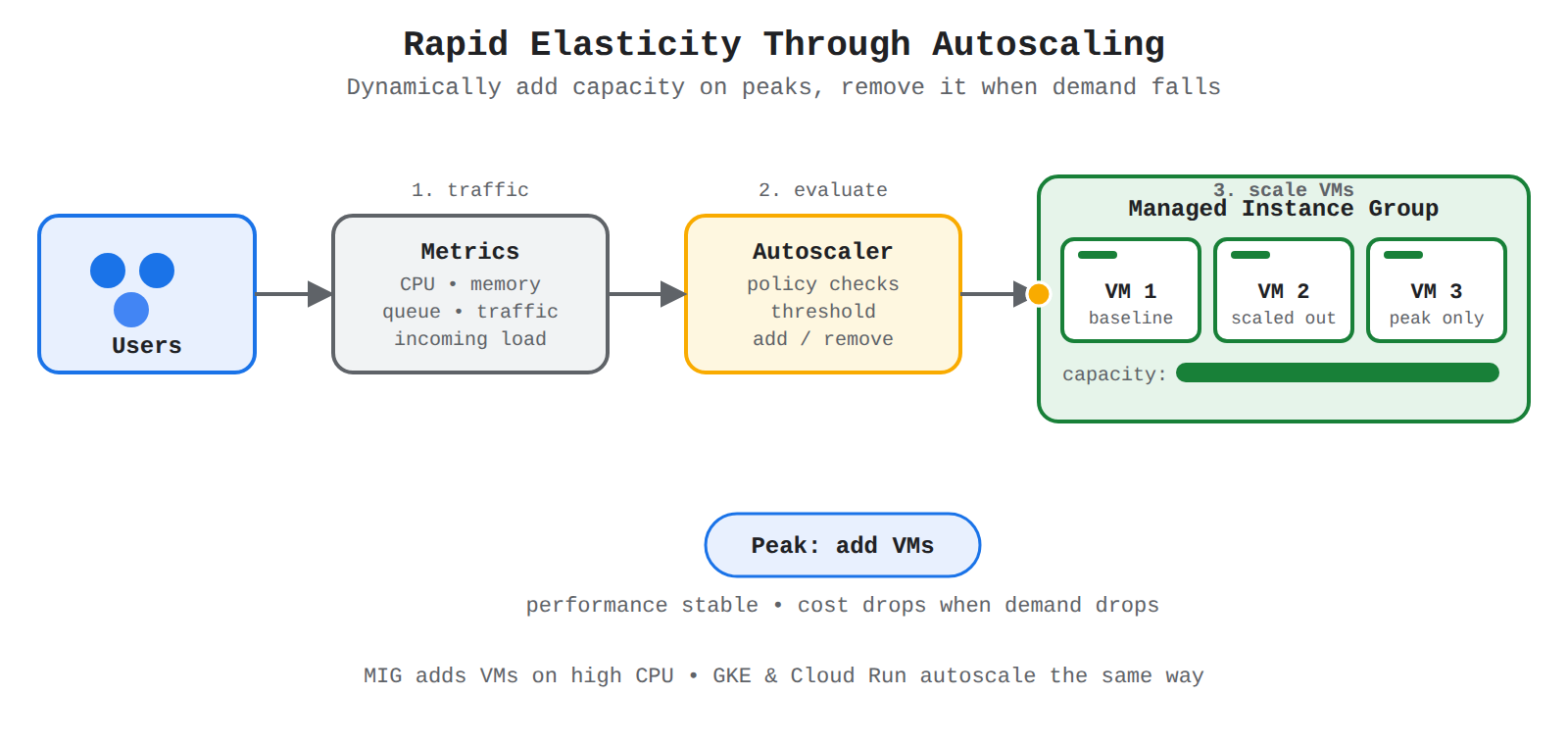
A left-to-right flow from Users to Metrics to Autoscaler to a Managed Instance Group. Animation shows traffic moving forward, the policy detecting over-threshold load, and extra VMs scaling out to handle the peak.
In the Domain
Rapid Elasticity Through Autoscaling
Rapid elasticity is the ability to dynamically adjust capacity based on workload changes so applications have resources when needed without overprovisioning. Autoscaling policies use metrics such as CPU utilization, memory usage, queue depth, or incoming traffic to add capacity during peaks and remove capacity when demand falls. Traffic flows from users to the autoscaler and then to the added or removed capacity, so performance stays stable during spikes and costs fall when demand drops.
| Option | What it scales | How scaling is triggered |
|---|---|---|
| Compute Engine managed instance groups (MIGs) | Groups of virtual machines (VMs) managed as a single entity | Policy adds VMs when CPU utilization reaches a threshold and removes VMs when utilization drops |
| Google Kubernetes Engine (GKE) autoscaling | Cluster nodes and Pod replicas | Cluster Autoscaler adds or removes nodes based on Pod demand, Horizontal Pod Autoscaler changes replicas, and Vertical Pod Autoscaler tunes requests and limits |
| Cloud Run | Serverless container instances | Built-in autoscaling increases instances as incoming traffic rises and decreases instances as traffic falls |
Domain 1 of 6
Explain general cloud concepts.
Read the Domain summaryPractice this Domain
27 practice questions
Practice this DomainMore from this Domain
Last updated