Simulation
Cloud Run scale-to-zero vs. warm instances: the cost-latency tradeoff
Toggle minimum instances and incoming traffic to see how Cloud Run balances idle cost against request latency.
Try the scenario
Cloud Run scale-to-zero vs. warm instances: the cost-latency tradeoff
Change the inputs and watch how the outcome changes.
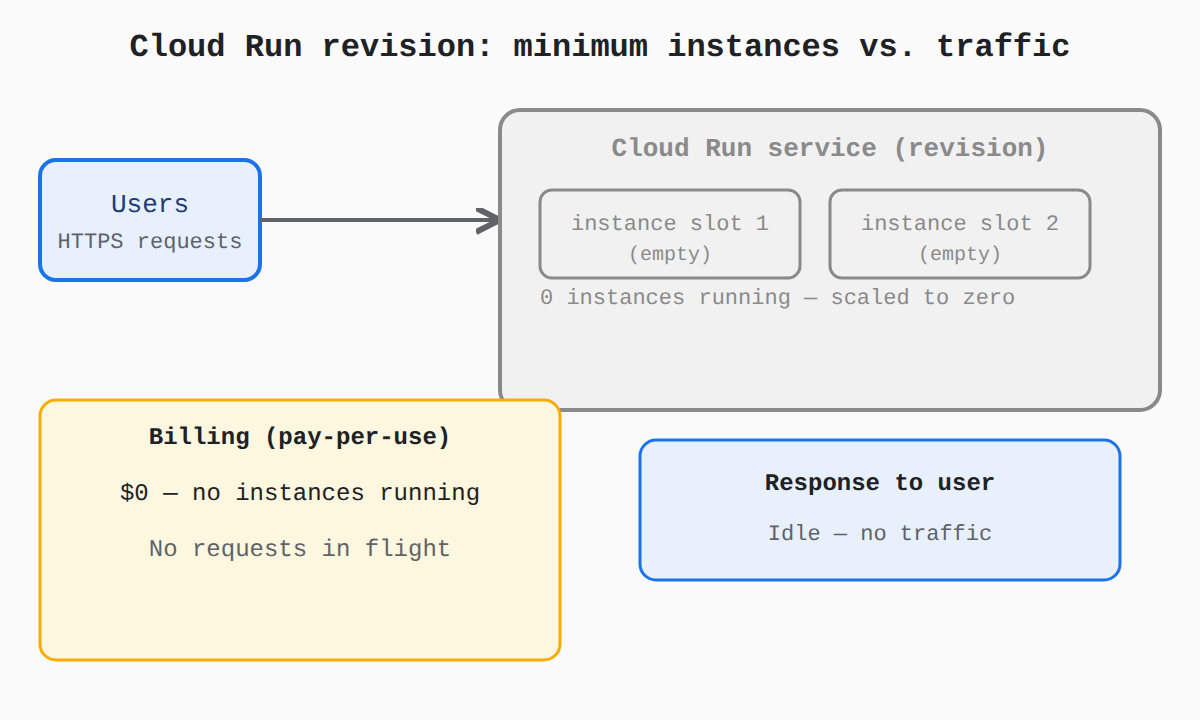
Toggle minimum instances and incoming traffic to see how Cloud Run balances idle cost against request latency.
Every outcome
Succeeds
3 outcomesZero-cost idle (scale to zero)
With minimum instances at its default of 0, Cloud Run removes the last container instance when the revision receives no traffic. You are not charged for CPU or memory while the service is unused, which removes idle cost during quiet periods.
Starting scenarioEvery input at its default
Cost-optimized scale-out (cold start accepted)
With minimum instances at 0 and cold starts acceptable, Cloud Run instantaneously scales out container instances to absorb the spike, and you pay only for the time code runs. The first requests absorb a brief startup delay, which keeps cost minimal.
What changed
- Incoming trafficIdle (zero traffic)toTraffic spike
Warm instance absorbs the spike instantly
With minimum instances set to 1, the pre-warmed instance is already running when the spike arrives, so initial requests are served with no cold-start delay. This trades the continuous idle cost of the warm instance for meeting strict latency targets.
What changed
- Minimum instances setting0 (Default scale-to-zero)to1 (Warm instance)
- Incoming trafficIdle (zero traffic)toTraffic spike
- Cold-start delay toleranceAcceptabletoUnacceptable
Fails
1 outcomeLatency target at risk (cold start not tolerated)
Because cold-start delay is now unacceptable but minimum instances is still 0, the first requests during the spike must wait while Cloud Run provisions a container from zero. That startup delay violates strict latency requirements even though cost stays at pay-per-use.
What changed
- Incoming trafficIdle (zero traffic)toTraffic spike
- Cold-start delay toleranceAcceptabletoUnacceptable
Mixed
2 outcomesIdle compute expense (warm instance, no traffic)
Because you changed minimum instances from the default of 0 to 1, Cloud Run keeps one container instance running even though the revision receives no traffic. The warm instance is billed continuously, trading idle cost for a faster first response.
What changed
- Minimum instances setting0 (Default scale-to-zero)to1 (Warm instance)
Redundant standby cost (warm instance, delay tolerated)
Requests are served instantly because the warm instance is running, but since cold starts were acceptable this performance was unnecessary. Keeping minimum instances at 1 means paying continuous idle charges that scale-to-zero would have avoided.
What changed
- Minimum instances setting0 (Default scale-to-zero)to1 (Warm instance)
- Incoming trafficIdle (zero traffic)toTraffic spike
In the Domain
Scaling to Zero and Idle Resource Costs
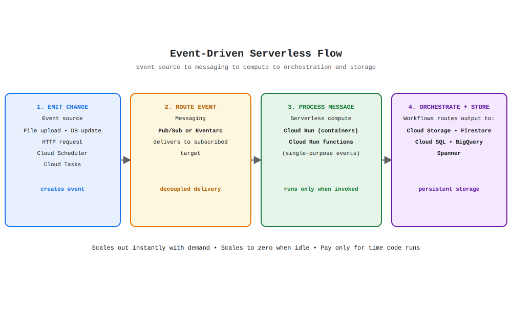
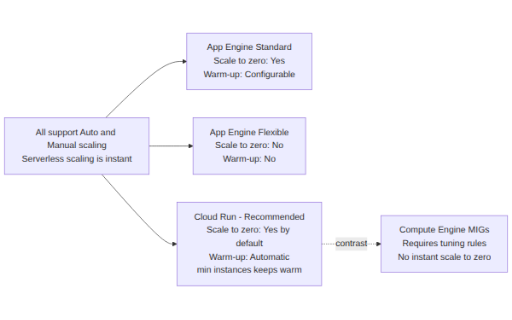
When a team wants to avoid the delay of starting from zero, the minimum instances setting on Cloud Run keeps a specified instance idle or warm. Keeping a warm instance trades some idle cost for faster response and more consistent performance. This is the central cost tradeoff in serverless planning: scale-to-zero minimizes cost, while warm instances trade cost for consistent performance.
Domain 1 of 3
Discuss the advantages of serverless computing in application modernization.
Read the Domain summaryPractice this Domain
27 practice questions
Practice this DomainMore from this Domain
Last updated