Fundamental
Prepare and test your skills

Fundamental
Prepare and test your skills
Decoupled Microservices React to Storage Events
Free sample question with answers and detailed explanation below. The Cloud Digital Leader practice bank has an additional 3,070 practice questions.Try 10 free realistic questions: instant score, no credit card, and no account required.
A media company is decomposing a legacy monolithic application into microservices on Google Cloud. When a user uploads a video to Cloud Storage, several downstream workflows must be triggered automatically. The engineering team has established the following architectural requirements:
- Trigger multiple independent processing tasks—such as thumbnail generation and metadata indexing—in parallel when a state change occurs
- Allow developers to experiment rapidly by adding or removing downstream services without modifying existing service logic
- Eliminate the need to manage underlying servers or write custom polling and routing code
How does a serverless event-driven architecture using services like Eventarc, Pub/Sub, and Cloud Run support these requirements?
Explanations
By establishing synchronous, direct service-to-service calls that require each downstream task to finish before the next service is invoked
By establishing synchronous, direct service-to-service calls that require each downstream task to finish before the next service is invoked
What Synchronous Service-to-Service Communication Is
Synchronous service-to-service communication is an architectural pattern where a calling service sends a direct request to a downstream service and blocks further execution until it receives a response. In a sequential chain of direct calls, each component must know the network location and API contract of the next service, waiting for each task to complete before moving forward.
Why It Doesn't Meet the Requirements
- Prevents parallel event fan-out: Sequential, blocking calls force tasks to wait on one another rather than allowing an event router to fan out a single state change to multiple independent consumers in parallel.
- Hinders rapid experimentation: Direct dependencies create tight coupling between services. Adding a new experimental workflow or modifying an endpoint requires updating the calling logic in upstream services, slowing down developer velocity.
- Reduces system resiliency: If a single downstream microservice in a synchronous chain fails or experiences high latency, the entire request pipeline can stall or fail.
Key Characteristics and Limitations
- Tight coupling: Services are directly dependent on the availability, performance, and API structure of downstream components.
- Blocking execution: The producer cannot simply emit an event and move on; it must maintain an open connection until processing completes.
- Cascading failure risks: Errors or bottlenecks in one microservice directly impact upstream callers unless complex circuit-breaking logic is manually implemented.
- Higher coordination overhead: Cross-team dependencies increase because changes to one service often require coordinated deployments across connected services.
This Answer Would Be Correct If
This approach would be appropriate if the scenario required a strictly sequential, transactional request-response workflow where the client immediately needed the combined output of every step before proceeding, or if orchestrating a step-by-step state machine where each step explicitly depends on the output of the previous step.
Additional Context
Modern event-driven architectures on Google Cloud intentionally replace direct, blocking service-to-service calls with asynchronous event routing via Eventarc and Pub/Sub. In an asynchronous model, the event producer only needs to publish the event once, and the event router handles pushing the notification to all subscribed Cloud Run services independently.
By using predictive autoscaling on managed instance groups to forecast CPU utilization and pre-provision virtual machines before uploads occur
By using predictive autoscaling on managed instance groups to forecast CPU utilization and pre-provision virtual machines before uploads occur
What Predictive Autoscaling on Managed Instance Groups Is
Predictive autoscaling is a feature of Compute Engine managed instance groups (MIGs) that analyzes historical metrics—such as CPU utilization—to forecast future workload demand and automatically provision virtual machine (VM) instances ahead of anticipated traffic peaks. It combines real-time metrics with historical trends to scale infrastructure-as-a-service (IaaS) resources proactively.
Why It Doesn't Meet the Requirements
- Relies on virtual machine management: Using Compute Engine MIGs requires configuring VM templates, fine-tuning scaling rules, and managing underlying server infrastructure, which violates the requirement to eliminate server management.
- Does not provide event-driven routing or decoupling: Predictive autoscaling only adjusts the number of running VMs in a group; it does not route state-change events, fan out messages to parallel workflows, or decouple microservices.
- Cannot scale to zero or scale instantly: VM-based autoscaling takes minutes to boot new instances and requires baseline capacity, unlike serverless platforms that scale instantly in response to events and scale down to zero when idle.
Key Characteristics and Limitations
- Designed for Compute Engine VMs: Operates specifically on managed instance groups rather than serverless compute services like Cloud Run or Cloud Run functions.
- Requires predictable historical patterns: Works best when workloads exhibit recurring daily or weekly traffic cycles that can be forecasted mathematically.
- Fine-tuning overhead: Administrators must define target utilization thresholds, minimum/maximum instance counts, and scaling policies.
This Answer Would Be Correct If
This option would be the right choice if the organization were running a stateful or VM-based application on Compute Engine with recurring, predictable traffic spikes (such as daily business-hour surges) and needed to pre-provision VM capacity that takes several minutes to initialize.
Additional Context
Unlike Compute Engine autoscaling, which requires configuring metric thresholds and forecasting rules, serverless services like Cloud Run, Cloud Run functions, Pub/Sub, and Eventarc are inherently elastic. They respond instantly to incoming events without requiring capacity forecasting or VM provisioning.
By decoupling event producers from consumers through asynchronous push-based routing so microservices can react to state changes and evolve independently
By decoupling event producers from consumers through asynchronous push-based routing so microservices can react to state changes and evolve independently
What a Serverless Event-Driven Architecture Is
A serverless event-driven architecture is a modern software design pattern in which decoupled microservices automatically react to state changes, known as events, without requiring developers to provision or manage underlying servers. In this model, event producers (such as Cloud Storage) generate immutable notifications when an action occurs, an event router or broker (such as Eventarc or Pub/Sub) ingests and filters those events, and event consumers (such as Cloud Run or Cloud Run functions) execute business logic in response.
How It Meets the Architectural Requirements
- Parallel event processing: The central event router automatically fans out a single upload event to multiple downstream consumers simultaneously, enabling parallel execution of thumbnail generation and metadata indexing without custom routing code.
- Rapid experimentation and independent evolution: Because event producers and consumers are logically separated (loosely coupled), developers can add new experimental microservices or remove existing receivers at any time without altering the code of the producing service or other consumers.
- Zero server management or polling overhead: Serverless compute platforms scale automatically from zero to peak demand, while push-based messaging delivers events directly to consumers as they occur, eliminating the need to maintain polling infrastructure.
Push-Based Fan-Out: Storage to Cloud Run
System Architecture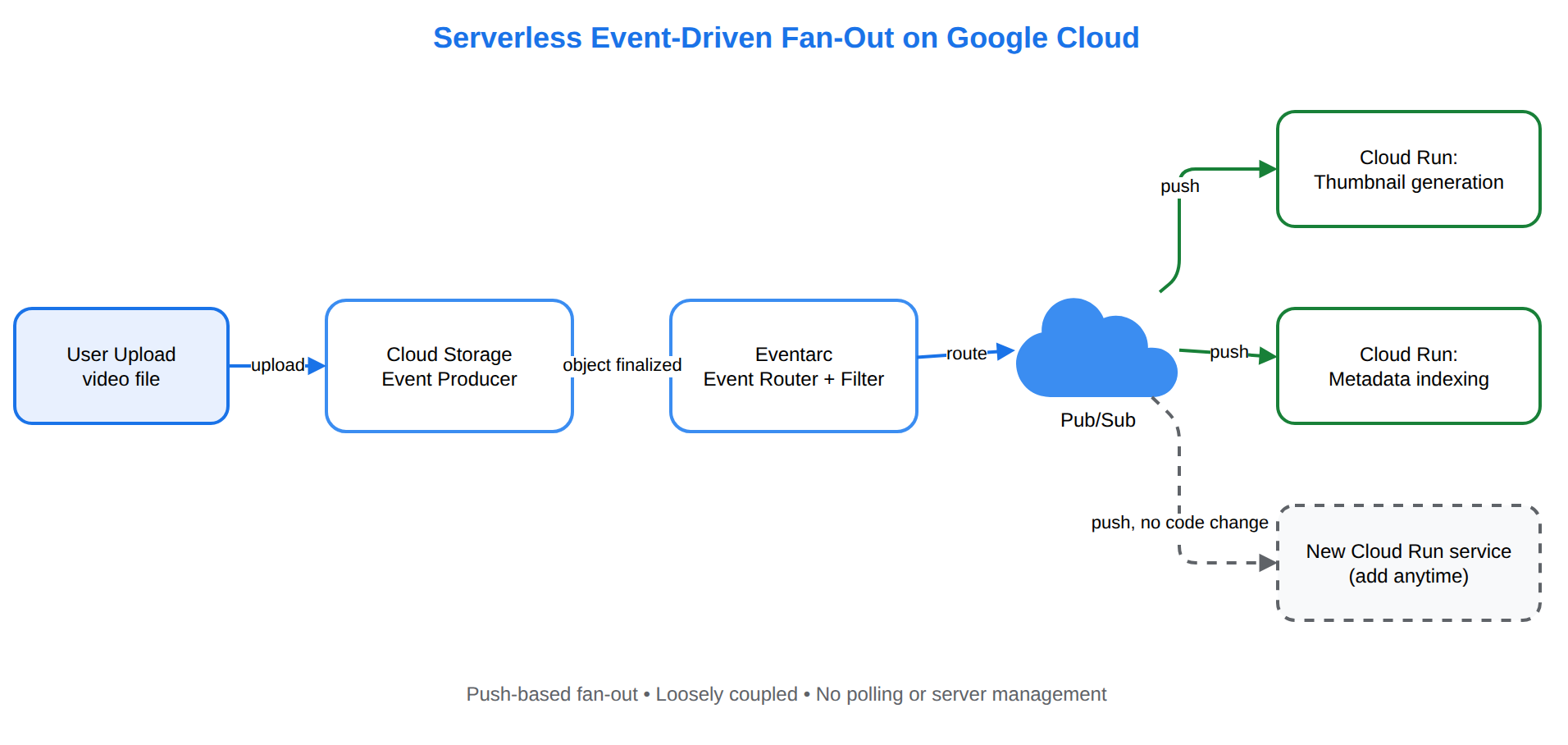
Key Advantages and Capabilities
- Loose coupling and developer agility: Teams can build, deploy, update, and scale individual microservices independently using different programming languages and frameworks.
- Asynchronous resiliency: Events are published asynchronously without waiting for an immediate response, meaning that if one downstream service experiences a failure, other microservices continue operating unaffected.
- Reduced network I/O and lower costs: Push-based event delivery removes the need for services to continuously query remote endpoints for state changes, minimizing unnecessary compute and network consumption.
- Inherent elasticity: Serverless services instantly scale out to handle bursts of concurrent events and scale down to zero when idle.
Why This Is Optimal
Compared to tightly coupled or polling-based designs, combining managed event routers like Eventarc and Pub/Sub with serverless compute like Cloud Run maximizes agility and minimizes operational overhead. It allows engineering teams to focus entirely on building modular business capabilities and experimenting with new features rather than maintaining complex communication plumbing.
By configuring each microservice to continuously poll Cloud Storage for state changes over dedicated, always-on network connections
By configuring each microservice to continuously poll Cloud Storage for state changes over dedicated, always-on network connections
What Continuous Polling Is
Continuous polling is a communication mechanism in which a client or consuming service repeatedly sends requests at regular intervals to a data source or remote service to check whether a state change has occurred. Even when no new data or events are available, the polling service must stay active and execute queries continuously.
Why It Doesn't Meet the Requirements
- Requires custom polling code: The scenario explicitly requires eliminating custom polling and routing logic, whereas a polling architecture forces developers to write, maintain, and schedule query loops inside every microservice.
- Increases operational and resource costs: Because microservices must run continuously to check Cloud Storage for new uploads, compute instances cannot scale down to zero during idle periods.
- Generates unnecessary network traffic: Constant querying produces high volumes of redundant network I/O and API requests that return empty results whenever no new videos have been uploaded.
Key Characteristics and Limitations
- Pull-based execution: Consumers are responsible for repeatedly asking the source for updates rather than having updates delivered automatically.
- Inefficient resource utilization: Compute and network resources are consumed 24/7 regardless of whether actual business events are occurring.
- Delayed reaction times: State changes are only detected when the next scheduled polling interval runs, introducing latency compared to real-time event streaming.
- Complex scaling as consumers grow: Adding more experimental microservices multiplies the number of services repeatedly querying the same storage bucket.
This Answer Would Be Correct If
This approach would be suitable if the application needed to retrieve data from a legacy external system or third-party endpoint that only supports pull-based queries and lacks the ability to emit events or push notifications.
Additional Context
Serverless event-driven architectures on Google Cloud use push-based messaging rather than continuous polling. When a file is uploaded to Cloud Storage, Eventarc or Pub/Sub automatically detects the state change and pushes the event to downstream Cloud Run services, enabling real-time processing while reducing network I/O and infrastructure costs.
Try 10 interactive questions like this one, free
Answer them yourself and get your score the moment you finish. No account needed.
Full access includes
- 3,070 practice questions across all 6 exam domains
- Every answer explained: why it is right, and why the others are not
- Scout, an AI tutor that answers your follow-up questions
- Readiness tracking by domain, so you know when to book the exam
Related free sample questions
Keep the momentum going with these hand-picked practice scenarios
FundamentalCloud Digital Leader
Serverless Infrastructure Management
Discuss the advantages of serverless computing in application modernization.
FundamentalCloud Digital Leader
Serverless Scale-to-Zero Autoscaling
Discuss the advantages of serverless computing in application modernization.
FundamentalCloud Digital Leader
AI Conversational Virtual Agents
Discuss the main AI and ML concepts, and explain how ML can create business value.
FundamentalCloud Digital Leader
GKE Managed Kubernetes Orchestration
Define the main cloud compute terms, including: virtual machines (VMs); containerization; containers; microservices; serverless computing; preemptible VMs; Kubernetes, autoscaling, load balancing.
FundamentalCloud Digital Leader
BigQuery Columnar Storage and Decoupled Compute
Differentiate between basic data management concepts, in particular: databases, data warehouses, and data lakes.
AdvancedProfessional Cloud Network Engineer
Dedicated Interconnect Dual-Stack VLAN Attachments
Creating Dedicated Interconnect connections and configuring VLAN attachments.
Last updated