Fundamental
Prepare and test your skills

Fundamental
Prepare and test your skills
End to End Custom Model Workflow in Vertex AI
Free sample question with answers and detailed explanation below. The Cloud Digital Leader practice bank has an additional 3,070 practice questions.Try 10 free realistic questions: instant score, no credit card, and no account required.
A retail organization wants to create a competitive advantage by building a custom machine learning model using its proprietary customer purchasing data. The data science team needs an end-to-end workflow in Vertex AI that meets the following requirements:
- Minimizes infrastructure management complexity
- Enables rapid experimentation during data preparation, training, and tuning
- Centralizes model version tracking
- Deploys the best model to serve low-latency online predictions
Which workflow using Vertex AI managed services should the team implement?
Explanations
Prepare raw datasets in Vertex AI Vizier, execute serverless custom training jobs inside Vertex AI TensorBoard, and deploy trained model versions directly from Vertex AI Feature Store to serve online predictions
Prepare raw datasets in Vertex AI Vizier, execute serverless custom training jobs inside Vertex AI TensorBoard, and deploy trained model versions directly from Vertex AI Feature Store to serve online predictions
What Vertex AI Vizier, TensorBoard, and Feature Store Do
Vertex AI Vizier, Vertex AI TensorBoard, and Vertex AI Feature Store are specialized managed services within the Vertex AI ecosystem that support hyperparameter optimization, experiment visualization, and feature management, respectively.
Why It Doesn't Meet the Requirements
- Incorrect service roles: This workflow assigns each service to the wrong phase of the model development lifecycle.
- Cannot prepare data in Vizier: Vertex AI Vizier is a black-box optimization service used for tuning hyperparameters, not a notebook or data preprocessing environment.
- Cannot run training jobs in TensorBoard: Vertex AI TensorBoard is a visualization interface for tracking training metrics and debugging models, not an execution engine for serverless training jobs.
- Cannot deploy models from Feature Store: Vertex AI Feature Store manages and serves machine learning features (input variables), whereas trained models are versioned and deployed from Vertex AI Model Registry to a Vertex AI endpoint.
Key Characteristics and Limitations
- Vertex AI Vizier: Optimizes model hyperparameters and other complex parameters during the tuning phase.
- Vertex AI TensorBoard: Provides persistent storage and visual dashboards to monitor time-series metrics (such as training loss and accuracy) logged during experiment runs.
- Vertex AI Feature Store: Centralizes the storage and serving of processed ML features so they can be reused consistently across training and inference.
This Answer Would Be Correct If
These services would be the right choice if the team specifically needed to store and share reusable ML features in Vertex AI Feature Store, optimize hyperparameters with Vertex AI Vizier, and visually debug training performance metrics using Vertex AI TensorBoard as supplemental tools within their broader workflow.
Additional Context
Understanding the Vertex AI lifecycle requires distinguishing between features (the processed data inputs stored in Vertex AI Feature Store) and models (the trained mathematical constructs stored in Vertex AI Model Registry and deployed to endpoints).
Prepare data and develop training code in Vertex AI Workbench, track training and tuning runs in Vertex AI Experiments, manage versions in Vertex AI Model Registry, and deploy the model to a managed Vertex AI endpoint
Prepare data and develop training code in Vertex AI Workbench, track training and tuning runs in Vertex AI Experiments, manage versions in Vertex AI Model Registry, and deploy the model to a managed Vertex AI endpoint
What the Vertex AI Managed Model Development Workflow Is
Vertex AI provides a unified, end-to-end platform of managed services that guides data science teams through every stage of the custom machine learning (ML) development lifecycle—from initial data exploration and preparation to model training, hyperparameter tuning, evaluation, version registration, and production deployment.
How It Meets the Requirements
- Minimizes infrastructure management complexity: Instead of manually configuring servers, teams use Vertex AI Workbench for a managed JupyterLab notebook environment and serverless training jobs to execute custom training code without maintaining underlying clusters.
- Enables rapid experimentation during data preparation, training, and tuning: Vertex AI Experiments tracks and logs every step of an experiment run—including data preprocessing steps, input algorithms, hyperparameters, datasets, and output evaluation metrics—allowing teams to rapidly compare iterations.
- Centralizes model version tracking: Vertex AI Model Registry acts as a central repository to organize, track, and manage the lifecycle of trained models and their versions.
- Deploys the best model for low-latency online predictions: Directly from the registry, teams assign the chosen model version to a fully managed Vertex AI endpoint, where Vertex AI automatically provisions and manages the compute and accelerator resources required for low-latency online inference.
Vertex AI Managed Model Development Workflow
Process Flow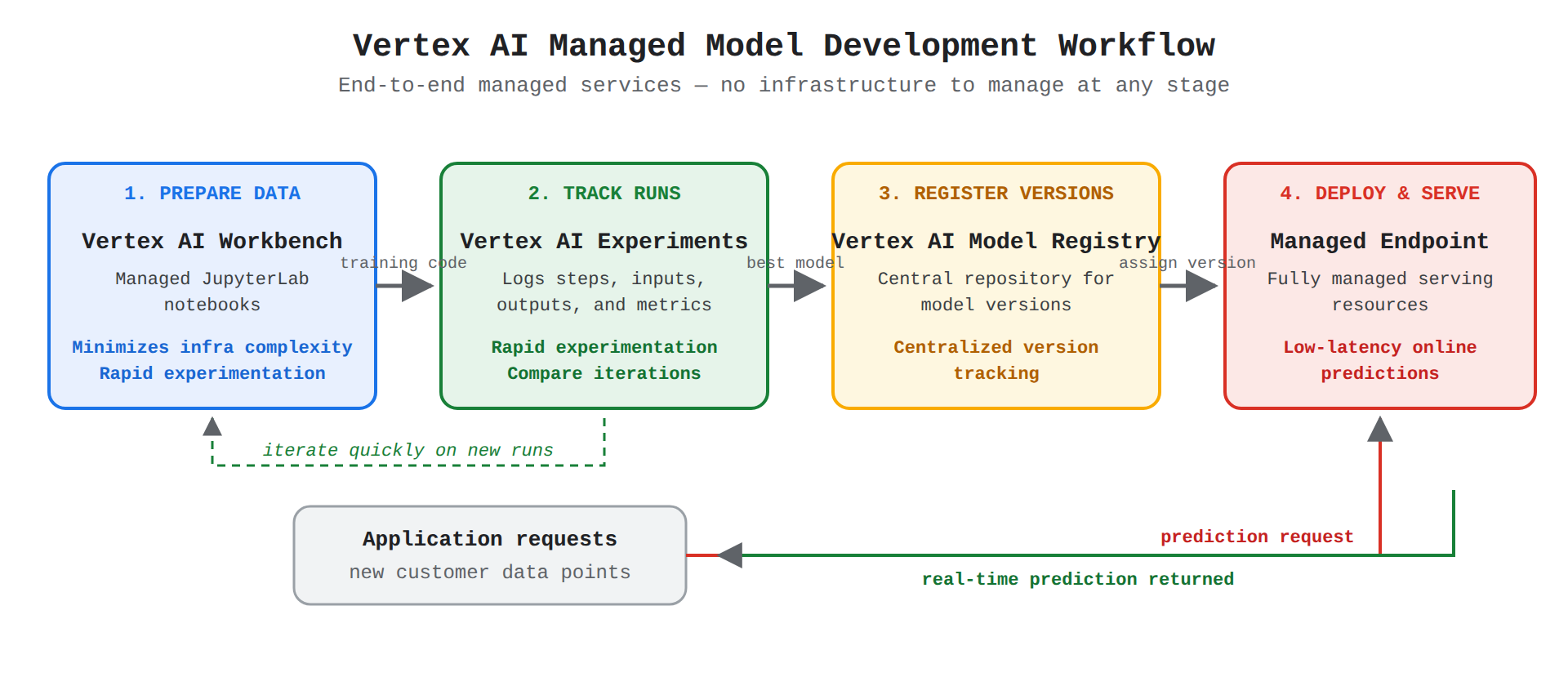
Key Advantages and Capabilities
- End-to-end lineage tracking: Automatically records metadata, artifacts, and execution steps across preprocessing, training, and evaluation.
- Seamless experimentation: Integrates with Vertex AI TensorBoard and Vertex AI Vizier to visualize training metrics and optimize hyperparameters.
- Streamlined MLOps: Connects model versioning in Vertex AI Model Registry directly to deployment endpoints using aliases.
- Business differentiation: Frees data scientists from infrastructure overhead so they can focus on tailoring custom models to proprietary business data.
Why This Is Optimal
Unlike fragmented or self-managed workflows that require extensive DevOps intervention at every transition point, combining Vertex AI Workbench, Vertex AI Experiments, Vertex AI Model Registry, and managed Vertex AI endpoints provides a cohesive, automated path from prototype to production.
Manually scale virtual machines for data preparation and training, store unmanaged artifacts outside of Vertex AI, and configure self-managed Google Kubernetes Engine (GKE) clusters to serve predictions
Manually scale virtual machines for data preparation and training, store unmanaged artifacts outside of Vertex AI, and configure self-managed Google Kubernetes Engine (GKE) clusters to serve predictions
What a Self-Managed and Manual ML Workflow Is
A self-managed machine learning workflow relies on manual scaling of compute instances, tracking unmanaged artifacts outside of a centralized ML platform, and deploying trained models onto self-managed container orchestration platforms such as Google Kubernetes Engine (GKE).
Why It Doesn't Meet the Requirements
- Fails to minimize infrastructure complexity: Requiring the data science team to use manual scaling and administer GKE clusters shifts their focus away from model development and onto complex cluster configuration, node provisioning, and hardware failure recovery.
- Hinders rapid experimentation: Storing unmanaged artifacts outside of the Vertex AI context prevents automated lineage tracking in Vertex AI Experiments and Vertex AI Model Registry, making it slow and error-prone to compare training runs or audit model versions.
Key Characteristics and Limitations
- Manual scaling overhead: Requires administrators to explicitly and deliberately adjust virtual machines or containers rather than relying on dynamic, automated resource provisioning.
- Unmanaged artifacts: Artifacts stored outside of Vertex AI lack integrated metadata tracking, provenance chaining, and one-click endpoint deployment.
- High operational burden on GKE: While serving models on GKE provides fine-grained infrastructure control, the engineering team must manage cluster scaling, GPU drivers, and serving containers on their own.
This Answer Would Be Correct If
This approach would be appropriate if the organization had a dedicated platform engineering team that required strict, fine-grained control over custom container orchestration on Google Kubernetes Engine (GKE) and wanted to manage its own infrastructure rather than using a fully managed ML environment.
Additional Context
When deploying models for online inference, organizations must choose between a fully managed environment (using Vertex AI endpoints where Google Cloud instantiates and manages the physical machine resources) and a self-managed environment (such as GKE). For teams seeking rapid experimentation and minimal operational overhead, fully managed services are the optimal choice.
Use prompt design and Vertex AI Extensions to train a custom model from scratch without preparing a training dataset, and serve predictions immediately without deploying the tuned model to an endpoint
Use prompt design and Vertex AI Extensions to train a custom model from scratch without preparing a training dataset, and serve predictions immediately without deploying the tuned model to an endpoint
What Prompt Design and Vertex AI Extensions Do
Prompt design is the process of crafting instructions and examples to guide the output of pre-trained foundation models, while Vertex AI Extensions connect generative models to external APIs and real-time systems so they can perform actions or retrieve external data.
Why It Doesn't Meet the Requirements
- Does not train or tune a custom model on proprietary datasets: Prompt design and extensions adapt how an existing foundation model responds at inference time, but they do not train a custom machine learning model from scratch or perform supervised model tuning on a large proprietary dataset.
- Misstates endpoint deployment rules for tuned models: While Google's out-of-the-box foundation models have pre-configured project endpoints available immediately, any model that undergoes custom training or model tuning must be explicitly deployed to a Vertex AI endpoint to associate physical compute resources for serving online predictions.
Key Characteristics and Limitations
- Prompt design: Useful for quick behavioral adjustments on pre-trained language models, but insufficient when specialized business tasks or proprietary tabular/purchasing patterns require custom model training or model tuning.
- Vertex AI Extensions: Provide prebuilt integrations to call external functions (such as booking a calendar reservation), requiring credentials in the application code.
- Endpoint requirements: Custom-trained and tuned models always require deployment to an endpoint before they can serve low-latency online predictions.
This Answer Would Be Correct If
This approach would be appropriate if the organization wanted to build a generative AI application using an existing pre-trained foundation model out of the box—guiding its responses with instructions and connecting it to external tools via Vertex AI Extensions—rather than training or tuning a custom model.
Additional Context
When building AI solutions on Vertex AI, organizations typically progress from prompt design and grounding (using pre-trained foundation models) to model tuning or full custom training when they need deep customization and business differentiation using their own proprietary training sets.
Try 10 interactive questions like this one, free
Answer them yourself and get your score the moment you finish. No account needed.
Full access includes
- 3,070 practice questions across all 6 exam domains
- Every answer explained: why it is right, and why the others are not
- Scout, an AI tutor that answers your follow-up questions
- Readiness tracking by domain, so you know when to book the exam
Related free sample questions
Keep the momentum going with these hand-picked practice scenarios
FundamentalCloud Digital Leader
Vertex AI Custom Model Training
Discuss how building custom models by using Google Cloud’s Vertex AI can create opportunities for business differentiation.
FundamentalCloud Digital Leader
Vertex AI Model Registry Endpoint Deployment
Discuss how building custom models by using Google Cloud’s Vertex AI can create opportunities for business differentiation.
FundamentalCloud Digital Leader
Google Cloud Default Security Controls
Explain the business value of Google’s defense-in-depth multilayered approach to infrastructure security.
FundamentalCloud Digital Leader
Cloud Audit Logs Immutable Audit Trail
Differentiate between authentication, authorization, and auditing.
FundamentalCloud Digital Leader
Hybrid Multi-Cloud Business Drivers
Discuss the business reasons for choosing hybrid or multi-cloud strategies and how GKE Enterprise enables these strategies.
IntermediateProfessional Cloud Architect
AlloyDB Continuous Backup and PITR
Data protection (e.g., backup and recovery)
Last updated