Fundamental
Prepare and test your skills

Fundamental
Prepare and test your skills
Managed Endpoints for Tuned Vertex AI Models
Free sample question with answers and detailed explanation below. The Cloud Digital Leader practice bank has an additional 3,070 practice questions.Try 10 free realistic questions: instant score, no credit card, and no account required.
A financial services company has tuned a foundation model in Vertex AI using proprietary market data to create a differentiated customer advisory application. To operationalize this customized model into production, the company must meet the following requirements:
- Serve online, low-latency predictions to customers without managing underlying infrastructure clusters
- Balance inference costs and performance by selecting machine and accelerator types aligned with anticipated traffic
- Manage model versions centrally to streamline future updates
Which strategy should the company implement?
Explanations
Replace the tuned model with prompt design on the largest parameter foundation model to maximize response quality across all requests
Replace the tuned model with prompt design on the largest parameter foundation model to maximize response quality across all requests
What Prompt Design on a Large Foundation Model Is
Prompt design is the practice of crafting natural language instructions and input-response examples to guide a foundation model's output without altering its underlying weights. Selecting the largest parameter model relies on a high parameter count to process complex patterns and relationships in data.
Why It Doesn't Meet the Requirements
- Insufficient for specialized terminology: Specialized domain tasks, such as adhering to proprietary financial terminology and strict output formats, often require model tuning beyond what prompt design alone can achieve.
- Poor cost and latency tradeoff: Within a model family, larger models with more parameters generally incur higher latency and higher costs. Using the largest model for all customer requests conflicts with the requirement to balance low-latency serving and budget efficiency.
- Diminished competitive advantage: Abandoning the tuned model removes the specialized behavior learned from the company's proprietary training dataset.
Key Characteristics and Limitations
- Higher parameter count tradeoffs: While larger models capture complex relationships well, they consume more compute resources and increase response times.
- Prompt context limits: Including extensive domain terminology in every prompt increases input token counts, raising per-request costs and latency.
- No weight customization: Prompt design does not permanently adapt the model's internal parameters to specialized business tasks.
This Answer Would Be Correct If
This approach would be the right choice if the company lacked a training dataset large enough for tuning, needed to handle highly complex, general-purpose reasoning where response quality outweighed latency and cost concerns, and could satisfy its requirements through prompt engineering alone.
Host the tuned model on a self-managed Google Kubernetes Engine (GKE) cluster configured with manual scaling policies
Host the tuned model on a self-managed Google Kubernetes Engine (GKE) cluster configured with manual scaling policies
What Self-Managed GKE Model Serving Is
Deploying models in a self-managed environment on Google Kubernetes Engine (GKE) involves packaging the model into containers and orchestrating the underlying Kubernetes nodes and GPU accelerators directly. Combining this with manual scaling means administrators explicitly adjust the number of compute instances or containers through direct intervention.
Why It Doesn't Meet the Requirements
- High infrastructure management overhead: The company explicitly wants to avoid managing underlying clusters. In a self-managed environment like GKE, the engineering team is responsible for cluster configuration, node maintenance, and container orchestration.
- Inefficient scaling and cost management: Using manual scaling lacks dynamic responsiveness to changing customer traffic. Administrators must manually provision or de-provision resources, risking high latency during unexpected traffic spikes or wasted spend during low-usage periods.
Key Characteristics and Limitations
- Granular infrastructure control: Provides deep control over container networking, custom serving runtimes, and multi-GPU scheduling on GKE.
- Higher operational burden: Requires specialized DevOps and Kubernetes expertise to maintain uptime and reliability.
- Static resource allocation: Manual scaling requires human intervention to adjust compute capacity rather than adapting automatically to real-time demand.
This Answer Would Be Correct If
This option would be suitable if the organization required fine-grained control over custom container orchestration and infrastructure configurations on GKE, had a dedicated platform engineering team to manage clusters, and ran highly predictable batch workloads that only needed occasional manual capacity adjustments.
Send prediction requests directly to the default pre-configured project endpoint without provisioning dedicated endpoint machine resources
Send prediction requests directly to the default pre-configured project endpoint without provisioning dedicated endpoint machine resources
What Default Pre-Configured Project Endpoints Are
In Vertex AI, Google's standard, out-of-the-box foundation models come with pre-configured endpoints that are automatically available within a Google Cloud project. This allows developers to send API requests immediately to base models without explicitly provisioning machine types or deploying model artifacts.
Why It Doesn't Meet the Requirements
- Incompatible with tuned models: While base foundation models do not require explicit deployment, any tuned model or custom-trained model must be deployed to an endpoint with associated physical machine resources before it can serve online predictions.
- Lack of resource customization: Relying on a pre-configured base endpoint bypasses the ability to right-size machine types and accelerator types for a customized model's specific traffic and latency profile.
- Loss of business differentiation: Calling an untuned base endpoint ignores the proprietary market data tuning that differentiates the company's advisory application.
Key Characteristics and Limitations
- Immediate availability for base models: Designed for rapid prototyping and general-purpose generative tasks using standard foundation models.
- Token-based metering: Base model calls are typically billed per input and output tokens rather than dedicated node hours.
- No custom weight hosting: Cannot host custom-trained parameters or supervised tuning adapters without creating a deployed endpoint.
This Answer Would Be Correct If
This approach would be appropriate if the organization only needed a standard, untuned foundation model for general tasks—such as basic text summarization or drafting—and wanted the fastest possible go-to-market without customizing model weights or provisioning endpoint hardware.
Deploy the tuned model from Vertex AI Model Registry to a fully managed Vertex AI endpoint with machine resources matched to latency and budget goals
Deploy the tuned model from Vertex AI Model Registry to a fully managed Vertex AI endpoint with machine resources matched to latency and budget goals
What Managed Vertex AI Endpoint Deployment with Model Registry Is
Vertex AI Model Registry is a centralized repository that manages the lifecycle of machine learning models, organizing versions and enabling direct deployment to production. Deploying a custom or tuned model to a fully managed Vertex AI endpoint associates the model with dedicated physical machine and accelerator resources that Google Cloud automatically provisions, scales, and maintains for online, low-latency predictions.
Registry to Managed Endpoint Flow
Process Flow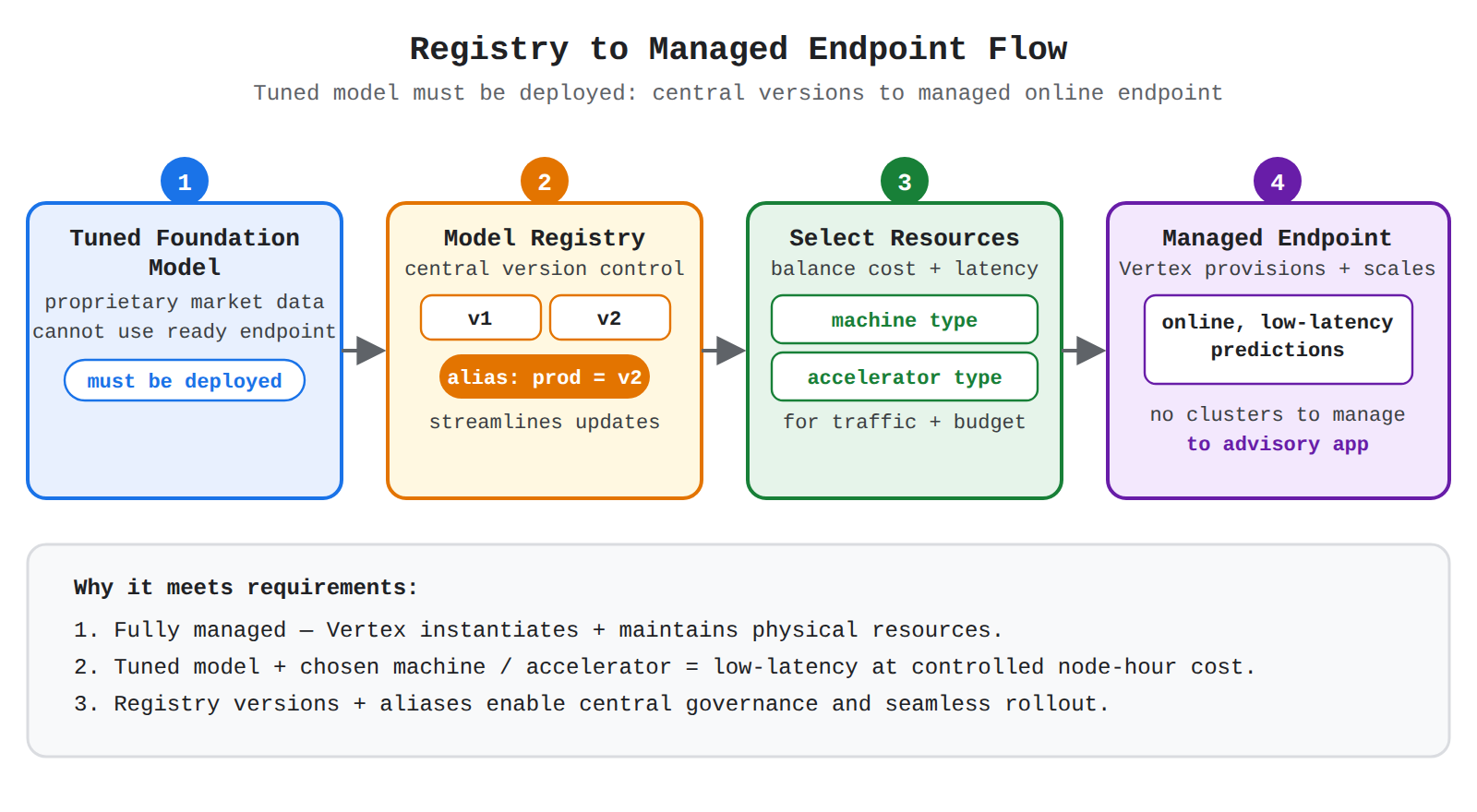
How It Meets the Requirements
- Low-latency predictions without infrastructure management: Unlike untuned foundation models, a tuned model must be deployed to an endpoint to serve requests. In a fully managed environment, engineers select the desired compute profile and Vertex AI handles provisioning and cluster maintenance.
- Balancing cost and performance: Vertex AI allows organizations to choose specific machine types and accelerator types based on expected traffic volume, latency targets, and budget constraints—such as selecting cost-effective machines where slightly higher latency is acceptable, or high-performance accelerators for real-time customer interactions.
- Centralized version governance: Vertex AI Model Registry tracks customized model versions in one place and uses aliases to assign and update production endpoints seamlessly.
Key Advantages and Capabilities
- Sustained business differentiation: Operationalizing models trained or tuned on proprietary domain data delivers tailored customer experiences that competitors using generic models cannot easily replicate.
- Operational agility: Automated infrastructure management lets teams focus on refining product features rather than maintaining servers.
- Predictable cost control: Aligning physical node allocations with traffic demand optimizes node-hour expenses.
- Streamlined MLOps lifecycle: Centralized tracking simplifies auditing, testing, and rolling out iterative model improvements.
Why This Is Optimal
Compared to self-managed container clusters or unconfigured endpoints, combining Vertex AI Model Registry with a fully managed Vertex AI endpoint directly supports end-to-end operational integration while balancing scalability, latency, and cost.
Try 10 interactive questions like this one, free
Answer them yourself and get your score the moment you finish. No account needed.
Full access includes
- 3,070 practice questions across all 6 exam domains
- Every answer explained: why it is right, and why the others are not
- Scout, an AI tutor that answers your follow-up questions
- Readiness tracking by domain, so you know when to book the exam
Related free sample questions
Keep the momentum going with these hand-picked practice scenarios
FundamentalCloud Digital Leader
Vertex AI Managed ML Workflow
Discuss how building custom models by using Google Cloud’s Vertex AI can create opportunities for business differentiation.
FundamentalCloud Digital Leader
Vertex AI Custom Model Training
Discuss how building custom models by using Google Cloud’s Vertex AI can create opportunities for business differentiation.
FundamentalCloud Digital Leader
BigQuery Serverless Data Warehouse
Determine which Google Cloud data management products are applicable to different business use cases.
FundamentalCloud Digital Leader
Hybrid Cloud with Sensitive Data Protection
Identify when private, hybrid, or multicloud infrastructures best apply to different business use cases.
FundamentalCloud Digital Leader
BigQuery ML SQL Model Training
Discuss the range of Google Cloud AI and ML solutions and products available, and how to select the most appropriate solution for different business use cases.
FundamentalAssociate Cloud Engineer
Database Center Fleet Management
Using Database Center to manage the Google Cloud database fleet
Last updated