Fundamental
Prepare and test your skills

Fundamental
Prepare and test your skills
How Google SecOps Unifies Detection and Response
Free sample question with answers and detailed explanation below. The Cloud Digital Leader practice bank has an additional 3,070 practice questions.Try 10 free realistic questions: instant score, no credit card, and no account required.
A retail organization is expanding its cloud-native environment on Google Cloud. Understanding that Google secures the underlying infrastructure under the shared responsibility model, the company wants to strengthen how it secures its own data, workloads, and configurations. They need a cloud-native Security Operations (SecOps) approach that integrates continuous risk assessment, security monitoring, threat detection, and incident response.
Which approach describes how Google Cloud's SecOps capabilities integrate these functions?
Explanations
Offloading the management of customer data access, identity permissions, and workload configurations entirely to Google's dedicated infrastructure security team
Offloading the management of customer data access, identity permissions, and workload configurations entirely to Google's dedicated infrastructure security team
What the Shared Responsibility Model Is
The shared responsibility model is the foundational framework that defines which security tasks belong to the cloud provider and which belong to the customer. In Google Cloud, Google's dedicated security team is responsible for protecting the cloud itself—including physical data centers, custom server hardware, storage infrastructure, and the global network fabric. Conversely, the customer is always responsible for securing what they bring to the cloud.
Why It Doesn't Meet the Requirements
Attempting to offload the security of customer data access, identity permissions, and workload configurations to Google violates the core principles of the shared responsibility model. Even when using advanced cloud-native services, Google does not automatically configure a customer's internal business policies or decide which employees should access specific datasets. The retail organization must actively use cloud security tools to monitor, govern, and remediate risks within its own cloud workloads and data.
Key Characteristics and Limitations
- Customer Ownership of Data: Regardless of whether a workload runs on Infrastructure as a Service (IaaS), Platform as a Service (PaaS), or Software as a Service (SaaS), securing customer data and its access usage remains the customer's responsibility.
- Provider Infrastructure Protection: Google handles physical security, hardware disposal, infrastructure patching, and baseline encryption at rest.
- Shared Operational Controls: While Google provides tools like Identity and Access Management (IAM), Security Command Center, and Google SecOps, the customer is responsible for configuring roles, reviewing alerts, and managing cases.
This Answer Would Be Correct If
This concept would apply if the question asked solely about the security of underlying physical hardware, data center perimeter fencing, or global network cabling, which are managed entirely by Google's infrastructure teams without customer intervention.
Additional Context
A common misconception during cloud adoption is assuming that moving to a trusted public cloud eliminates the need for an internal Security Operations Center (SOC). In reality, cloud adoption shifts the customer's focus away from physical hardware maintenance toward cloud-native SecOps—monitoring telemetry, managing cloud posture, and responding to application-level or identity-based threats.
Provisioning physical hardware appliances to store raw logs locally and requiring analysts to manually inspect every event without automated correlation
Provisioning physical hardware appliances to store raw logs locally and requiring analysts to manually inspect every event without automated correlation
What Traditional On-Premises Log Management Is
Traditional log management involves deploying physical servers or storage appliances within a local data center to collect raw event logs from network devices and servers. In legacy environments without modern Security Information and Event Management (SIEM) automation, security personnel often had to write manual queries to inspect raw, unformatted text logs after a security breach had already occurred.
Why It Doesn't Meet the Requirements
This approach directly contradicts the principles of cloud-native Security Operations (SecOps). Modern cloud environments generate massive volumes of telemetry that cannot be effectively stored on fixed local hardware or analyzed manually by humans in real time. Furthermore, failing to normalize data or use automated correlation prevents the organization from achieving continuous risk assessment, rapid threat detection, and streamlined incident response.
Key Characteristics and Limitations
- Hardware Overhead: Maintaining physical log-storage appliances introduces capacity limits, high upfront costs, and ongoing maintenance burdens that Chronicle APIs and cloud-native storage eliminate.
- Lack of Normalization: Relying solely on unparsed raw logs makes it difficult to connect related events across disparate cloud services, endpoints, and identity providers.
- Reactive and Slow: Manual inspection of individual events leads to alert fatigue and slow response times, allowing attackers to move laterally before analysts can identify a compromise.
- Missing Orchestration: Without automated detection rules and SOAR playbooks, every remediation action must be executed manually across disconnected systems.
This Answer Would Be Correct If
This approach would only apply if an organization were operating a strictly air-gapped, legacy on-premises environment with minimal log volume and regulatory mandates prohibiting the use of cloud APIs or automated cloud analysis platforms.
Additional Context
While Google SecOps does offer a Raw Log Scan and Regular Expressions search for deep-dive forensic investigations when needed, its core strength lies in cloud-native scale. By ingesting data directly via APIs or lightweight collectors and normalizing it into the Unified Data Model (UDM), Google SecOps automates correlation and threat detection across months of historical telemetry.
Ingesting and normalizing telemetry using the Unified Data Model (UDM), enriching alerts with cloud asset context and threat intelligence, and executing automated response playbooks
Ingesting and normalizing telemetry using the Unified Data Model (UDM), enriching alerts with cloud asset context and threat intelligence, and executing automated response playbooks
What Google Security Operations (Google SecOps) Is
Google Security Operations (Google SecOps) is a cloud-native service built as a specialized layer on top of core Google infrastructure. Within the shared responsibility model, while Google protects the underlying physical data centers, hardware, and global network, customers are responsible for securing the data, workloads, and configurations they bring to the cloud. Google SecOps empowers security teams to fulfill their side of this model by privately retaining, analyzing, and responding to massive volumes of security and network telemetry across the entire threat lifecycle.
How It Meets the Requirements
In a modern cloud-native environment, security functions cannot operate in isolated silos. Google SecOps integrates with Security Command Center under the umbrella of Google Unified Security to connect monitoring, risk assessment, detection, and response into a single continuous workflow:
- Collection and Monitoring: Telemetry from cloud workloads, audit logs, and third-party sources is continuously ingested via APIs, collectors, and forwarders.
- Threat Detection and Risk Assessment: Incoming data is normalized using the Unified Data Model (UDM) and enriched with Cloud Asset Inventory metadata, security posture findings, and Google Threat Intelligence to automatically detect risky activities and misconfigurations.
- Investigation and Automated Incident Response: Security analysts use Security Orchestration, Automation, and Response (SOAR) capabilities, case management, and automated playbooks to triage alerts and remediate threats rapidly.
Key Capabilities and Advantages
- Unified SIEM and SOAR: Combines Security Information and Event Management (SIEM) log analysis with automated SOAR workflows in a single converged platform.
- Entity Graph Enrichment: Automatically combines threat alerts with cloud resource metadata and posture status to help analysts prioritize high-risk issues.
- Detection Engine: Automates continuous searching across historical and real-time telemetry using curated rules to surface known and emerging threats.
- Playbook Designer: Enables teams to build automated remediation workflows using drag-and-drop actions to contain threats at cloud speed.
- Planet-Scale Performance: Inherits the compute, storage, and security design of Google infrastructure to search months of enterprise telemetry instantly.
Unified SIEM + SOAR Threat Lifecycle
System Architecture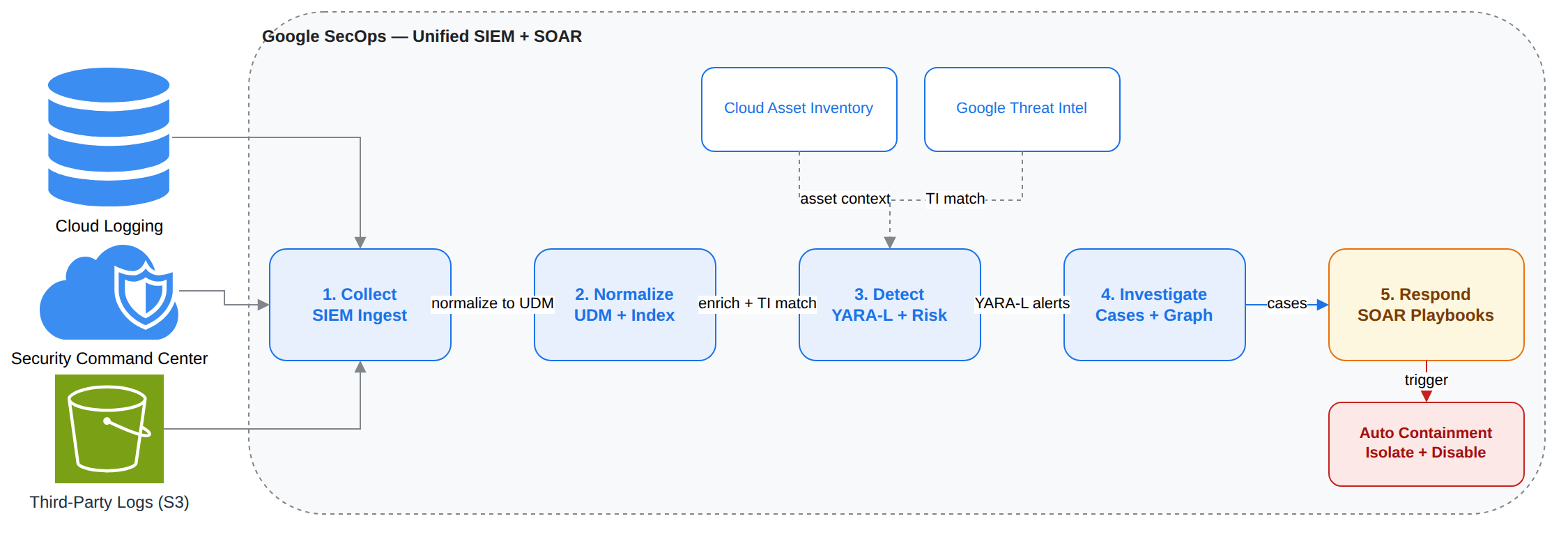
Why This Is Optimal
Unlike fragmented security tools or manual review processes, this integrated approach connects continuous risk assessment directly with real-time threat detection and automated response. By unifying telemetry normalization, posture context, and orchestration playbooks, organizations can shift from reactive troubleshooting to proactive, cloud-native defense.
Relying exclusively on Google Cloud Armor at the network edge to block distributed denial-of-service (DDoS) and SQL injection attacks before traffic reaches workloads
Relying exclusively on Google Cloud Armor at the network edge to block distributed denial-of-service (DDoS) and SQL injection attacks before traffic reaches workloads
What Google Cloud Armor Is
Google Cloud Armor is a network edge security service and Web Application Firewall (WAF) designed to protect Google Cloud deployments from external web-based attacks. It operates at the global load-balancing layer to inspect incoming network requests and mitigate threats before they can overwhelm or compromise backend applications.
Why It Doesn't Meet the Requirements
While edge protection is an important layer of defense in depth, relying exclusively on Google Cloud Armor does not provide a comprehensive Security Operations (SecOps) program. Cloud Armor focuses specifically on filtering inbound web traffic at the perimeter; it does not ingest enterprise-wide telemetry, normalize multi-cloud logs, manage investigation cases, assess internal identity misconfigurations, or orchestrate automated SOAR incident response playbooks across the broader environment.
Key Characteristics and Limitations
- DDoS Mitigation: Defends public-facing applications and services against large-scale distributed denial-of-service (DDoS) volume attacks.
- OWASP Top 10 Protection: Uses predefined and custom rules to block common application-layer attacks such as cross-site scripting (XSS) and SQL injection (SQLi).
- Perimeter Focus: Operates strictly on ingress web traffic and cannot detect internal lateral movement, compromised service accounts, or data exfiltration occurring through authorized internal channels.
- Signal Source Rather Than SIEM: Generates valuable security logs, but relies on platforms like Security Command Center and Google SecOps for broader correlation and case management.
This Answer Would Be Correct If
This option would be the right choice if the organization specifically needed a Web Application Firewall (WAF) and DDoS protection service to filter malicious HTTP/HTTPS traffic targeting its public-facing web applications at the network perimeter.
Additional Context
Within Google Cloud's security ecosystem, Google Cloud Armor acts as a preventative control and a telemetry source. Its logs and findings feed into Security Command Center and Google SecOps, where analysts can correlate edge attacks with internal system logs to conduct full-lifecycle threat investigations.
Try 10 interactive questions like this one, free
Answer them yourself and get your score the moment you finish. No account needed.
Full access includes
- 3,070 practice questions across all 6 exam domains
- Every answer explained: why it is right, and why the others are not
- Scout, an AI tutor that answers your follow-up questions
- Readiness tracking by domain, so you know when to book the exam
Related free sample questions
Keep the momentum going with these hand-picked practice scenarios
FundamentalCloud Digital Leader
Streaming ETL vs ELT
Discuss the main data value chain concepts and terms.
FundamentalCloud Digital Leader
BigQuery ML SQL Model Training
Discuss the range of Google Cloud AI and ML solutions and products available, and how to select the most appropriate solution for different business use cases.
FundamentalCloud Digital Leader
Cloud Trace Distributed Tracing
Define important cloud operations terms.
FundamentalCloud Digital Leader
Standardized APIs for Reusable Integration
Explain the business value of application programming interfaces (APIs).
FundamentalCloud Digital Leader
Business Consequences of Security Incidents
Describe today’s top cybersecurity threats and business implications.
AdvancedProfessional Cloud DevOps Engineer
URL Map Weighted Routing with Connection Draining
Draining/redirecting traffic
Last updated