Fundamental
Prepare and test your skills

Fundamental
Prepare and test your skills
How BigQuery Speeds Up Analytical Queries
Free sample question with answers and detailed explanation below. The Cloud Digital Leader practice bank has an additional 3,070 practice questions.Try 10 free realistic questions: instant score, no credit card, and no account required.
A retail organization runs monthly revenue aggregations and trend analyses directly on its legacy transactional database. As data volumes grow, the analytics team notices two major issues:
- Analytical queries fetch unnecessary data columns across millions of records, causing slow report generation.
- Complex multi-table joins compete with daily customer checkout transactions for server memory and CPU.
The organization decides to offload its historical structured data to BigQuery for analytical processing.
How does BigQuery organize and process data to resolve these performance bottlenecks?
Explanations
It stores records in row-based blocks and enforces strict table normalization to reduce data redundancy
It stores records in row-based blocks and enforces strict table normalization to reduce data redundancy
What Row-Based Storage and Normalization Are
Row-oriented storage and relational normalization are foundational design principles of traditional Online Transaction Processing (OLTP) databases, such as Cloud SQL or Cloud Spanner. In a row-based format, all columns belonging to a single record are stored sequentially inside a shared data block. Normalization splits data into multiple distinct tables connected by primary and foreign keys to eliminate duplicate data and maintain strict transactional integrity during frequent inserts and updates.
Why It Doesn't Meet the Requirement
- Inefficient analytical scans: When an analytical query aggregates one or two columns across millions of records in a row-based system, the database engine must fetch the entire row block into memory, wasting I/O bandwidth on unneeded columns.
- High join overhead: Strictly normalized schemas require reconstructing business entities by executing complex
JOINoperations across multiple tables, which degrades performance at large analytical scales.
Key Characteristics and Limitations
- Optimized for whole-row access: Reading or writing a complete individual record (such as looking up a single customer order) is fast because all attributes sit together on disk.
- Minimizes data redundancy: Normalization ensures that updating an attribute (like a customer's email address) only requires modifying a single row in one table.
- Poor batch aggregation scaling: Scanning massive historical datasets across normalized row stores consumes excessive CPU and memory.
This Answer Would Be Correct If
The organization needed to build a transactional relational database (using a service like Cloud SQL or Cloud Spanner) to process real-time e-commerce shopping carts, inventory updates, and single-customer order lookups with strong relational consistency.
Additional Context
While BigQuery supports traditional star and snowflake schemas that use dimension tables, best practices for columnar data warehouses favor denormalizing data into flat structures or nested and repeated fields to avoid join penalties.
It builds row-level indexes on all tables to accelerate individual record lookups and transactional updates
It builds row-level indexes on all tables to accelerate individual record lookups and transactional updates
What Row-Level Indexes Do
Database indexes are auxiliary data structures used primarily in transactional databases to map specific column values to the physical storage locations of corresponding rows. By maintaining an index, a relational database can quickly locate and update a single row without scanning the entire table from beginning to end.
Why It Doesn't Meet the Requirement
- Not used for batch analytics in BigQuery: Because BigQuery stores data in a columnar format and uses massively parallel distributed processing to scan only relevant columns concurrently, indexes are not needed for batch analytical workloads.
- Maintenance bottlenecks at scale: Constantly rebuilding and maintaining row-level indexes across terabytes or petabytes of historical data introduces significant storage and compute overhead during data ingestion.
Key Characteristics and Limitations
- Accelerates point lookups: Indexes excel when a query filters for a highly selective single record or small subset of rows.
- Adds write overhead: Every time data is inserted, updated, or deleted, the database must also update all associated indexes, which can slow down ingestion pipelines.
- Replaced by partitioning and clustering in warehouses: Instead of traditional indexes, BigQuery optimizes query pruning by dividing tables into partitions and sorting column blocks via clustering.
This Answer Would Be Correct If
The workload required low-latency, single-row lookups and updates in a relational database like Cloud SQL, or high-throughput access to a small set of row-based records using a NoSQL database service like Cloud Bigtable.
Additional Context
A common misconception when migrating from legacy databases to a cloud data warehouse is attempting to recreate transactional indexes. In BigQuery, adding more parallel compute slots and applying partitioning and clustering eliminates unnecessary data scans without the administrative burden of index management.
It uses columnar storage and supports denormalized schemas with decoupled compute and storage
It uses columnar storage and supports denormalized schemas with decoupled compute and storage
What Columnar Storage and Denormalized Architecture Are
In an enterprise data warehouse like BigQuery, large volumes of structured data are organized specifically for Online Analytical Processing (OLAP). Internally, BigQuery stores data in a columnar storage format (called Capacitor) rather than storing entire rows together. Additionally, it supports denormalized schemas—such as flat tables or nested and repeated fields—and completely decouples its storage layer (Colossus) from its compute layer (Dremel).
How It Meets the Requirements
- Eliminating unnecessary column scans: Because data is stored by column rather than by row, an analytical query that calculates monthly revenue only reads the specific columns referenced in the query (such as
OrderDateandOrderAmount), completely ignoring irrelevant columns like customer addresses or product descriptions. - Reducing expensive multi-table joins: By consolidating dimension data into a denormalized schema or using nested and repeated fields, BigQuery minimizes the need to perform compute-intensive
JOINoperations across multiple tables at query time. - Preventing resource contention: Separating storage and compute allows BigQuery to dynamically allocate compute slots for heavy analytical queries independently of data ingestion, while offloading analytics from the transactional database leaves checkout operations unaffected.
Columnar Storage Reads Only Needed Columns
Annotated Structure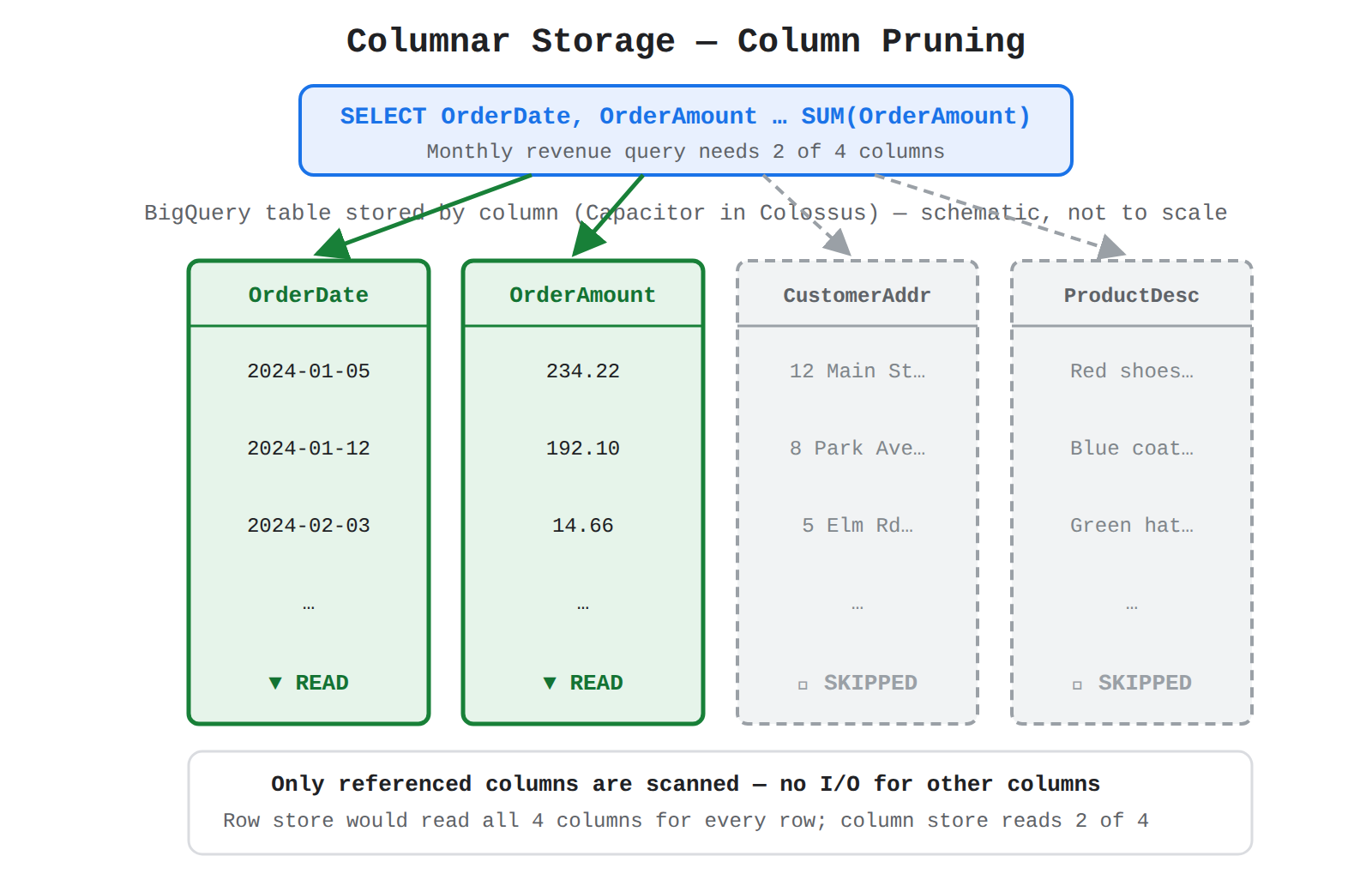
Key Advantages and Capabilities
- Direct execution on compressed data: BigQuery operates directly on compressed columnar blocks without needing to decompress entire rows first.
- Partitioning and clustering: Tables can be divided by
DATEorTIMESTAMP(partitioning) and sorted by key attributes (clustering) to further reduce the volume of scanned bytes. - Serverless scalability: Compute resources scale automatically on the query level to scan terabytes in seconds and petabytes in minutes.
- Zero infrastructure overhead: Administrators do not need to manually size hardware, rebuild indexes, or vacuum data blocks.
Why This Is Optimal
Unlike traditional row-oriented databases that must read entire data blocks and join normalized tables, combining columnar storage, schema denormalization, and decoupled serverless compute directly addresses the I/O and CPU bottlenecks of large-scale business intelligence workloads.
It shares a fixed pool of server resources between transactional write operations and analytical queries
It shares a fixed pool of server resources between transactional write operations and analytical queries
What a Shared-Resource Database Architecture Is
A shared-resource architecture is typical of legacy databases where a fixed allocation of CPU, RAM, and disk I/O is statically assigned to a database server. In this model, the same underlying hardware pool must simultaneously handle incoming read/write transactions, analytical reporting queries, and administrative tasks like assigning permissions or running backups.
Why It Doesn't Meet the Requirement
- Creates resource contention: Sharing a fixed hardware pool is the exact architectural limitation causing the retail company's current bottleneck, where heavy analytical queries starve customer checkout transactions of memory and CPU.
- Misrepresents BigQuery's architecture: BigQuery does not use a fixed, shared hardware pool that couples storage and compute; instead, it separates the storage layer and compute layer over a petabit-scale network.
Key Characteristics and Limitations
- Fixed hardware ceilings: Capacity is bound by pre-provisioned server limits, requiring manual hardware upgrades or complex clustering to scale.
- Workload interference: High-volume data writes slow down concurrent analytical reads, while resource-heavy aggregations degrade real-time application responsiveness.
- High administrative overhead: Database administrators must manually tune memory allocations, storage segments, and concurrency parameters.
This Answer Would Be Correct If
The question asked to describe the architectural limitation of legacy databases that run both Online Transaction Processing (OLTP) and Online Analytical Processing (OLAP) workloads on the same pre-provisioned server infrastructure.
Additional Context
By decoupling compute and storage in a serverless architecture, BigQuery allows each layer to allocate resources dynamically and independently. Analytical teams can run massive ad hoc queries using isolated compute slots without ever degrading data ingestion or impacting external transactional databases.
Try 10 interactive questions like this one, free
Answer them yourself and get your score the moment you finish. No account needed.
Full access includes
- 3,070 practice questions across all 6 exam domains
- Every answer explained: why it is right, and why the others are not
- Scout, an AI tutor that answers your follow-up questions
- Readiness tracking by domain, so you know when to book the exam
Related free sample questions
Keep the momentum going with these hand-picked practice scenarios
FundamentalCloud Digital Leader
Data Lake vs Data Warehouse
Differentiate between basic data management concepts, in particular: databases, data warehouses, and data lakes.
FundamentalCloud Digital Leader
Cloud SQL Managed Relational OLTP
Differentiate between basic data management concepts, in particular: databases, data warehouses, and data lakes.
FundamentalCloud Digital Leader
Confidential VM and Cloud HSM Key Access Justifications
Describe the role of encryption in securing an organization’s data and the ways that it can protect data exposed to risks in different states.
FundamentalCloud Digital Leader
Access Transparency Provider Audit Logs
Describe how Google Cloud earns and maintains customer trust in the cloud.
FundamentalCloud Digital Leader
Google Purpose-Built Data Centers Efficiency
Describe the benefits of Google designing and building its own data centers, using purpose-built servers, networking, and custom security hardware / software.
IntermediateProfessional Cloud Architect
Security Command Center VPC Service Controls Integration
Ensuring the reliability of solutions in production (e.g., chaos engineering, penetration testing, and load testing)
Last updated