Fundamental
Prepare and test your skills

Fundamental
Prepare and test your skills
Cold Backup and Restore for Regional Recovery
Free sample question with answers and detailed explanation below. The Cloud Digital Leader practice bank has an additional 3,070 practice questions.Try 10 free realistic questions: instant score, no credit card, and no account required.
An organization is designing a disaster recovery (DR) strategy for a non-critical reporting database and needs to align its architecture with the following business requirements:
- Recovery Point Objective (RPO): Up to 8 hours of data loss is acceptable.
- Recovery Time Objective (RTO): Up to 12 hours of downtime is acceptable.
- Resilience: Data must remain recoverable even if an entire geographic region experiences an outage.
- Budget: Ongoing infrastructure and licensing expenses must be minimized.
Which disaster recovery strategy should the organization implement?
Explanations
Maintain a pre-provisioned standby database instance with continuous asynchronous replication in a secondary region
Maintain a pre-provisioned standby database instance with continuous asynchronous replication in a secondary region
What a Pre-Provisioned Standby Database Is
A pre-provisioned standby database with continuous asynchronous replication represents a warm standby disaster recovery pattern. In this model, a secondary database instance runs continuously in a recovery region and receives ongoing data updates from the primary database, while web and application tier Compute Engine VMs remain stopped or stored as snapshots until a disaster occurs.
Why It Doesn't Meet the Requirements
This approach does not meet the strict budget requirement to minimize ongoing infrastructure and licensing costs. Keeping a pre-provisioned database instance running 24/7 in a secondary region continuously consumes compute, memory, and licensing resources. Because the business can tolerate up to 12 hours of downtime (RTO) and 8 hours of data loss (RPO), paying for an always-on secondary database server is over-provisioning.
Key Characteristics and Limitations
- Low RPO: Continuous asynchronous replication keeps data loss down to seconds or minutes rather than hours.
- Moderate-to-fast RTO: Having the database already running and populated with data significantly accelerates recovery time compared to restoring from cold backups.
- Medium-to-high ongoing costs: Although application VMs can remain stopped or stored as
snapshotsto save money, the continuously running database instance still generates substantial operating expenses. - Operational overhead: Requires continuous monitoring of replication links and network connectivity between the primary and recovery regions.
This Answer Would Be Correct If
This option would be appropriate if the organization needed a warm standby solution for an important business application requiring a low RPO (minutes) and an RTO of less than an hour, while trying to save money on the web and application tiers by launching VMs from snapshots during a failover.
Additional Context
Warm standby architectures bridge the gap between cold backups and hot active-active clusters. However, when a workload's RPO is 8 hours or more and its RTO is several hours, cold backups in Cloud Storage are much more cost-effective.
Deploy a multi-zone availability group within a single region using local disk snapshots
Deploy a multi-zone availability group within a single region using local disk snapshots
What a Single-Region Multi-Zone Availability Group Is
A multi-zone availability group within a single region is a high availability (HA) architecture that distributes database nodes across separate zones inside the same geographic region, paired with Compute Engine snapshots to capture point-in-time disk states.
Why It Doesn't Meet the Requirements
This option fails two critical requirements:
- Resilience: Deploying resources exclusively within a single region does not protect the workload if an entire geographic region experiences a site-wide outage or disaster.
- Budget: Running multiple database instances across zones in an availability group incurs high ongoing compute and licensing costs that are unjustified for a non-critical reporting database with relaxed RTO and RPO targets.
Key Characteristics and Limitations
- Zonal fault tolerance: Protects databases against hardware-level, instance-level, and single-zone failures within one region.
- Lack of regional DR: Cannot recover workloads during a regional catastrophe unless data is also replicated or backed up to a geographically dispersed location.
- Fast local snapshots: Using
Compute Engine instant snapshotscaptures multi-disk backups in under a second, but requires multi-regional storage placement if regional disaster recovery is needed. - Higher infrastructure expense: Running redundant zonal instances increases monthly operational expenditure (
OpEx).
This Answer Would Be Correct If
This strategy would be correct if the organization needed to protect a production database strictly against hardware, instance, or zonal failures within a single region while achieving fast local failover.
Additional Context
It is vital to distinguish between High Availability (HA) across zones and Disaster Recovery (DR) across regions. While multi-zone deployments handle localized infrastructure failures seamlessly, true business continuity during a regional outage requires cross-region replication or multi-region backups.
Perform scheduled database backups directly to a multi-region Cloud Storage bucket
Perform scheduled database backups directly to a multi-region Cloud Storage bucket
What Scheduled Backups to Multi-Region Cloud Storage Are
Backing up a database directly to a multi-region Cloud Storage bucket is a foundational cold disaster recovery (DR) strategy. In this approach, database backups and transaction logs are periodically written to object storage that automatically replicates data across multiple geographic regions within a defined multi-region boundary, without maintaining active standby database servers.
Multi-Region Backup and Restore DR Flow
System Architecture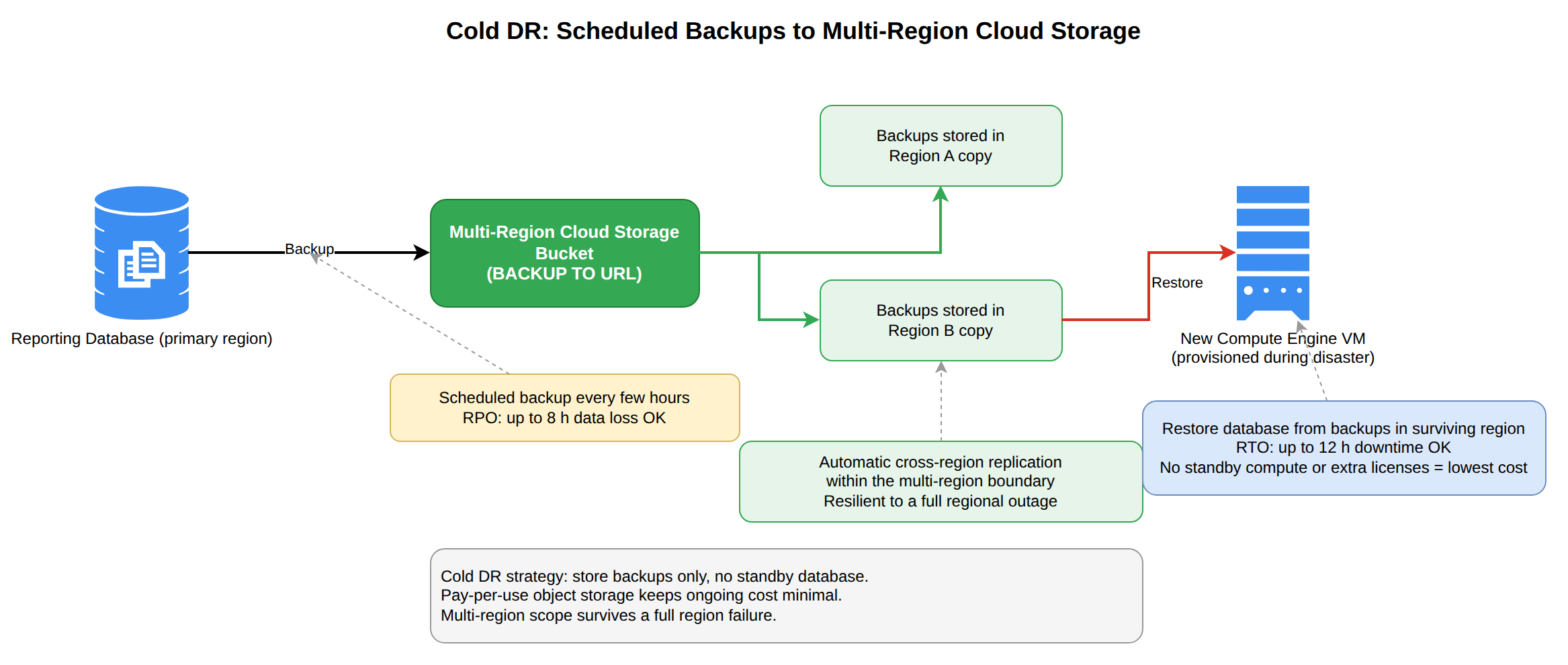
How It Meets the Requirements
- Recovery Point Objective (RPO): Scheduling backups every few hours easily satisfies an RPO of 8 hours or more, as the organization can tolerate losing the data generated between scheduled backup intervals.
- Recovery Time Objective (RTO): Because a 12-hour RTO allows sufficient time to provision new compute instances and restore database files from object storage after an outage occurs, a backup-and-restore approach fits within the acceptable downtime window.
- Resilience: Using a multi-region bucket ensures cross-region replication, keeping backup data redundant and accessible even if the primary region fails completely.
- Budget: Storing backups in Cloud Storage without running redundant compute instances or paying for extra active database licenses provides the lowest ongoing operational cost.
Key Advantages and Capabilities
- Cross-region redundancy: Automatically protects backup data against zonal and regional outages without manual replication scripts.
- Pay-per-use economics: Eliminates the need to pay for continuously running standby Compute Engine instances during normal operations.
- Direct integration: Modern databases can write backups directly to Cloud Storage URLs (such as using
BACKUP TO URL) without requiring intermediate local disk storage. - Simplified architecture: Reduces networking complexity and avoids split-brain data synchronization issues.
Why This Is Optimal
When designing for business continuity, architects must balance the trade-offs between cost, RPO, and RTO. For less critical systems that can tolerate several hours of downtime and data loss, an off-site backup strategy using multi-region Cloud Storage delivers the required geographic resilience at a fraction of the cost of warm or hot standby clusters.
Configure an active availability group with synchronous replication across multiple regions
Configure an active availability group with synchronous replication across multiple regions
What Synchronous Availability Groups Are
An availability group with synchronous replication is a high availability (HA) and hot standby disaster recovery architecture. In this setup, every transaction committed to the primary database is simultaneously written to one or more active secondary database nodes before the transaction is confirmed as complete.
Why It Doesn't Meet the Requirements
While synchronous replication across regions provides exceptional resilience, it directly violates the budget requirement to minimize ongoing infrastructure and licensing expenses. Maintaining active, continuously running database clusters across multiple regions requires redundant compute capacity, high-bandwidth networking, and duplicate software licenses, which is unnecessary when an 8-hour RPO and 12-hour RTO are acceptable.
Key Characteristics and Limitations
- Near-zero RPO: Guarantees virtually zero data loss because primary and secondary nodes remain continuously synchronized.
- Minimal RTO: Enables automated or rapid failover in under a minute (
RTO < 1 minute) by keeping standby database nodes online and ready to accept traffic. - High operational cost: Incurs maximum expenditure due to 24/7 operation of duplicate compute instances, storage disks, and enterprise database licenses.
- Latency sensitivity: Synchronous communication across long geographic distances can introduce network latency that slows down write performance on the primary database.
This Answer Would Be Correct If
This strategy would be the right choice if the scenario involved a mission-critical transactional application (such as a core banking system) that required near-zero data loss (RPO < 1 minute) and immediate failover (RTO < 1 minute) regardless of infrastructure cost.
Additional Context
A common misconception in disaster recovery planning is assuming that the fastest recovery strategy is always the best choice. Effective cloud architecture aligns system expenditure with business criticality, avoiding expensive hot-standby architectures when simple off-site backups meet the business impact objectives.
Try 10 interactive questions like this one, free
Answer them yourself and get your score the moment you finish. No account needed.
Full access includes
- 3,070 practice questions across all 6 exam domains
- Every answer explained: why it is right, and why the others are not
- Scout, an AI tutor that answers your follow-up questions
- Readiness tracking by domain, so you know when to book the exam
Related free sample questions
Keep the momentum going with these hand-picked practice scenarios
FundamentalCloud Digital Leader
Multi-Zone High Availability Architecture
Describe the importance of designing resilient, fault-tolerant, and scalable infrastructure and processes for high availability and disaster recovery.
FundamentalCloud Digital Leader
MIG Autoscaling and Autohealing
Describe the importance of designing resilient, fault-tolerant, and scalable infrastructure and processes for high availability and disaster recovery.
FundamentalCloud Digital Leader
Prebuilt Industry AI Solutions vs Custom ML
Explain which decisions and tradeoffs organizations need to consider when selecting Google Cloud AI/ML solutions and products, including: speed; effort; differentiation; required expertise.
FundamentalCloud Digital Leader
Cloud TPUs for TensorFlow Acceleration
Recognize TensorFlow as an end-to-end open source set of tools for building and training machine learning models and that Cloud Tensor Processing Unit (TPU) is Google’s proprietary hardware optimized for TensorFlow and ML performance.
FundamentalCloud Digital Leader
Coldline 90-Day Minimum Storage Duration
Differentiate between storage classes in Cloud Storage regarding cost and frequency of access, including: Standard, Nearline, Coldline, and Archive.
FundamentalAssociate Cloud Engineer
Regional vs Global Static External IP
Reserving static external or internal IP addresses
Last updated