Fundamental
Prepare and test your skills

Fundamental
Prepare and test your skills
Coldline Storage for 90-Day Disaster Recovery
Free sample question with answers and detailed explanation below. The Cloud Digital Leader practice bank has an additional 3,070 practice questions.Try 10 free realistic questions: instant score, no credit card, and no account required.
A retail organization is updating its business continuity strategy and needs to store critical system images in Cloud Storage for disaster recovery. The organization has established the following storage requirements:
- The data must be retained for at least 90 days.
- The data will be accessed at most once every quarter for disaster recovery testing or during an actual outage.
- Storage costs must be minimized for this specific 90-day retention window without committing to a full-year minimum storage duration.
Which Cloud Storage class best aligns with these business requirements?
Explanations
Nearline storage
Nearline storage
What Nearline Storage Is
Nearline storage is a low-cost, highly durable object storage class in Google Cloud Storage designed for data that is accessed less than once a month on average. It is commonly used for monthly backups, long-tail multimedia content, and data that remains active for short-term operational recovery.
Why It Doesn't Meet the Requirements
- Suboptimal Cost for 90-Day Retention: While Nearline is cheaper at rest than Standard storage, its monthly per-gigabyte storage rate is higher than Coldline storage. For data guaranteed to remain stored for at least 90 days and accessed only once per quarter, Nearline does not provide the lowest total cost.
- Designed for 30-Day Cycles: Nearline is structured around a 30-day minimum storage duration and monthly access patterns rather than quarterly disaster recovery cycles.
Key Characteristics and Limitations
- 30-Day Minimum Storage Duration: Objects deleted, overwritten, or transitioned before 30 days incur an early deletion charge prorated for the remainder of the 30-day window.
- Moderate Retrieval Fees: Charges a small per-gigabyte data retrieval fee when objects are read, which is lower than Coldline and Archive retrieval fees.
- Millisecond Latency: Provides immediate, rapid access to stored backups without offline tape-style delays.
- 11 9s Annual Durability: Guarantees the same enterprise-grade data protection as all other Cloud Storage tiers.
This Answer Would Be Correct If
This option would be correct if the organization needed to store routine monthly backups or long-tail media files that must be retained for at least 30 days and are accessed roughly once every month.
Additional Context
A common misconception is that all backups and recovery workloads belong in Nearline storage. In Google Cloud architecture, routine 30-day backups align with Nearline, whereas 90-day disaster recovery datasets align with Coldline storage to maximize cost savings over the longer retention window.
Archive storage
Archive storage
What Archive Storage Is
Archive storage is the lowest-cost, highly durable storage class available in Google Cloud Storage, engineered for long-term data archiving, regulatory compliance, and digital preservation. It is tailored for "coldest" data that is accessed less than once a year.
Why It Doesn't Meet the Requirements
- 365-Day Minimum Duration Mismatch: Archive storage enforces a strict 365-day minimum storage duration. Because the organization's requirement is a 90-day retention window without committing to a full year, deleting or rotating system images after 90 days in Archive storage would trigger 275 days of early deletion penalties.
- High Retrieval Costs for Quarterly Drills: Archive storage charges the highest per-gigabyte data retrieval fees of any storage class. Reading the entire set of system images four times a year for quarterly disaster recovery testing would generate excessive operational and retrieval expenses.
Key Characteristics and Limitations
- Lowest At-Rest Storage Price: Offers the lowest monthly per-gigabyte storage rate across all Cloud Storage options.
- 365-Day Minimum Retention: Imposes early deletion charges if objects are removed or overwritten prior to one full year.
- Highest Data Access Costs: Carries the highest costs for Class A and Class B operations as well as per-gigabyte data reads.
- Online Millisecond Access: Unlike legacy tape archives that take hours to restore, Archive storage still delivers millisecond time-to-first-byte.
This Answer Would Be Correct If
This option would be the ideal choice if the organization needed to retain financial audit logs, healthcare records, or archived media assets for 3 to 7 years to satisfy legal compliance mandates, where the data is almost never read.
Additional Context
Choosing a storage class requires balancing at-rest storage costs against minimum duration rules and access frequency. Even though Archive storage has the lowest monthly sticker price per gigabyte, using it for a 90-day lifecycle with quarterly reads results in a higher total cost of ownership than Coldline storage.
Standard storage
Standard storage
What Standard Storage Is
Standard storage is the default object storage class in Google Cloud Storage designed for "hot" data that is accessed frequently or stored for only brief periods. It serves as the primary tier for active workloads such as content delivery, streaming media, websites, mobile applications, and high-throughput data lakes.
Why It Doesn't Meet the Requirements
- Excessive At-Rest Cost: Standard storage carries the highest monthly per-gigabyte storage cost among the four primary Cloud Storage classes. Storing multi-terabyte disaster recovery images that sit idle for 90 days in Standard storage wastes budget on immediate, free retrieval capabilities that are rarely used.
- Mismatch with Quarterly Access: Because the system images are only accessed once a quarter, paying a premium to avoid data retrieval fees is financially inefficient.
Key Characteristics and Limitations
- Zero Minimum Storage Duration: Objects can be created, modified, and deleted immediately without incurring early deletion penalties.
- No Data Retrieval Fees: Reading or downloading objects does not incur per-gigabyte retrieval charges (though standard network egress rates still apply).
- High Availability: Engineered for maximum availability across regional, dual-region, and multi-region configurations.
- Higher Storage Baseline Cost: Optimized for high-frequency transactions rather than long-term, low-cost retention.
This Answer Would Be Correct If
This option would be the right choice if the retail organization needed to store active website assets, live streaming video segments, or transactional analytics datasets that are read and written daily by users or compute clusters.
Additional Context
Many organizations initially land newly created data in Standard storage when it is actively used and then configure Object Lifecycle Management rules or Autoclass to automatically transition the objects down to Coldline storage once the data becomes inactive.
Coldline storage
Coldline storage
What Coldline Storage Is
Coldline storage is a very-low-cost, highly durable object storage class in Google Cloud Storage designed specifically for infrequently accessed data. It is engineered for workloads where data is read or modified at most once a quarter, making it ideal for disaster recovery (DR) scenarios, quarterly compliance reporting, and long-term cold data storage.
How It Meets the Business Requirements
- 90-Day Minimum Retention: Coldline storage enforces a 90-day minimum storage duration, aligning directly with the organization's requirement to retain system images for at least three months.
- Quarterly Access Pattern: Because the organization only reads the system images once every quarter during scheduled disaster recovery drills or rare outages, the infrequent access profile matches Coldline's pricing model.
- Cost Optimization: It provides a significantly lower per-gigabyte monthly at-rest storage cost than hotter storage tiers while avoiding the 365-day commitment and higher retrieval fees of archival tiers.
Coldline 90-Day Retention Timeline
Timeline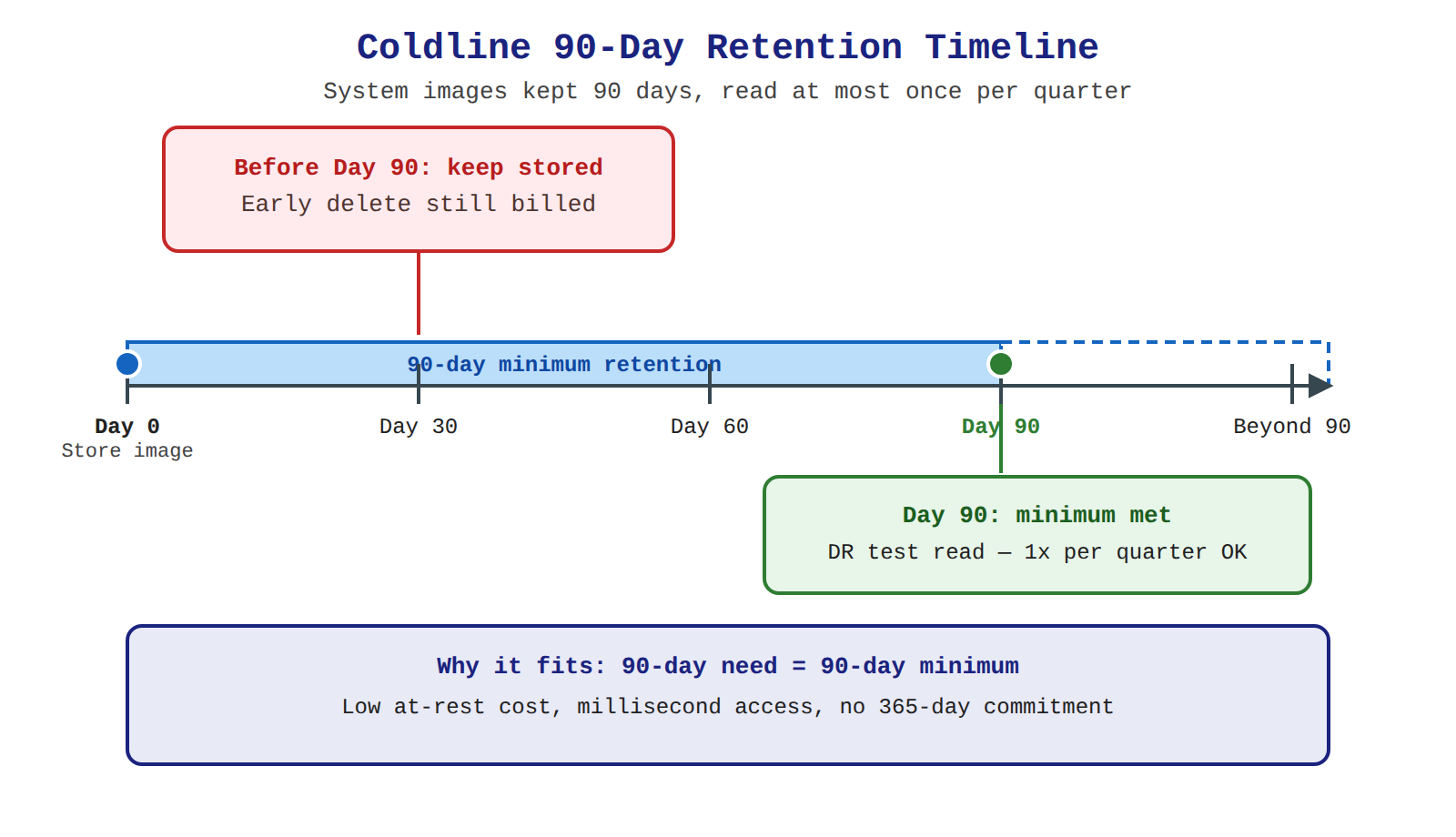
Key Advantages and Capabilities
- Low Monthly Storage Rates: Minimizes ongoing operational expenditure for large volumes of idle disaster recovery data.
- Millisecond Access Latency: Despite being a "cold" storage tier, Coldline provides the same sub-second access speed and high throughput as Standard storage when an emergency restoration is triggered.
- High Durability: Offers 99.999999999% (11 9s) annual durability, ensuring critical recovery images remain intact and uncorrupted.
- Flexible Location Support: Can be deployed across single-region, dual-region, or multi-region locations to support cross-region redundancy during a disaster.
- Consistent API Integration: Uses the exact same Cloud Storage APIs, IAM permissions, and lifecycle management tools as all other storage classes.
Why This Is Optimal
When balancing storage cost, retrieval fees, and minimum duration commitments, Coldline hits the exact sweet spot for a 90-day disaster recovery workload. Standard and Nearline storage charge higher monthly rates per gigabyte stored at rest, whereas Archive storage imposes a 365-day minimum storage duration and charges the highest data retrieval fees during quarterly drills.
Try 10 interactive questions like this one, free
Answer them yourself and get your score the moment you finish. No account needed.
Full access includes
- 3,070 practice questions across all 6 exam domains
- Every answer explained: why it is right, and why the others are not
- Scout, an AI tutor that answers your follow-up questions
- Readiness tracking by domain, so you know when to book the exam
Related free sample questions
Keep the momentum going with these hand-picked practice scenarios
FundamentalCloud Digital Leader
Cloud Storage Archive Class Millisecond Access
Differentiate between storage classes in Cloud Storage regarding cost and frequency of access, including: Standard, Nearline, Coldline, and Archive.
FundamentalCloud Digital Leader
Coldline vs Archive Minimum Storage Duration
Differentiate between storage classes in Cloud Storage regarding cost and frequency of access, including: Standard, Nearline, Coldline, and Archive.
FundamentalCloud Digital Leader
Cloud Modernization Competitive Advantage
Describe the implications and risks for organizations that do not adopt new technology.
FundamentalCloud Digital Leader
BigQuery ML Unstructured Data Processing
Explain the business value ML creates, including: ability to work with large datasets; scaling business decisions; and unlocking unstructured data.
FundamentalCloud Digital Leader
Cloud Run vs GKE Containerization
Discuss benefits of infrastructure modernization and application modernization by using Google Cloud.
IntermediateProfessional Cloud Developer
Apigee Advanced API Ops Anomalies
Using AI-assisted observability
Last updated