Fundamental
Prepare and test your skills

Fundamental
Prepare and test your skills
Coldline 90-Day Minimum Beats Archive 365-Day Rule
Free sample question with answers and detailed explanation below. The Cloud Digital Leader practice bank has an additional 3,070 practice questions.Try 10 free realistic questions: instant score, no credit card, and no account required.
A media company stores large volumes of video footage in Cloud Storage. To reduce monthly cloud spending, the finance team reviews their data retention strategy for completed project files and identifies the following usage patterns:
- The files are retained for 6 months and then permanently deleted.
- Editors read or modify the files at most once a quarter.
- The team wants to achieve the lowest possible at-rest storage cost without paying for unused minimum storage duration after the files are deleted.
Which Cloud Storage class and cost trade-off should the company select for these files?
Explanations
Standard storage, because avoiding data retrieval and operation fees is always more cost-effective than lowering at-rest storage rates
Standard storage, because avoiding data retrieval and operation fees is always more cost-effective than lowering at-rest storage rates
What Standard storage is
Standard storage (STANDARD) is the default storage class in Cloud Storage, designed specifically for "hot" data that is accessed frequently or stored for only brief periods of time. It charges the highest monthly rate for at-rest data storage among the standard object storage tiers, but it charges no data retrieval fees and enforces no minimum storage duration.
Why it doesn't meet the requirement
- 6-month retention with quarterly access: Keeping large volumes of video files in Standard storage for 6 months when they are only accessed once a quarter results in unnecessarily high monthly storage bills.
- Cost trade-off: When data sits idle for months at a time, the ongoing at-rest storage cost dominates the total cost of ownership. Paying a premium monthly storage rate just to avoid an occasional retrieval fee is not cost-effective for infrequently accessed data.
Key characteristics and limitations
- No minimum storage duration: Objects can be deleted at any time without incurring early deletion charges.
- No retrieval fees: Reading or downloading data does not incur per-gigabyte retrieval charges, and Class A and Class B operations are billed at the lowest rates.
- Highest availability: Offers a 99.95% availability SLA in multi-regions and dual-regions, and 99.9% in single regions.
- Higher at-rest storage cost: Incurs the highest baseline per-gigabyte monthly storage fee compared to Nearline, Coldline, and Archive storage.
This answer would be correct if
This option would be the right choice if the video editors were actively editing the footage daily or weekly, or if the raw files were temporary scratch assets deleted within a few days or weeks of upload.
Additional context
Organizations often leave data in Standard storage indefinitely by default, which is a common driver of avoidable cloud spend. Implementing Object Lifecycle Management or Autoclass helps transition aging data out of Standard storage once active usage ends.
Coldline storage, because the lower at-rest storage cost offsets the higher access fees and 90-day minimum storage duration
Coldline storage, because the lower at-rest storage cost offsets the higher access fees and 90-day minimum storage duration
What Coldline storage is
Coldline storage (COLDLINE) is a very-low-cost, highly durable object storage class engineered for infrequently accessed data that is read or modified at most once a quarter. It significantly reduces monthly at-rest storage costs in exchange for a 90-day minimum storage duration, slightly lower availability, and higher fees for data retrieval and Class A/B operations.
How it meets the retention and cost requirements
- 6-month retention period: Because the video files are retained for 6 months (approximately 180 days), they easily exceed the 90-day minimum storage duration of Coldline storage. The company will not pay for unused storage duration when deleting the files at the 6-month mark.
- Quarterly access frequency: Accessing the files at most once a quarter aligns with the pricing model of Coldline storage, ensuring that occasional retrieval and operation fees remain small compared to the substantial savings on monthly at-rest storage.
- Avoids 365-day commitment penalties: Unlike Archive storage, which bills for a full 365 days, Coldline storage allows deletion after 90 days without penalty.
Coldline Fits 6-Month Retention Timeline
Timeline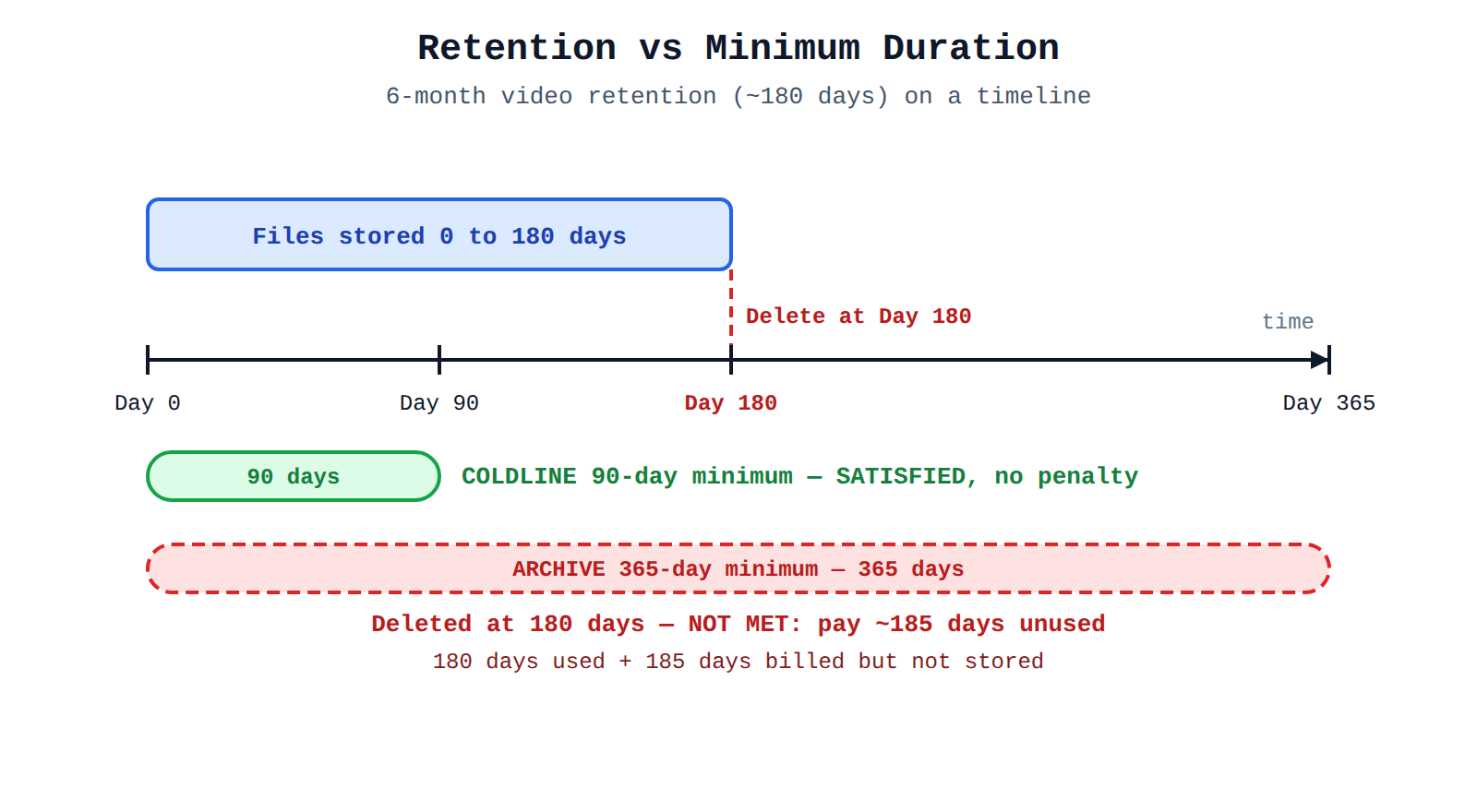
Key advantages and capabilities
- Very low at-rest storage cost: Significantly cheaper per gigabyte per month than both Standard and Nearline storage.
- Millisecond access latency: Provides rapid, online access to data without offline restoration delays.
- High durability: Guarantees 99.999999999% (11 nines) annual durability across all storage locations.
- Predictable lifecycle fit: Pairs seamlessly with Object Lifecycle Management to transition or delete objects once the 90-day threshold and 6-month retention window are met.
Why this is optimal
Selecting a storage class requires balancing at-rest storage rates, retrieval/operational fees, and minimum storage duration. Coldline storage hits the exact sweet spot for a 6-month retention strategy with quarterly access: it captures deeper storage discounts than Standard and Nearline storage while avoiding the 365-day minimum duration charge that Archive storage would impose on files deleted after 6 months.
Archive storage, because it offers the lowest at-rest storage rate and only requires a 90-day minimum storage duration
Archive storage, because it offers the lowest at-rest storage rate and only requires a 90-day minimum storage duration
What Archive storage is
Archive storage (ARCHIVE) is the coldest, lowest-cost storage class in Cloud Storage, built for long-term data archiving, online backup, and disaster recovery. It is designed for data accessed less than once a year and enforces a 365-day minimum storage duration along with the highest fees for data retrieval and Class A and Class B operations.
Why it doesn't meet the requirement
- Incorrect minimum storage duration: Archive storage requires a 365-day minimum storage duration, not a 90-day duration.
- Early deletion cost penalty: Because the company deletes the video files after 6 months (roughly 180 days), storing them in Archive storage would trigger an early deletion charge covering the remaining ~185 days of the 365-day minimum duration.
- High access and operation costs: Accessing or modifying the files once a quarter in Archive storage would incur the highest per-gigabyte retrieval and operational rates, eroding the savings from the lower at-rest rate.
Key characteristics and limitations
- 365-day minimum storage duration: Every object stored in Archive storage is billed for at least one full year of storage.
- Highest retrieval and operation fees: Carries the highest costs for reading data and executing Class A and Class B operations.
- Lowest at-rest storage price: Offers the lowest monthly per-gigabyte rate for long-term retention.
- Millisecond retrieval: Unlike tape-based archival tiers from other providers, data remains available within milliseconds.
This answer would be correct if
This option would be appropriate if the company needed to retain completed project files for at least 1 year (such as multi-year legal or regulatory compliance archives) and planned to access them less than once a year.
Additional context
A common misconception in cloud cost management is choosing Archive storage solely by looking at the per-gigabyte monthly storage price. Both access frequency and retention duration must be evaluated to prevent unexpected early deletion and retrieval charges.
Nearline storage, because it provides the lowest at-rest storage cost for data accessed less than once a quarter
Nearline storage, because it provides the lowest at-rest storage cost for data accessed less than once a quarter
What Nearline storage is
Nearline storage (NEARLINE) is a low-cost, highly durable storage class designed for infrequently accessed data that is read or modified on average once per month or less. It lowers the monthly at-rest storage rate compared to Standard storage in exchange for a 30-day minimum storage duration and per-gigabyte data retrieval fees.
Why it doesn't meet the requirement
- Quarterly access pattern: While Nearline storage is cheaper than Standard storage, it does not provide the lowest at-rest storage cost for data accessed at most once a quarter.
- Suboptimal cost savings: Because the media files are retained for 6 months and accessed only once every three months, leaving them in Nearline storage means paying a higher monthly at-rest storage rate than necessary compared to colder storage tiers.
Key characteristics and limitations
- 30-day minimum storage duration: Objects are billed for at least 30 days of storage even if they are deleted, overwritten, or transitioned earlier.
- Moderate storage and access costs: Features lower at-rest storage pricing than Standard storage, but higher at-rest storage pricing than Coldline and Archive storage.
- Retrieval and operation fees: Incurs data retrieval charges and higher Class A and Class B operation costs than Standard storage.
- Slightly lower availability: Provides a 99.9% availability SLA in multi-regions and dual-regions, and 99.0% in single regions.
This answer would be correct if
This option would be the optimal choice if the project files were accessed roughly once a month for monthly reporting or analysis, or if they were retained for only 30 to 60 days before deletion.
Additional context
In Cloud Storage, each step toward a colder tier reduces the at-rest storage cost while increasing retrieval fees, operation fees, and the minimum storage duration. For workloads accessed less than once a quarter, Coldline or Archive storage is more economical than Nearline.
Try 10 interactive questions like this one, free
Answer them yourself and get your score the moment you finish. No account needed.
Full access includes
- 3,070 practice questions across all 6 exam domains
- Every answer explained: why it is right, and why the others are not
- Scout, an AI tutor that answers your follow-up questions
- Readiness tracking by domain, so you know when to book the exam
Related free sample questions
Keep the momentum going with these hand-picked practice scenarios
FundamentalCloud Digital Leader
Cloud Storage Archive Class Millisecond Access
Differentiate between storage classes in Cloud Storage regarding cost and frequency of access, including: Standard, Nearline, Coldline, and Archive.
FundamentalCloud Digital Leader
Coldline 90-Day Minimum Storage Duration
Differentiate between storage classes in Cloud Storage regarding cost and frequency of access, including: Standard, Nearline, Coldline, and Archive.
FundamentalCloud Digital Leader
Google AI Principles Responsible AI Practices
Discuss the importance of explainable and responsible AI
FundamentalCloud Digital Leader
Regional Persistent Disks Synchronous Replication
Discuss the fundamental concepts of modern operations, reliability, and resilience in the cloud.
FundamentalCloud Digital Leader
Cloud Agility and Technical Flexibility
Describe how transitioning to a cloud infrastructure affects flexibility, scalability, reliability, elasticity, agility, and total cost of ownership (TCO). Apply these concepts to various business use cases.
IntermediateProfessional Cloud Database Engineer
Cloud SQL Spend-Based CUDs
Analyze the cost of running database solutions in Google Cloud (comparative analysis)
Last updated