Fundamental
Prepare and test your skills
Fundamental
Prepare and test your skills
Portable Apps and Unified Toolchains on Google Cloud
Free sample question with answers and detailed explanation below. The Cloud Digital Leader practice bank has an additional 3,070 practice questions.Try 10 free realistic questions: instant score, no credit card, and no account required.
A retail organization is modernizing its software development workflows on Google Cloud. Leadership wants to achieve two primary business transformation outcomes:
- Operational freedom: Prevent vendor lock-in and run applications portably across on-premises and cloud environments.
- Cross-team collaboration: Empower distributed teams to innovate together using consistent toolchains and shared development environments.
Which strategy should the organization adopt to meet these objectives?
Explanations
Use Transfer Appliance to synchronize code repositories and application updates across distributed engineering teams
Use Transfer Appliance to synchronize code repositories and application updates across distributed engineering teams
What Transfer Appliance is
Transfer Appliance is a high-capacity, rackable physical storage server provided by Google Cloud. It is designed to help organizations securely capture and ship massive volumes of data—ranging from hundreds of terabytes up to 1 petabyte—from an on-premises facility to Cloud Storage when network bandwidth is limited or unreliable.
Why it doesn't meet the requirement
- Operational freedom: Transfer Appliance is a physical data-shipping mechanism, not an architectural platform or open-source runtime that makes applications portable across hybrid or multicloud environments.
- Cross-team collaboration: Modern software collaboration relies on real-time, cloud-connected tools such as Developer Connect, Cloud Workstations, and automated CI/CD pipelines. Physically shipping hardware appliances between locations introduces weeks of delay and cannot synchronize live code repositories among distributed developers.
Key characteristics and limitations
- Bulk data migration focus: Built specifically for large-scale, one-time data transfers rather than continuous software delivery or daily team workflows.
- Physical transit latency: Requires ordering the hardware, loading data locally, and shipping the appliance back to Google for ingestion.
- No compute abstraction: Moves raw files and datasets into Cloud Storage without providing container orchestration or cross-environment compatibility.
- Bandwidth preservation: Prevents large migrations from saturating corporate internet connections during business hours.
This answer would be correct if
The organization needed to migrate hundreds of terabytes of historical archival video or scientific dataset files from an on-premises data center with slow internet connectivity into Google Cloud without disrupting daily network operations.
Additional context
For ongoing code synchronization and collaborative application development, teams should connect their source code management systems using Developer Connect and automate builds with Cloud Build rather than using physical migration hardware.
Transition all workloads to an Infrastructure as a Service (IaaS) model so Google Cloud manages all application code and data security
Transition all workloads to an Infrastructure as a Service (IaaS) model so Google Cloud manages all application code and data security
What Infrastructure as a Service (IaaS) and the shared responsibility model are
Infrastructure as a Service (IaaS) provides on-demand virtualized computing, storage, and networking resources, such as Compute Engine virtual machines. In Google Cloud, security and operational duties are governed by the shared responsibility model, which defines which tasks Google handles and which tasks remain with the customer across IaaS, Platform as a Service (PaaS), and Software as a Service (SaaS) offerings.
Why it doesn't meet the requirement
- Inaccurate responsibility allocation: In an IaaS model, Google Cloud is responsible only for securing the underlying physical hardware, storage, and network infrastructure. The customer remains fully responsible for managing the guest operating system, middleware, application code, configuration settings, and customer data.
- Operational freedom and collaboration: Moving workloads onto raw IaaS virtual machines increases manual maintenance burdens (such as OS patching) and does not inherently provide cross-environment container portability or unified collaborative toolchains.
Key characteristics and limitations
- Provider scope in IaaS: Google secures physical data centers, custom server hardware, storage media, and global networking.
- Customer scope in IaaS: Customers must secure and manage guest operating systems, network firewall rules, application deployments, identity access, and data usage.
- Higher management overhead: Requires more hands-on administration compared to managed platforms like Google Kubernetes Engine (GKE) or serverless compute.
- Data ownership principle: Across all cloud service models (IaaS, PaaS, and SaaS), securing customer data and controlling access always remains the customer's responsibility.
This answer would be correct if
The question asked which cloud service model requires the customer to manage guest operating systems and application stacks while relying on Google Cloud solely for physical hardware, storage, and network security.
Additional context
When organizations want to reduce administrative effort so teams can focus on innovation and collaboration, they typically adopt managed services and open-source-compatible platforms rather than relying solely on unmanaged IaaS instances.
Require engineers to provision and configure all cloud infrastructure exclusively through the Google Cloud mobile app
Require engineers to provision and configure all cloud infrastructure exclusively through the Google Cloud mobile app
What the Google Cloud mobile app does
The Google Cloud mobile app is a portable companion interface for iOS and Android devices that connects to a user's Google Cloud environment. It enables administrators and engineers to view service metrics, receive real-time alerts, triage incidents, and perform basic resource actions while away from their desks.
Why it doesn't meet the requirement
- Operational freedom: Operational freedom in the cloud includes giving teams the flexibility to interact with resources using the tools that best fit their workflows—such as Terraform, the Google Cloud CLI, Cloud Client Libraries, or the web-based Google Cloud console. Forcing exclusive use of a mobile app removes programmatic automation and Infrastructure as Code (IaC) capabilities.
- Cross-team collaboration: The mobile app is not designed for collaborative coding, complex resource provisioning, or shared pipeline management. Distributed teams need full-featured environments like Cloud Workstations, Cloud Shell Editor, and Cloud Code to build and innovate together.
Key characteristics and limitations
- Optimized for incident triage: Best suited for on-the-go monitoring, viewing Cloud Monitoring dashboards, and responding to urgent operational alerts.
- Limited configuration depth: Does not support complex architectural provisioning, detailed policy authoring, or multi-file code editing.
- Complementary interface: Intended to supplement—not replace—the web-based Google Cloud console and command-line developer tools.
- Individual device interaction: Operates on personal mobile devices rather than providing a shared, version-controlled infrastructure workflow.
This answer would be correct if
An on-call site reliability engineer needed a convenient mobile tool to check system health, review active incident alerts, and restart a stalled virtual machine while commuting or away from a computer.
Additional context
To modernize workflows effectively, organizations allow teams to mix and match interfaces—using Cloud Code in their IDEs, Google Cloud CLI in automated scripts, and the Google Cloud console for visual administration.
Adopt open-source-compatible services like Google Kubernetes Engine (GKE) alongside standardized, cloud-hosted toolchains
Adopt open-source-compatible services like Google Kubernetes Engine (GKE) alongside standardized, cloud-hosted toolchains
What open-source compatibility and standardized toolchains are
Google Cloud delivers operational freedom and cross-team collaboration by combining scalable, open-source-aligned infrastructure with connected developer and productivity tools. Services such as Google Kubernetes Engine (GKE), Cloud SQL, Bigtable, and Dataflow are built to be compatible with widely adopted open-source technologies like Kubernetes, PostgreSQL, Apache HBase, and Apache Beam. Alongside these services, tools like Cloud Workstations, Cloud Build, and Developer Connect provide unified environments for building and deploying software.
How it meets the requirements
- Operational freedom: Containerizing applications with Kubernetes and managing infrastructure with open tools like Terraform abstracts away underlying environment differences. Organizations avoid vendor lock-in and retain the freedom to run workloads across on-premises data centers, Google Cloud, or multicloud environments while scaling resources on demand.
- Cross-team collaboration: Establishing a common toolchain and standardized, cloud-hosted development environments ensures that distributed engineering, security, and operations teams work from the same configurations, binaries, and deployment pipelines. This consistency breaks down silos and accelerates collective innovation.
Portable Containers with Shared Toolchain
System Architecture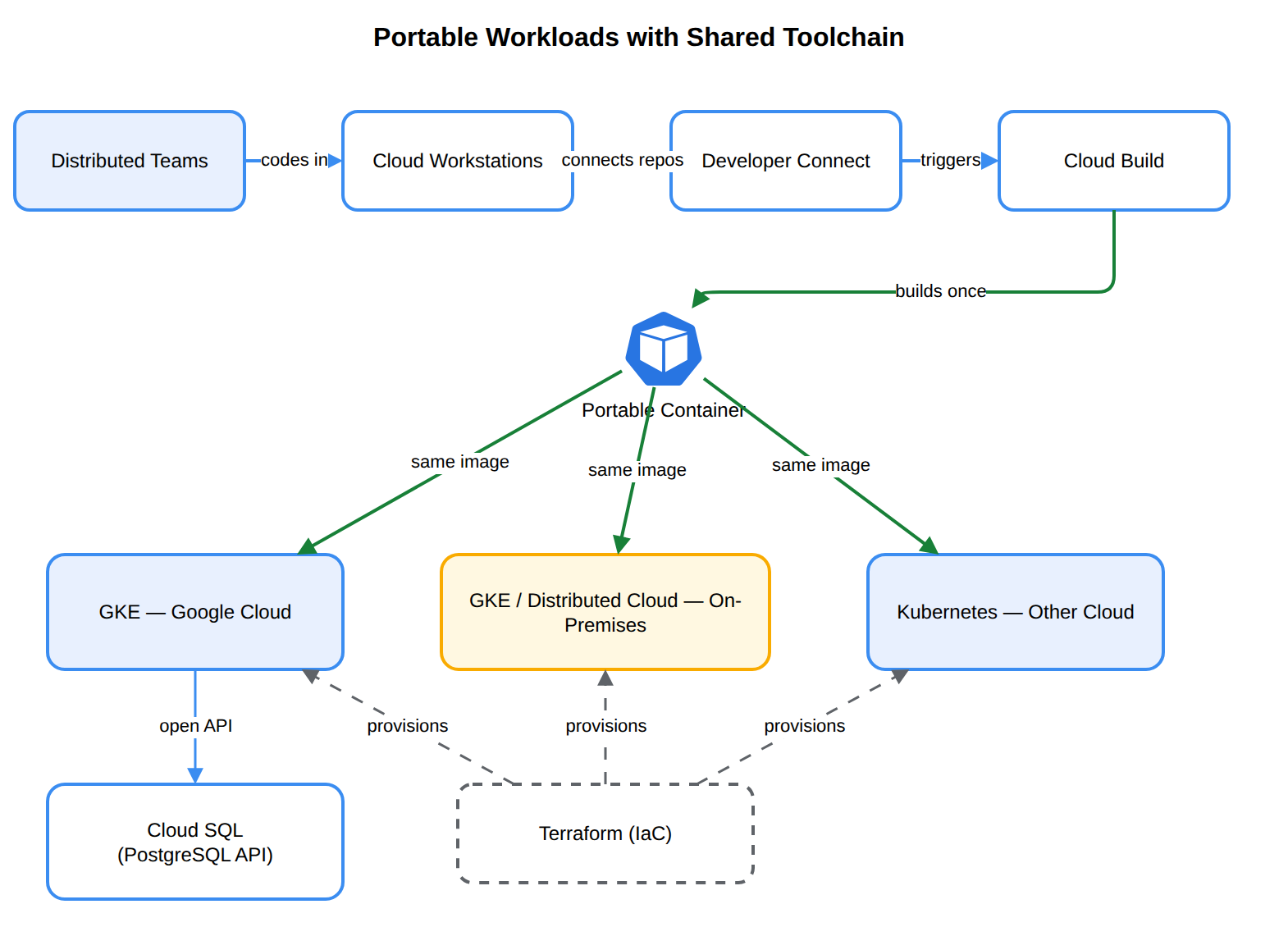
Key advantages and capabilities
- Workload portability: Containers and open standards allow applications to move seamlessly between hybrid and multicloud environments.
- Ecosystem flexibility: Native support for open-source databases, analytics frameworks, and Infrastructure as Code (IaC) lets teams use familiar skills and tools.
- Unified CI/CD workflows: Connected build and deployment pipelines validate code automatically, reducing errors and speeding up release cycles.
- Reduced administrative overhead: Managed equivalents of open-source systems free engineers from routine maintenance so they can focus on experimentation.
- Consistent security and governance: Standardized development environments keep code and configurations aligned with organizational policies.
Why this is optimal
Unlike proprietary architectures or manual operational processes that trap workloads in a single environment and isolate teams, pairing open technologies with standardized cloud toolchains maximizes both architectural flexibility and team productivity.
Try 10 interactive questions like this one, free
Answer them yourself and get your score the moment you finish. No account needed.
Full access includes
- 3,070 practice questions across all 6 exam domains
- Every answer explained: why it is right, and why the others are not
- Scout, an AI tutor that answers your follow-up questions
- Readiness tracking by domain, so you know when to book the exam
Related free sample questions
Keep the momentum going with these hand-picked practice scenarios
FundamentalCloud Digital Leader
Google Cloud Trust and Sustainability Benefits
Describe the main business transformation benefits of Google Cloud: intelligence, freedom, collaboration, trust, and sustainability.
FundamentalCloud Digital Leader
Hybrid Cloud Bursting
Discuss the reasons and use cases for why organizations choose a hybrid cloud or multi-cloud strategy.
FundamentalCloud Digital Leader
Business Value-Driven AI Approach
Discuss the main data value chain concepts and terms.
FundamentalCloud Digital Leader
Regional Multi-Zone Deployment with Edge POPs
Define basic network infrastructure terminology, including: IP address; internet service provider (ISP); domain name server (DNS), regions, and zones; fiber optics; subsea cables; network edge data centers, latency; and bandwidth.
FundamentalCloud Digital Leader
API Specification Components
Define application programming interface (API).
FundamentalAssociate Data Practitioner
Dataform for BigQuery SQL Transformations
Select a data transformation tool (e.g., Dataproc, Dataflow, Cloud Data Fusion, Cloud Composer, Dataform) based on business requirements
Last updated