Fundamental
Prepare and test your skills

Fundamental
Prepare and test your skills
Curation Quality Checks and Lineage for Trusted Data
Free sample question with answers and detailed explanation below. The Cloud Digital Leader practice bank has an additional 3,070 practice questions.Try 10 free realistic questions: instant score, no credit card, and no account required.
A retail company wants to use machine learning (ML) to forecast inventory demand, but business stakeholders do not trust the organization's current analytical reports. A review of their data environment reveals several underlying challenges:
- Different departments use conflicting definitions for key business metrics.
- Datasets frequently contain missing, unverified, or inaccurate values.
- Data scientists cannot trace the origin or transformations of the data used to train their models.
How does implementing a data governance framework in Google Cloud solve these challenges and drive reliable ML outcomes?
Explanations
It requires consolidating all distributed datasets into a single physical storage location to eliminate redundancy before any analysis can occur.
It requires consolidating all distributed datasets into a single physical storage location to eliminate redundancy before any analysis can occur.
What Data Consolidation vs. Unified Data Fabric Is
Traditional data management often relied on physically moving and consolidating all organizational data into a single monolithic repository. However, modern cloud data governance in Google Cloud uses Knowledge Catalog and BigQuery as an intelligent data fabric and lakehouse runtime catalog. This approach logically unifies distributed data across multiple storage systems without requiring physical consolidation.
Why It Doesn't Meet the Requirements
First, Google Cloud data governance explicitly avoids the need to consolidate distributed datasets into one place. Second, merely moving files into a single storage location does nothing to fix missing values, conflicting departmental definitions, or untracked transformations. Moving inaccurate data into a centralized repository simply creates a centralized collection of untrustworthy data.
Key Characteristics and Limitations
- Govern data in place: Services like Knowledge Catalog automatically extract metadata from distributed sources—such as BigQuery, Cloud SQL, Spanner, and Cloud Storage—without duplicating or moving the underlying data.
- Single schema across engines: A lakehouse runtime catalog allows multiple processing engines (like BigQuery and Apache Spark) to query a single copy of data without duplication.
- Storage vs. Stewardship: Physical storage consolidation is an infrastructure architecture decision, whereas data accuracy and consistency require active curation, profiling, and quality rules.
This Answer Would Be Correct If
Consolidating data into a single location is not a requirement for Google Cloud data governance; however, physically migrating data might be appropriate if an organization wanted to decommission legacy on-premises hardware to reduce local maintenance costs.
Additional Context
By governing distributed data in place through logical data lakes and zones, organizations reduce the cost and complexity of maintaining duplicate copies while still enforcing centralized access controls, quality scans, and metadata standards.
It provides data curation capabilities like a business glossary, automated data quality checks, and data lineage to ensure data is accurate, consistent, and traceable.
It provides data curation capabilities like a business glossary, automated data quality checks, and data lineage to ensure data is accurate, consistent, and traceable.
What a Data Governance Framework is
A data governance framework is a structured set of policies, procedures, roles, and technologies designed to manage data throughout its entire lifecycle. In Google Cloud, built-in governance capabilities within BigQuery and Knowledge Catalog empower data stewards and administrators to discover, curate, monitor, and govern organizational data and artificial intelligence (AI) assets at scale.
How it Meets the Requirements
Implementing a robust data governance framework directly resolves each of the retail company's trust and reliability issues:
- Resolving conflicting definitions: Using a business glossary in Knowledge Catalog allows data stewards to define standardized organizational terminology and attach those terms directly to data asset fields, ensuring consistent interpretation across all departments.
- Eliminating inaccurate values: Administrators can configure automated data quality checks and data profiling across tables in BigQuery and Cloud Storage to continuously validate schemas, catch missing values, and enforce ongoing quality controls.
- Verifying data origins: Data lineage tracks how data moves through systems at the table and column levels—recording where it originates, where it flows, and what transformations are applied—helping teams identify potential sources of error or bias before training ML models.
Automated Data Quality Checks Flow
Process Flow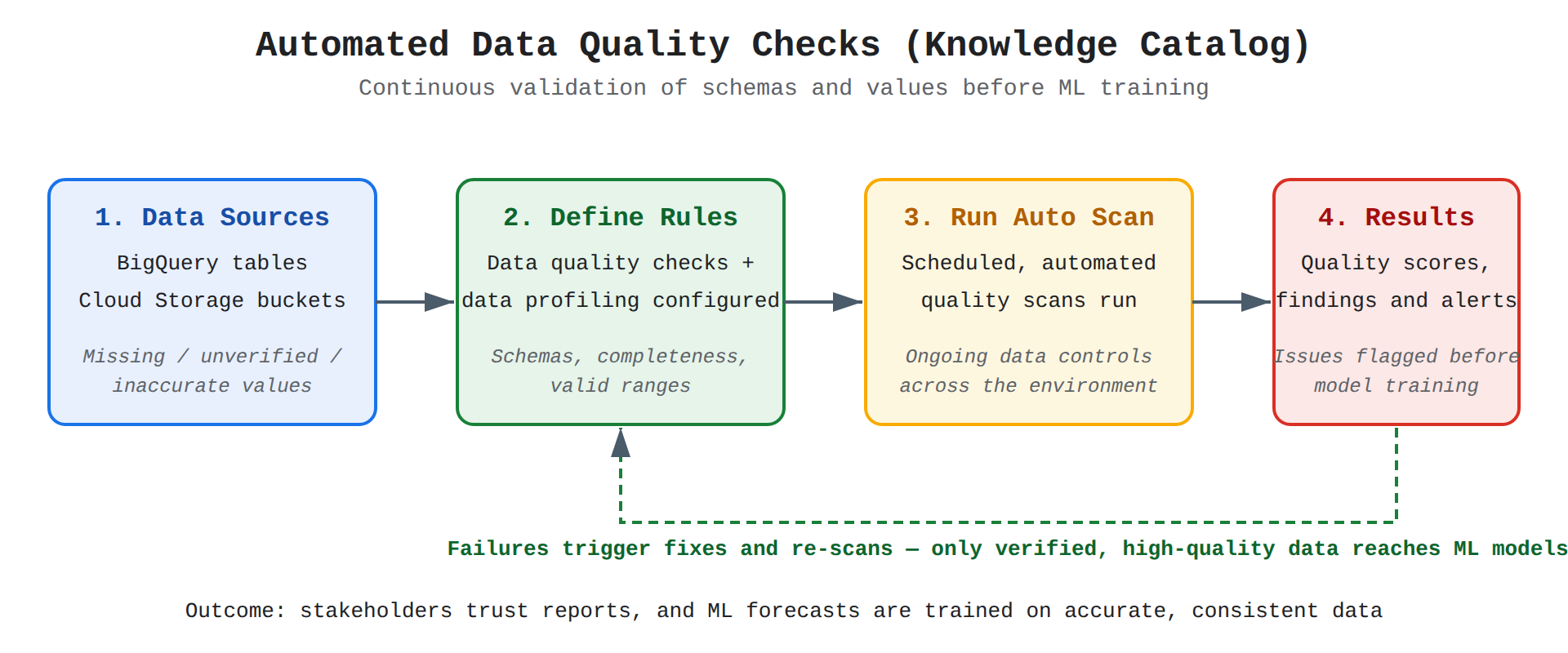
Key Advantages and Capabilities
- Foundational stakeholder trust: Ensuring data accuracy and consistency gives business leaders confidence in analytical reports and strategic insights.
- Superior ML outcomes: Proactively governing data guarantees that machine learning models are trained on relevant, high-quality, and verified datasets.
- Enhanced discoverability: Centralized metadata management enriches technical metadata with business context, making trusted datasets easy to search and reuse.
- Compliance and accountability: Clear governance policies ensure data is utilized consistently and in strict alignment with organizational standards.
Why This is Optimal
Unlike infrastructure monitoring or deployment automation tools that focus on system performance and code delivery, a data governance framework addresses the root cause of unreliable analytics: poor data integrity. By combining curation, quality verification, and lineage tracking, the organization establishes the foundational trust required for informed business decision-making and accurate ML forecasting.
It automates the building, testing, and deployment of machine learning code using Cloud Build and Artifact Registry to prevent manual deployment errors.
It automates the building, testing, and deployment of machine learning code using Cloud Build and Artifact Registry to prevent manual deployment errors.
What CI/CD for Machine Learning Does
Continuous Integration and Continuous Delivery (CI/CD) is a core MLOps practice that automates the software engineering lifecycle of machine learning applications. By using Cloud Build and Artifact Registry, engineering teams can create automated pipelines that compile code, package container images, run software tests, and deploy ML models into production environments.
Why It Doesn't Meet the Requirements
While CI/CD pipelines prevent manual errors during software deployment, they do not address underlying data governance, data accuracy, or semantic consistency across business departments. Automating the deployment of a model that was trained on inaccurate, unverified, or inconsistently defined data will simply accelerate the delivery of unreliable predictions, failing to build trust with business stakeholders.
Key Characteristics and Limitations
- Focuses on code and artifacts: Manages application code, container images, and model binaries rather than curating business metadata or validating raw dataset accuracy.
- Operational efficiency: Minimizes the operational costs and delays associated with manual software interventions during model releases.
- Lacks business context: Does not provide a business glossary to align departmental metric definitions or data lineage to audit historical data transformations.
This Answer Would Be Correct If
This option would be the right choice if the organization already had high-quality, trusted datasets, but struggled with slow, error-prone manual processes when packaging and deploying trained ML models into production.
Additional Context
A common misconception is conflating MLOps deployment automation with data governance. While both are critical to a mature AI strategy, MLOps focuses on streamlining the operational lifecycle of models, whereas data governance establishes the foundational data integrity required before model training even begins.
It uses Cloud Monitoring and TensorBoard to profile model training bottlenecks and establish resource quota thresholds for cost optimization.
It uses Cloud Monitoring and TensorBoard to profile model training bottlenecks and establish resource quota thresholds for cost optimization.
What Performance Profiling and Monitoring Do
Cloud Monitoring and TensorBoard are observability and performance profiling tools used during machine learning experimentation and production operations. They track infrastructure resource utilization, training duration, inference latency, and computational bottlenecks, helping teams align their workloads with project quotas and cost-benefit thresholds.
Why It Doesn't Meet the Requirements
Tracking infrastructure metrics and computational bottlenecks does not validate the integrity, accuracy, or consistency of the underlying business data. If a retail forecasting model is trained on datasets with missing values and conflicting metric definitions, optimizing its training speed or CPU utilization will not make its business predictions any more accurate or trustworthy.
Key Characteristics and Limitations
- Infrastructure and model telemetry: Focuses on system metrics like CPU/GPU usage, memory consumption, training time, and inference latency.
- Cost optimization: Helps engineering teams identify diminishing returns when scaling hardware resources so they can stay within budget and quota limits.
- No metadata or quality curation: Cannot standardize business terminology across departments, run data quality scans on storage tables, or map column-level data lineage.
This Answer Would Be Correct If
This approach would be correct if the company's primary challenge was excessive cloud spending caused by inefficient hardware utilization and long training times during ML model experimentation.
Additional Context
While monitoring model performance in production is an important practice for maintaining operational efficiency, it operates downstream of data governance. Stakeholders can only trust ML outcomes when the input data is governed, verified, and consistent from the very beginning of the data journey.
Try 10 interactive questions like this one, free
Answer them yourself and get your score the moment you finish. No account needed.
Full access includes
- 3,070 practice questions across all 6 exam domains
- Every answer explained: why it is right, and why the others are not
- Scout, an AI tutor that answers your follow-up questions
- Readiness tracking by domain, so you know when to book the exam
Related free sample questions
Keep the momentum going with these hand-picked practice scenarios
FundamentalCloud Digital Leader
Sensitive Data Protection De-identification
Explain how data governance is essential to a successful data journey.
FundamentalCloud Digital Leader
Knowledge Catalog Data Lineage
Explain how data governance is essential to a successful data journey.
FundamentalCloud Digital Leader
Google Front End Edge Protection
Discuss fundamental cloud security concepts.
FundamentalCloud Digital Leader
Pub/Sub Dataflow BigQuery Streaming Pipeline
Describe how streaming analytics in real-time makes data more useful and generates business value.
FundamentalCloud Digital Leader
Confidential Computing Data In Use
Describe the importance of control, compliance, confidentiality, integrity, and availability in a cloud security model.
AdvancedProfessional Data Engineer
Apache Beam MLTransform Artifact Reuse
Preparing data for feature engineering, training and serving machine learning models (e.g., BigQueryML)
Last updated