Fundamental
Prepare and test your skills
Fundamental
Prepare and test your skills
Serverless Streaming Analytics With Pub/Sub and Dataflow
Free sample question with answers and detailed explanation below. The Cloud Digital Leader practice bank has an additional 3,070 practice questions.Try 10 free realistic questions: instant score, no credit card, and no account required.
A retail organization wants to build an automated, real-time streaming analytics pipeline on Google Cloud to capture customer interactions and store IoT sensor events. To generate immediate business insights, the architecture must fulfill three core responsibilities:
- Ingestion: Asynchronously ingest and distribute continuous streams of incoming JSON event messages.
- Processing: Continuously process and transform the streaming message data in real time.
- Analytics: Store the transformed results and run analytic queries on large datasets.
How should the organization combine Google Cloud services to fulfill these roles?
Explanations
Use BigQuery Data Transfer Service to ingest continuous IoT sensor streams, Dataform to transform the raw events in transit, and Pub/Sub to store the datasets for analysis
Use BigQuery Data Transfer Service to ingest continuous IoT sensor streams, Dataform to transform the raw events in transit, and Pub/Sub to store the datasets for analysis
What BigQuery Data Transfer Service, Dataform, and Pub/Sub Do
BigQuery Data Transfer Service is a no-code tool that automates scheduled or ad hoc data movement from SaaS applications into BigQuery. Dataform is an orchestration and version-control tool that helps data teams build SQL pipelines inside BigQuery after data has already been loaded. Pub/Sub is a real-time asynchronous messaging service rather than an analytical data warehouse.
Why It Doesn't Meet the Requirements
- Ingestion limitation: BigQuery Data Transfer Service operates on a scheduled or ad hoc basis to import batch data from supported SaaS sources (such as Google Ads or external cloud storage), making it unsuitable for ingesting continuous, sub-second IoT sensor streams.
- Processing limitation: Dataform executes ELT (Extract, Load, Transform) SQL transformations on tables already residing inside BigQuery, rather than transforming raw streaming JSON messages in transit.
- Analytics limitation: Pub/Sub provides temporary message retention for event distribution and cannot store structured analytical tables or execute SQL queries.
Key Characteristics and Limitations
- BigQuery Data Transfer Service: Automates batch ingestion at scale without code on recurring schedules.
- Dataform: Manages in-warehouse SQL table transformations, dependency graphs, and data quality assertions.
- Pub/Sub: Buffers and routes real-time messages between decoupled microservices and pipelines.
This Answer Would Be Correct If
BigQuery Data Transfer Service and Dataform would be appropriate if the organization wanted to run a scheduled batch ELT workflow—such as importing daily marketing performance reports into BigQuery on a recurring schedule and then using Dataform to run SQL transformations inside BigQuery to build reporting tables.
Use Pub/Sub to ingest and distribute the event messages, Dataflow to transform the streaming data, and BigQuery to store the results and run analytic queries
Use Pub/Sub to ingest and distribute the event messages, Dataflow to transform the streaming data, and BigQuery to store the results and run analytic queries
What the Pub/Sub, Dataflow, and BigQuery Architecture Is
Combining Pub/Sub, Dataflow, and BigQuery forms Google Cloud's foundational serverless architecture for real-time streaming analytics. Each service handles a distinct stage of the data lifecycle—messaging ingestion, stream transformation, and analytical warehousing—allowing organizations to turn continuous raw event streams into immediate, actionable business insights without managing underlying infrastructure.
How It Meets the Requirements
- Ingestion with Pub/Sub: Pub/Sub acts as the front-door asynchronous messaging service that ingests and distributes high-volume data streams from decoupled sources, such as mobile user interactions, server events, and IoT devices.
- Processing with Dataflow: Dataflow subscribes to the Pub/Sub stream, continuously reading incoming JSON messages and applying User-Defined Functions (UDFs) or Apache Beam transformations to clean, enrich, deduplicate, and aggregate the data in flight.
- Analytics with BigQuery: Dataflow writes the structured, transformed records directly into BigQuery, a serverless enterprise data warehouse where analysts and business intelligence tools can immediately execute fast SQL analytic queries across massive datasets.
Key Advantages and Capabilities
- End-to-end serverless scaling: All three services automatically scale compute and storage resources up or down to match fluctuating event volumes.
- Decoupled reliability: Pub/Sub buffers incoming messages durably, protecting downstream processing pipelines from sudden traffic spikes or producer outages.
- Unified batch and stream processing: Dataflow uses the Apache Beam programming model to guarantee exactly-once processing and handle late-arriving data accurately.
- Real-time business value: Streaming data directly into BigQuery eliminates batch waiting periods, enabling instant operational dashboards and anomaly detection.
Pub/Sub Buffer Absorbs Bursts, Protects Pipeline
Process Flow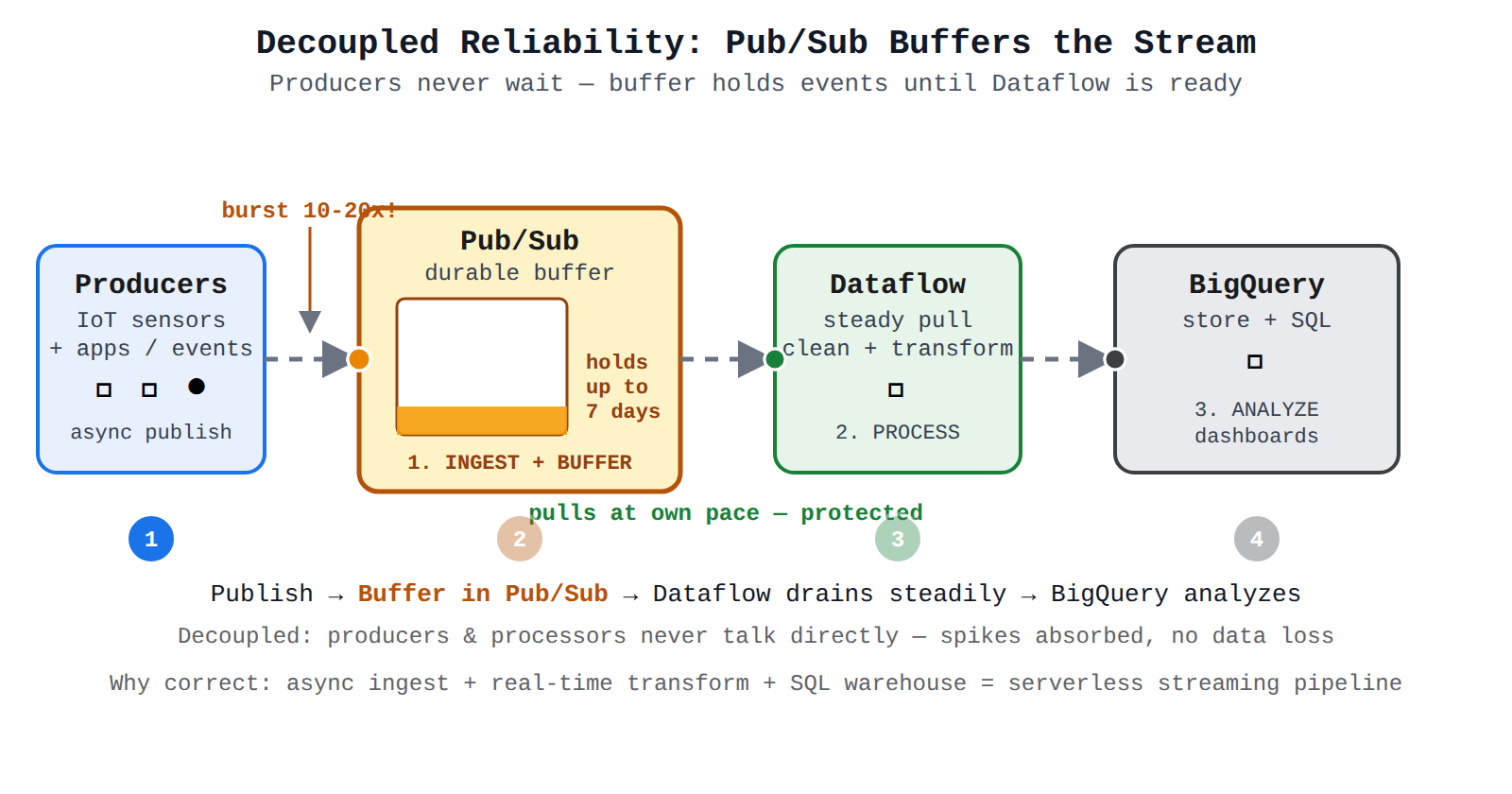
Why This Is Optimal
Unlike batch-oriented or schedule-driven architectures that introduce delays between data generation and analysis, the Pub/Sub to Dataflow to BigQuery pipeline processes events continuously as they occur. This integration provides an automated, highly reliable, and scalable foundation tailored specifically for real-time enterprise analytics.
Use Dataflow as an asynchronous messaging tool to ingest events, Pub/Sub to transform the data in transit, and BigQuery to store and query the datasets
Use Dataflow as an asynchronous messaging tool to ingest events, Pub/Sub to transform the data in transit, and BigQuery to store and query the datasets
What These Services Actually Do
While this option selects the right three services for a streaming pipeline, it reverses the core architectural roles of Pub/Sub and Dataflow. In Google Cloud's data analytics ecosystem, Pub/Sub is the asynchronous messaging tool responsible for event ingestion and distribution, whereas Dataflow is the serverless data processing service responsible for transforming data streams.
Why It Doesn't Meet the Requirements
- Ingestion mismatch: Dataflow is an execution engine for Apache Beam data pipelines rather than a message broker or event bus. It does not act as an asynchronous messaging queue for external IoT devices or mobile applications to publish events into.
- Processing mismatch: Pub/Sub is designed to ingest, retain, and deliver messages reliably between decoupled systems, not to execute complex User-Defined Functions (UDFs), windowing aggregations, or data enrichment transformations.
Key Characteristics and Limitations
- Pub/Sub focus: Specializes in durable, low-latency message ingestion, topic-based publishing, and subscription-based delivery at global scale.
- Dataflow focus: Specializes in executing parallel ETL (Extract, Transform, Load) pipelines, handling duplicate records, and transforming streaming or batch datasets.
- BigQuery focus: Correctly identified here as the analytical data warehouse, though it relies on Dataflow (or direct storage writes) to receive properly transformed streaming data.
This Answer Would Be Correct If
This option would be valid only if the roles of Pub/Sub and Dataflow were swapped so that Pub/Sub handled the asynchronous event ingestion from mobile and IoT sources and Dataflow executed the real-time JSON message transformations before loading the data into BigQuery.
Additional Context
A common misconception when learning cloud analytics architectures is confusing message streaming with stream processing. Pub/Sub moves messages from point A to point B reliably, while Dataflow inspects and transforms the contents of those messages along the way.
Use Cloud Scheduler to ingest continuous event streams at fixed intervals, Cloud Tasks to transform and aggregate the streaming data, and Dataflow to store the final tables for SQL analytics
Use Cloud Scheduler to ingest continuous event streams at fixed intervals, Cloud Tasks to transform and aggregate the streaming data, and Dataflow to store the final tables for SQL analytics
What Cloud Scheduler, Cloud Tasks, and Dataflow Do
Cloud Scheduler is a fully managed enterprise cron job scheduler that triggers operations at defined time intervals. Cloud Tasks is an asynchronous task distribution service used to manage background work queues and control API execution rates. Dataflow is a serverless data processing engine for batch and streaming pipelines, not a persistent database or data warehouse.
Why It Doesn't Meet the Requirements
- Ingestion failure: Cloud Scheduler is strictly time-driven and triggers batch jobs or infrastructure tasks on fixed schedules; it cannot ingest continuous, unpredictable streams of user interactions or IoT events.
- Processing failure: Cloud Tasks is designed to dispatch independent background tasks (such as sending an email or calling a slow API) outside a main application workload, not to perform continuous data stream transformations or aggregations.
- Analytics failure: Dataflow processes data in transit and outputs it to a sink like BigQuery or Cloud Storage; it does not store long-term analytical tables or provide a SQL query engine for business intelligence.
Key Characteristics and Limitations
- Cloud Scheduler: Triggers HTTP endpoints or Pub/Sub messages on defined cron intervals.
- Cloud Tasks: Manages point-to-point asynchronous task execution, retry policies, and rate limiting.
- Dataflow: Executes compute pipelines to transform data but relies on BigQuery for analytical storage and querying.
This Answer Would Be Correct If
Cloud Scheduler and Cloud Tasks would be the right choices if an application team needed to trigger a time-driven maintenance job every night at midnight (Cloud Scheduler) or offload slow, independent background API calls from a web application (Cloud Tasks).
Try 10 interactive questions like this one, free
Answer them yourself and get your score the moment you finish. No account needed.
Full access includes
- 3,070 practice questions across all 6 exam domains
- Every answer explained: why it is right, and why the others are not
- Scout, an AI tutor that answers your follow-up questions
- Readiness tracking by domain, so you know when to book the exam
Related free sample questions
Keep the momentum going with these hand-picked practice scenarios
FundamentalCloud Digital Leader
Real-Time Visibility Business Value
Describe how streaming analytics in real-time makes data more useful and generates business value.
FundamentalCloud Digital Leader
Real-Time Streaming Analytics Pipelines
Describe how streaming analytics in real-time makes data more useful and generates business value.
FundamentalCloud Digital Leader
Open Source Software vs Open Standards
Define the terms: cloud, cloud technology, data, digital transformation, cloud-native, open source, open standard.
FundamentalCloud Digital Leader
Cloud Modernization Competitive Advantage
Describe the implications and risks for organizations that do not adopt new technology.
FundamentalCloud Digital Leader
BigQuery Serverless Data Warehouse
Determine which Google Cloud data management products are applicable to different business use cases.
IntermediateProfessional Cloud Developer
Bigtable Reversed Row Key Design
Designing appropriate schemas for structured databases (e.g., AlloyDB, Spanner) and unstructured databases (e.g., Bigtable, Firestore)
Last updated