Fundamental
Prepare and test your skills

Fundamental
Prepare and test your skills
Identity Based Zero Trust for Google Cloud
Free sample question with answers and detailed explanation below. The Cloud Digital Leader practice bank has an additional 3,070 practice questions.Try 10 free realistic questions: instant score, no credit card, and no account required.
A global retail organization is migrating its IT infrastructure from a traditional on-premises data center to Google Cloud. In their legacy on-premises environment, the security architecture relied on the following practices:
- Filtering incoming traffic using physical hardware firewall appliances
- Defining a rigid physical network perimeter around corporate offices
- Automatically trusting any user or device already connected inside the internal network
How should the organization adapt its security strategy to align with Google Cloud's security model?
Explanations
Shift from trusting internal network locations to enforcing software-defined, identity-based access controls and explicit verification for every request
Shift from trusting internal network locations to enforcing software-defined, identity-based access controls and explicit verification for every request
What Identity-Centric, Software-Defined Security Is
Modern cloud security operates on a Zero Trust philosophy combined with software-defined infrastructure. Rather than relying on physical network boundaries (often called "castle-and-moat" security) and dedicated hardware appliances, Google Cloud uses software-defined controls—such as Identity and Access Management (IAM), Virtual Private Cloud (VPC) firewall rules, VPC Service Controls, and Google Cloud Armor—to secure resources dynamically across a global infrastructure.
How It Meets the Requirements
- Replaces hardware appliances with software-defined controls: Instead of routing traffic through physical boxes, administrators define security policies in software at the organization, folder, and VPC network levels, as well as at the global edge.
- Eliminates implicit network trust: Every access attempt is explicitly authenticated and authorized regardless of whether the user or service is inside or outside a specific network perimeter.
- Centers security on identity and context: Access decisions rely on strong identity verification—such as Multi-Factor Authentication (MFA) and Single Sign-On (SSO)—combined with granular policies that evaluate user roles, device posture, and location.
Key Capabilities and Advantages
- Explicit verification: Authenticates every user, device, and workload before granting access to cloud APIs or data.
- Principle of least privilege: Ensures users and service accounts receive only the exact permissions required to perform their designated tasks.
- Software-defined perimeters: Uses VPC Service Controls and strict egress firewall rules to establish virtual perimeters around sensitive services and prevent data exfiltration.
- Global edge protection: Leverages Google Front End (GFE) servers and Google Cloud Armor to absorb Distributed Denial-of-Service (DDoS) attacks and enforce web application security policies globally.
Zero Trust: Every Request Verified
Process Flow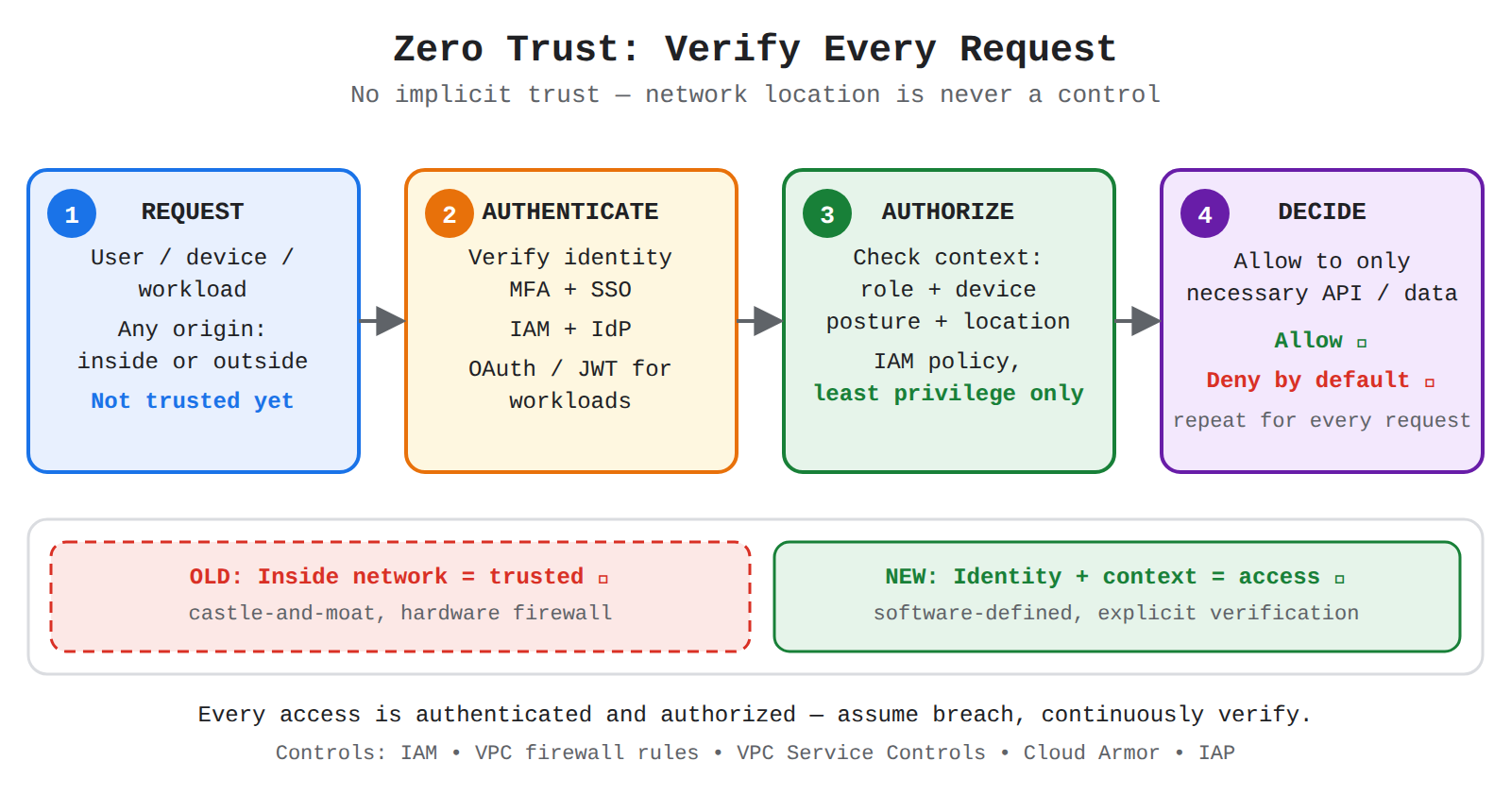
Why This Is Optimal
Traditional physical perimeters cannot effectively protect a globally distributed workforce accessing cloud applications from anywhere. By adopting software-defined, identity-centric controls, the organization achieves consistent, automated security that scales seamlessly across Google Cloud's global network while preventing lateral movement if a single credential is compromised.
Route all global user traffic through on-premises hardware appliances over the public internet before connecting to Google Cloud resources
Route all global user traffic through on-premises hardware appliances over the public internet before connecting to Google Cloud resources
What Traffic Backhauling Through On-Premises Hardware Is
Traffic backhauling (or hair-pinning) is a legacy networking practice where an organization forces all remote and cloud-bound network traffic to travel back to a centralized, on-premises data center for inspection by physical hardware appliances before forwarding it to cloud services.
Why It Doesn't Meet the Requirement
- Degrades global network security: When customer data travels across the public internet to reach an on-premises facility, it passes through multiple intermediate network paths known as hops. Each additional hop introduces a new opportunity for traffic to be intercepted or attacked.
- Undermines Google Cloud's global scale: Google Cloud's global network connects directly to most Internet Service Providers (ISPs) worldwide specifically to minimize hops across the public internet. Forcing traffic back to an on-premises appliance bypasses this direct edge protection.
- Maintains a legacy perimeter mindset: Relying on a physical inspection point fails to implement modern, identity-based access controls within the cloud environment itself.
Key Characteristics and Limitations
- Increased attack surface: More hops across the public internet increase exposure to bad actors and man-in-the-middle threats.
- Hardware capacity bottlenecks: Physical on-premises appliances have fixed throughput limits and can easily become single points of failure during traffic spikes or large DDoS attacks.
- High latency: Routing global users through a single physical data center degrades application performance compared to terminating traffic at the nearest Google Front End (GFE) location.
This Answer Would Be Correct If
The organization needed to inspect traffic exclusively destined for legacy servers that remain hosted inside their private on-premises data center rather than modernizing their security strategy for workloads migrated to Google Cloud.
Additional Context
Instead of backhauling traffic to physical hardware, organizations on Google Cloud use Google Cloud Armor and Google Front End (GFE) servers to detect and stop malicious requests and DDoS attacks right at the global network edge.
Rely on Google Cloud's physical data center safeguards, such as biometric access and perimeter fencing, to automatically authenticate application users
Rely on Google Cloud's physical data center safeguards, such as biometric access and perimeter fencing, to automatically authenticate application users
What Physical Data Center Security Is
Physical data center security encompasses the layered physical safeguards that Google deploys at its global facilities to protect server hardware and storage media. These controls include perimeter fencing, vehicle access barriers, metal detectors, biometrics, laser beam intrusion detection, and 24/7 monitoring by high-resolution cameras and security guards.
Why It Doesn't Meet the Requirement
- Confuses the Shared Responsibility Model: Cloud security is divided between the provider and the customer. While Google is responsible for protecting the underlying physical infrastructure (security of the cloud), the customer is always responsible for securing their own data, configurations, and user access (security in the cloud).
- Cannot authenticate remote network users: Physical barriers keep unauthorized people off the data center floor, but they play no role in verifying the identity of a remote employee or customer accessing a cloud application over the internet.
Key Characteristics and Limitations
- Strict physical isolation: Only a very small number of approved Google employees with specific roles are ever permitted to enter a data center floor.
- Hardware lifecycle protection: Includes rigorous equipment tracking via barcodes, full disk encryption (FDE), and physical shredding of retired storage drives.
- No logical access enforcement: Physical security controls cannot prevent unauthorized data access if a customer fails to configure proper IAM permissions or firewall rules.
This Answer Would Be Correct If
The question asked how Google Cloud fulfills its responsibility under the Shared Responsibility Model to prevent unauthorized physical tampering or theft of the underlying servers hosting customer workloads.
Additional Context
While Google handles physical security, hardware hardening, and custom Titan security chips at the infrastructure layer, customers must still implement logical, software-defined controls—such as Cloud Identity, MFA, and least-privilege IAM roles—to govern who can access their cloud applications and data.
Deploy dedicated physical firewall appliances inside Google Cloud data centers to recreate their traditional hardware-based perimeter
Deploy dedicated physical firewall appliances inside Google Cloud data centers to recreate their traditional hardware-based perimeter
What Physical Hardware Appliances Are
Physical firewall appliances are dedicated, rack-mounted hardware devices traditionally installed at the edge of an on-premises data center to inspect network packets, enforce access control lists, and separate trusted internal networks from untrusted external networks.
Why It Doesn't Meet the Requirement
- Incompatible with public cloud operations: Customers cannot ship, install, or manage their own physical hardware appliances inside Google Cloud data centers. Google designs and maintains its own purpose-built servers and networking equipment.
- Fails to modernize the security paradigm: Attempting to recreate a rigid, hardware-based perimeter ignores the fundamental cloud shift toward software-defined networking and identity-centric security.
Key Characteristics and Limitations
- Custom Google-managed hardware: Google data centers use custom-designed servers stripped of unnecessary components (like video cards or peripheral connectors) to reduce vulnerabilities, managed entirely by Google's proprietary orchestration software.
- Lack of cloud elasticity: Physical boxes require manual installation and fixed capacity planning, whereas cloud resources are dynamically allocated through software.
- Static perimeter limitations: Hardware firewalls focus on network IP addresses and physical ports rather than continuous verification of user identity, device health, and application context.
This Answer Would Be Correct If
The organization was migrating its servers to a traditional colocation facility (where customers rent physical rack space and provide their own servers, switches, and hardware firewalls) rather than adopting a public cloud platform.
Additional Context
In Google Cloud, traditional hardware appliances are replaced by globally scalable, software-defined services. Organizations enforce network segregation and perimeter security using VPC firewall rules, Shared VPC, VPC Service Controls, and Google Cloud Armor, all of which can be provisioned consistently using Infrastructure as Code (IaC).
Try 10 interactive questions like this one, free
Answer them yourself and get your score the moment you finish. No account needed.
Full access includes
- 3,070 practice questions across all 6 exam domains
- Every answer explained: why it is right, and why the others are not
- Scout, an AI tutor that answers your follow-up questions
- Readiness tracking by domain, so you know when to book the exam
Related free sample questions
Keep the momentum going with these hand-picked practice scenarios
FundamentalCloud Digital Leader
Cloud Audit Logs vs Security Command Center
Differentiate between cloud security and traditional on-premises security.
FundamentalCloud Digital Leader
Cloud Billing Reports Cost Visualization
Discuss how organizations can visualize their cost data by using Cloud Billing Reports.
FundamentalCloud Digital Leader
Hybrid Cloud Bursting
Discuss the reasons and use cases for why organizations choose a hybrid cloud or multi-cloud strategy.
FundamentalCloud Digital Leader
BigQuery and Looker Smart Analytics
Discuss how smart analytics, business intelligence tools, and streaming analytics can add value in different business use cases.
FundamentalCloud Digital Leader
Monolith to Microservices Refactoring
Discuss the main benefits of containers and microservices for application modernization.
IntermediateProfessional Cloud Architect
Llama 4 Maverick 17B-128E
Integrating AI models from Model Garden into the solution
Last updated