Fundamental
Prepare and test your skills

Fundamental
Prepare and test your skills
Elastic Cloud Scaling for Seasonal Traffic Surges
Domain: Describe the differences between cloud technology and traditional or on-premises technology.
Free sample question with answers and detailed explanation below. The Cloud Digital Leader practice bank has an additional 3,070 practice questions.Try 10 free realistic questions: instant score, no credit card, and no account required.
A retail organization runs its e-commerce application in an on-premises data center. To handle massive traffic surges during seasonal sales, the company purchased enough physical servers to meet peak demand. This traditional setup has resulted in several challenges:
- Over-provisioning: Most servers sit idle during normal traffic periods.
- Unnecessary costs: The company pays to maintain redundant capacity year-round.
- Rigid scaling: Staff must manually procure and configure hardware in advance.
How does migrating to a cloud environment resolve these resource provisioning challenges?
Explanations
It enforces resource type-specific quotas to cap infrastructure usage at baseline levels during peak traffic periods
It enforces resource type-specific quotas to cap infrastructure usage at baseline levels during peak traffic periods
What Resource Quotas Are
Google Cloud service quotas are per-project, regional, or global limits that define the maximum amount of a specific cloud resource that an organization can provision or consume. They include resource quotas (such as the maximum number of Compute Engine VMs, Cloud Storage buckets, or GKE nodes) and rate quotas (which limit the number of API requests sent to a service within a given timeframe).
Why It Doesn't Meet the Requirement
- Prevents scaling during legitimate demand: Capping infrastructure at baseline levels during a seasonal holiday sale would prevent the e-commerce application from scaling out to meet customer demand.
- Causes under-provisioning and outages: When traffic surges hit a rigid quota ceiling, the system cannot provision additional compute instances, resulting in severe performance degradation, high latency, and lost retail sales.
Key Characteristics and Limitations
- Cost and governance guardrails: Quotas are designed to prevent unexpected cost overruns, accidental infinite loops in deployment scripts, or malicious resource consumption.
- Adjustable boundaries: Quotas are not meant to strangle legitimate business growth; administrators should monitor usage with quota alerts and request a quota adjustment ahead of anticipated peak load periods.
- Governance tool, not a scaling mechanism: Quotas act as a safety ceiling rather than a dynamic resource allocation engine.
This Answer Would Be Correct If
The scenario asked how an organization could implement financial governance guardrails in a development or testing environment to restrict developers from accidentally provisioning excessive Compute Engine VMs and exceeding their department budget.
It relies on static zonal reservations to permanently maintain maximum virtual machine capacity year-round
It relies on static zonal reservations to permanently maintain maximum virtual machine capacity year-round
What Compute Capacity Reservations Are
In Google Cloud, a capacity reservation is a feature used with Compute Engine to guarantee that a specific number of virtual machines (VMs) of a chosen machine type are always available in a designated zone. Reservations can be scoped to a single project or shared across multiple projects to ensure that critical workloads can always acquire compute resources when needed.
Why It Doesn't Meet the Requirement
- Fails to solve over-provisioning: Permanently maintaining maximum VM capacity year-round simply replicates the exact same over-provisioning problem the retail organization experienced in its on-premises data center.
- Fails to reduce unnecessary costs: Reserved capacity is billed continuously whether the VMs are actively processing customer orders or sitting completely idle during slow retail months.
Key Characteristics and Limitations
- Assured capacity: Guarantees hardware availability in a specific zone for mission-critical deployments or disaster recovery failovers.
- Static allocation: Reservations lock in a fixed quantity of resources rather than dynamically adjusting to fluctuating user traffic.
- Continuous billing: Organizations pay for reserved resources at the standard on-demand rate (unless combined with committed use discounts) regardless of actual utilization.
This Answer Would Be Correct If
The scenario asked how an organization could guarantee that a fixed number of Compute Engine VMs are always available in a specific zone to satisfy strict disaster recovery (DR) or continuous high-availability compliance mandates.
Additional Context
While reservations are valuable for assuring baseline capacity or preparing just ahead of a known, massive event, relying on permanent maximum reservations year-round ignores the core cloud benefits of elasticity and autoscaling.
It replaces horizontal scaling with manual vertical scaling so administrators can upgrade server memory ahead of traffic spikes
It replaces horizontal scaling with manual vertical scaling so administrators can upgrade server memory ahead of traffic spikes
What Vertical and Horizontal Scaling Are
Vertical scaling (scaling up or down) involves replacing or resizing an existing compute component with one that has more or less capacity, such as increasing the CPU cores, memory, or storage of a single virtual machine. Horizontal scaling (scaling out or in) involves adding or removing replica nodes—such as adding more VM instances in a Compute Engine managed instance group (MIG) or more Pods in Google Kubernetes Engine (GKE)—to distribute the workload across multiple machines.
Why It Doesn't Meet the Requirement
- Does not eliminate manual overhead: Requiring administrators to manually upgrade server memory before every traffic spike retains the rigid, labor-intensive operational model of traditional IT.
- Misrepresents cloud scaling paradigms: Cloud environments do not replace horizontal scaling with manual vertical scaling; in fact, modern cloud architectures heavily favor automated horizontal scaling for handling fluctuating web traffic.
Key Characteristics and Limitations
- Vertical scaling limits: Scaling a single machine vertically is constrained by the maximum physical size of the underlying host hardware and often requires restarting the instance, causing temporary downtime.
- Horizontal scaling resilience: Adding replica nodes increases both overall system capacity and fault tolerance, as traffic can be routed across multiple healthy instances via Cloud Load Balancing.
- Automation capabilities: Google Cloud supports automated scaling for both paradigms, such as Horizontal Pod Autoscaler and Vertical Pod Autoscaler in GKE.
This Answer Would Be Correct If
The organization was migrating a legacy, single-node monolithic database that cannot be distributed across multiple servers, and administrators needed to manually resize the VM's machine type during a scheduled maintenance window prior to a seasonal sale.
It provides elasticity and autoscaling to dynamically add or remove compute resources based on real-time demand
It provides elasticity and autoscaling to dynamically add or remove compute resources based on real-time demand
What Cloud Elasticity and Autoscaling Are
Elasticity is the fundamental cloud capability that allows a system to dynamically adjust its computing resources based on changing workload requirements. Autoscaling is the automated mechanism that executes this principle by monitoring performance metrics—such as CPU utilization, memory usage, or incoming network traffic—and automatically provisioning or deprovisioning resources like Compute Engine virtual machines (VMs) or Cloud Run container instances.
How It Meets the Requirements
- Eliminates over-provisioning: Instead of maintaining physical servers sized for the highest possible annual traffic spike, the application runs only the baseline resources needed for everyday operations.
- Reduces unnecessary costs: When seasonal sales end and customer traffic drops, autoscaling policies automatically remove unneeded instances. In serverless environments like Cloud Run, resources can even scale down to zero, ensuring the business only pays for what it actively consumes.
- Replaces rigid manual scaling: Automated scaling policies respond dynamically to real-time metrics or forecasted trends using predictive autoscaling, removing the need for IT staff to manually procure and rack physical hardware.
Key Advantages
- Independent component scaling: Different tiers of an application (such as the web frontend and payment processing backend) can scale independently based on targeted demand.
- Improved availability and performance: Newly created instances automatically absorb sudden traffic surges, preventing system bottlenecks and maintaining optimal response times.
- Operational efficiency: Engineering teams are freed from the operational overhead of managing redundant, idle hardware.
- Cost optimization: Aligns infrastructure spending directly with actual business activity and revenue-generating traffic.
Why This Is Optimal
Compared to traditional on-premises infrastructure—which forces organizations to choose between costly over-provisioning or risky under-provisioning—cloud elasticity combined with autoscaling provides an automated, pay-as-you-go model that seamlessly matches capacity to current demand.
Autoscaling Feedback Loop
Process Flow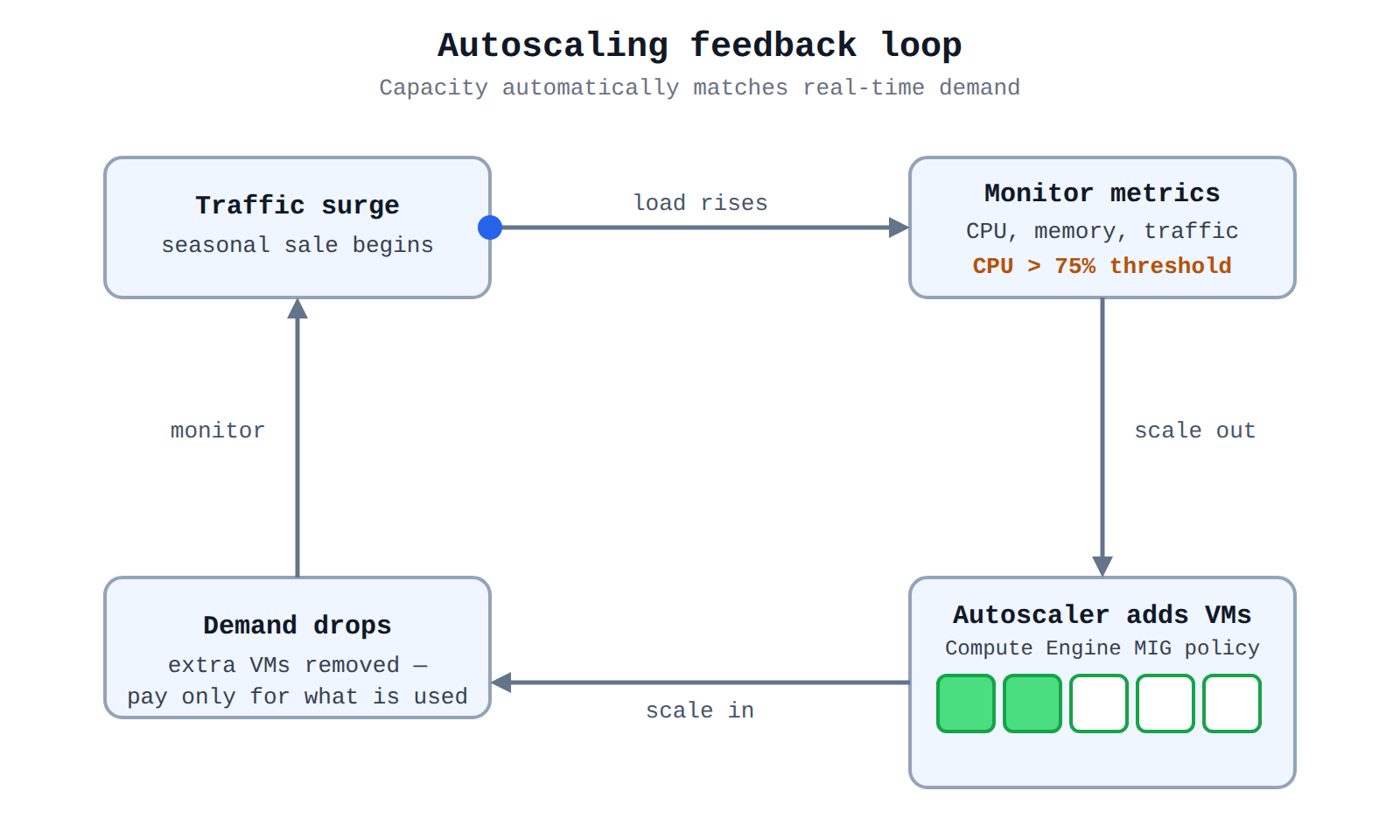
Try 10 interactive questions like this one, free
Answer them yourself and get your score the moment you finish. No account needed.
Full access includes
- 3,070 practice questions across all 6 exam domains
- Every answer explained: why it is right, and why the others are not
- Scout, an AI tutor that answers your follow-up questions
- Readiness tracking by domain, so you know when to book the exam
Related free sample questions
Keep the momentum going with these hand-picked practice scenarios
FundamentalCloud Digital Leader
Transparency Reports vs Third-Party Audits
Describe how sharing transparency reports and undergoing independent third-party audits support customer trust in Google.
FundamentalCloud Digital Leader
Cloud Armor Preconfigured WAF Rules
Describe how an organization can protect against network attacks using Google products, including distributed denial-of-service (DDoS) using Google Cloud Armor.
FundamentalCloud Digital Leader
Cloud Armor Edge DDoS Mitigation
Describe how an organization can protect against network attacks using Google products, including distributed denial-of-service (DDoS) using Google Cloud Armor.
FundamentalCloud Digital Leader
Unsupervised Clustering vs Natural Language AI
Discuss the types of problems that ML can solve.
FundamentalCloud Digital Leader
GKE Enterprise Fleets Multi-Cloud Management
Discuss the business reasons for choosing hybrid or multi-cloud strategies and how GKE Enterprise enables these strategies.
IntermediateProfessional Cloud Developer
Eventarc Standard Triggers CloudEvents
Invoking Cloud Run services using triggers (e.g., Eventarc, Pub/Sub)
Last updated