Fundamental
Prepare and test your skills

Fundamental
Prepare and test your skills
Identity Platform User Verification With MFA
Free sample question with answers and detailed explanation below. The Cloud Digital Leader practice bank has an additional 3,070 practice questions.Try 10 free realistic questions: instant score, no credit card, and no account required.
An enterprise is deploying a new application on Google Cloud and needs to establish a secure sign-in process. The security team has established the following requirements:
- Identity verification: Confirm that every user attempting to access the application is who they claim to be before checking their resource permissions.
- Flexible sign-in: Allow users to sign in with either an email address and password or their existing corporate credentials from an external identity provider.
- Enhanced account security: Prevent unauthorized access even if a user's primary password is compromised.
Which authentication approach should the enterprise implement to meet these requirements?
Explanations
Implement Workload Identity Federation to grant on-premises and multi-cloud workloads access to Google Cloud resources without using service account keys
Implement Workload Identity Federation to grant on-premises and multi-cloud workloads access to Google Cloud resources without using service account keys
What Workload Identity Federation Is
Workload Identity Federation is a Google Cloud security capability that enables external, non-human workloads—such as applications running in on-premises data centers or other cloud providers—to authenticate to Google Cloud resources without requiring downloadable service account keys. It exchanges credentials from external OIDC-compatible or SAML 2.0-compatible identity providers for short-lived Google Cloud access tokens.
Why It Doesn't Meet the Requirements
- Targets machine workloads rather than end users: Workload Identity Federation is designed for programmatic, machine-to-machine authentication rather than interactive human sign-in flows.
- Lacks email and password management: It does not provide user-facing sign-up pages, password reset workflows, or consumer/employee email and password credential verification.
- Does not provide interactive user MFA: Because it is built for automated backend workloads, it does not prompt human users for a second piece of identification (such as an SMS code or Titan Security Key) to mitigate stolen user passwords.
Key Characteristics
- Eliminates service account keys: Removes the security risk and operational burden of rotating and storing long-lived service account keys outside of Google Cloud.
- Supports multi-cloud and on-premises environments: Allows external compute workloads to impersonate Google Cloud service accounts securely.
- Uses external workload tokens: Validates tokens issued by external workload identity providers using OpenID Connect (OIDC) or SAML 2.0 standards.
This Answer Would Be Correct If
This option would be the right choice if the enterprise needed to allow automated applications running in an on-premises data center or another public cloud to access Google Cloud storage or databases securely without managing service account keys.
Additional Context
While both Workload Identity Federation and Identity Platform support SAML and OIDC federation, they serve entirely different principals. Workload Identity Federation authenticates external software services and server workloads, whereas Identity Platform and Cloud Identity authenticate human users through passwords, federated single sign-on (SSO), and multi-factor authentication (MFA).
Assign Identity and Access Management (IAM) roles and use three-legged OAuth (3LO) to grant applications permission to access end-user resources
Assign Identity and Access Management (IAM) roles and use three-legged OAuth (3LO) to grant applications permission to access end-user resources
What IAM Roles and Three-Legged OAuth (3LO) Do
Identity and Access Management (IAM) roles and three-legged OAuth (3LO) are mechanisms primarily used for authorization—the process of determining what resources a user or application is permitted to access after their identity has already been verified. In a three-legged OAuth flow, an application obtains explicit permission from an end user via an authorization server to access resources owned by that user.
Why It Doesn't Meet the Requirements
- Confuses authorization with authentication: Assigning IAM roles dictates what actions a principal can perform on Google Cloud resources, rather than verifying who the user is during sign-in.
- Does not provide primary sign-in methods: Neither IAM role bindings nor 3LO permission grants provide the underlying credential verification mechanisms (such as email and password management or SAML federation) needed to establish who a user is.
- Does not address compromised passwords: Authorization permissions evaluate resource access rights assuming the presented identity is valid; they do not enforce a second factor of identification (MFA/2FA) to protect against stolen passwords.
Key Characteristics
- Resource access control: IAM roles bundle permissions that govern which APIs or cloud resources an authenticated principal can view or modify.
- Delegated user permission: Three-legged OAuth (3LO) coordinates between three entities—the application, the authorization server, and the user—to authorize access to user-owned data.
- Depends on prior authentication: Authorization checks can only be meaningfully enforced after an authentication service has verified the user's identity and issued a valid token.
This Answer Would Be Correct If
This approach would be appropriate if the enterprise had already established user authentication and needed to configure authorization policies to control which Google Cloud resources an authenticated principal can access, or needed an application to request permission to read data owned by an end user.
Additional Context
In cloud security, distinguishing between authentication (verifying identity via passwords, MFA, or federated identity providers), authorization (controlling resource access via IAM roles), and auditing (recording access logs) is essential. Services like Identity-Aware Proxy (IAP) rely on authentication tokens first before evaluating IAM roles for authorization.
Enable anonymous authentication in Identity Platform to create temporary user accounts that bypass credential verification during sign-in
Enable anonymous authentication in Identity Platform to create temporary user accounts that bypass credential verification during sign-in
What Anonymous Authentication Is
Anonymous authentication is a feature within Identity Platform and Firebase Authentication that creates temporary, unverified accounts for end users. This mechanism allows users to interact with application features that technically require an authentication token without forcing the user to sign in or provide personal credentials upfront.
Why It Doesn't Meet the Requirements
- Fails to verify real user identity: Because anonymous authentication generates a temporary placeholder account without collecting credentials, it cannot confirm that a user is who they claim to be.
- Does not integrate corporate federation at sign-in: Anonymous accounts bypass email and password entry as well as federated identity provider sign-in flows (such as SAML or OIDC) during initial access.
- Cannot protect against compromised credentials: Anonymous sessions do not use passwords or enforce two-factor authentication (2FA) challenges, providing no defense against compromised corporate credentials.
Key Characteristics
- Frictionless onboarding: Lets prospective users explore an application and save temporary state before deciding to register.
- Account upgrading: If a temporary user later decides to sign up using a password or federated identity provider, the anonymous account can be upgraded and linked to a permanent account so the user can continue where they left off.
- Low trust level: Anonymous tokens identify a specific session or device temporarily but do not establish verified identity trust for sensitive enterprise resources.
This Answer Would Be Correct If
This approach would be correct if the company were building a consumer mobile game or e-commerce app where guests needed to try out features or build a shopping cart before registering for a permanent account.
Additional Context
Establishing true identity trust requires collecting verifiable credentials—such as a password, a cryptographic assertion from a trusted Identity Provider (IdP), and a second verification factor (MFA). Anonymous authentication is strictly a convenience mechanism for guest sessions until full authentication is performed.
Use Identity Platform to verify user identities through email and password authentication, federated identity providers (SAML or OIDC), and two-factor authentication (2FA)
Use Identity Platform to verify user identities through email and password authentication, federated identity providers (SAML or OIDC), and two-factor authentication (2FA)
What Authentication with Identity Platform Is
Authentication is the foundational security process of verifying a user's identity to confirm that they are who they claim to be. Unlike authorization (which determines which resources an authenticated user can access) and auditing (which logs and tracks user activity), authentication focuses strictly on establishing initial trust at sign-in. Identity Platform is a customer identity and access management (CIAM) service in Google Cloud that provides customizable backend authentication services, SDKs, and UI libraries to verify user identities across web and mobile applications.
How It Meets the Requirements
- Identity verification: When a user attempts to sign in, Identity Platform collects authentication credentials—such as an email and password, a SAML assertion, or an OAuth token—and validates them on Google-hosted backend handlers before issuing signed JSON Web Tokens (JWTs) to confirm the user's identity.
- Flexible sign-in: Identity Platform natively supports traditional email and password authentication alongside federated identity providers. By integrating inbound Security Assertion Markup Language (SAML) or OpenID Connect (OIDC) protocols, employees and customers can authenticate using their existing corporate or social identities.
- Enhanced account security: Requiring two-factor authentication (2FA), also known as multi-factor authentication (MFA), mandates a second piece of identification—such as an SMS verification code or a FIDO-compliant Titan Security Key—before authentication succeeds. This stops malicious actors from accessing accounts even if primary passwords are leaked.
Identity Platform Sign-In Flow, Step by Step
Sequence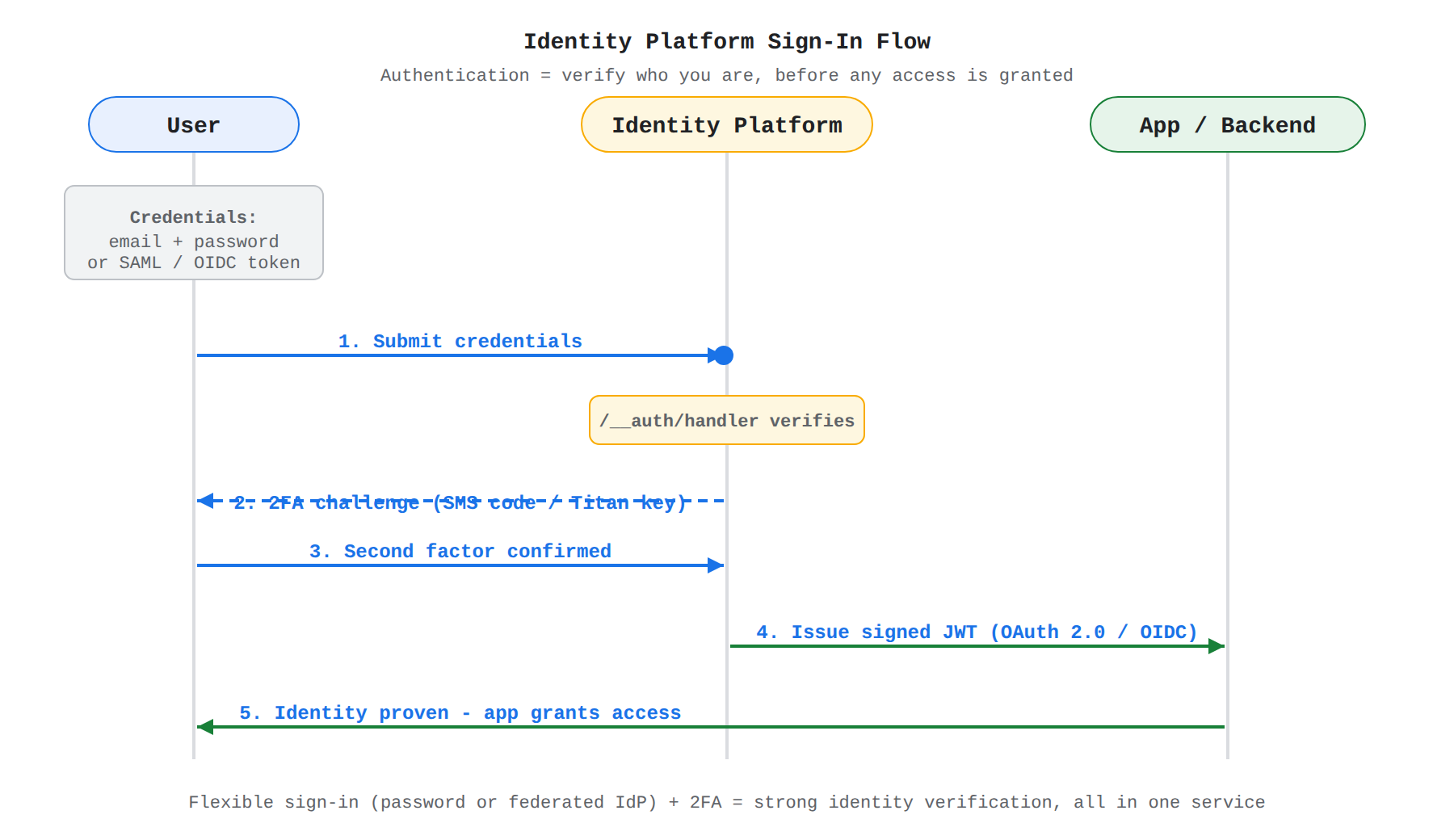
Key Capabilities and Advantages
- Broad protocol support: Supports passwords, phone numbers, social sign-in (Google, Facebook, GitHub), and enterprise federation via SAML 2.0 and OIDC.
- Multi-factor authentication (MFA): Protects accounts against credential stuffing and phishing by requiring a second verification factor.
- Automated token validation: Receives and verifies external identity provider tokens on a managed endpoint (
/__auth/handler), reducing custom backend overhead. - Standards-based integration: Issues verifiable ID tokens based on OAuth 2.0 and OpenID Connect standards to securely identify signed-in users across backend services.
Why This Is Optimal
Combining password authentication, federated identity services, and MFA within Identity Platform directly addresses every layer of modern user identity verification. It establishes strong cryptographic trust without forcing administrators to build custom credential verification workflows from scratch.
Try 10 interactive questions like this one, free
Answer them yourself and get your score the moment you finish. No account needed.
Full access includes
- 3,070 practice questions across all 6 exam domains
- Every answer explained: why it is right, and why the others are not
- Scout, an AI tutor that answers your follow-up questions
- Readiness tracking by domain, so you know when to book the exam
Related free sample questions
Keep the momentum going with these hand-picked practice scenarios
FundamentalCloud Digital Leader
Cloud Audit Logs Immutable Audit Trail
Differentiate between authentication, authorization, and auditing.
FundamentalCloud Digital Leader
IAM Allow Policy on Bucket
Differentiate between authentication, authorization, and auditing.
FundamentalCloud Digital Leader
Cloud Trace Distributed Tracing
Define important cloud operations terms.
FundamentalCloud Digital Leader
Managed Instance Group Autoscaling
Define the main cloud compute terms, including: virtual machines (VMs); containerization; containers; microservices; serverless computing; preemptible VMs; Kubernetes, autoscaling, load balancing.
FundamentalCloud Digital Leader
Looker In-Database Architecture and Action Hub
Describe how Looker democratizes access to data by empowering individuals to self-serve business intelligence and create insights.
IntermediateProfessional Cloud Developer
AI-Generated Test Auditing and Refinement
Writing unit tests with the help of AI coding assistants
Last updated