Fundamental
Prepare and test your skills
Fundamental
Prepare and test your skills
Cleaning Data in Dataflow Before BigQuery Load
Free sample question, answered and explained below. The Associate Data Practitioner practice bank has 1,132 more like it. Try 10 free: instant score, no account.
An enterprise is migrating its legacy data warehousing workflows to Google Cloud. The architecture team has established the following technical requirements for its primary data ingestion pipeline:
- Transactional data from external databases must be extracted, cleansed, and aggregated prior to being stored in the cloud data warehouse.
- BigQuery computational capacity must be preserved strictly for high-concurrency business intelligence dashboards and analytical reporting, rather than spent on data wrangling.
- The pipeline must use a fully managed, serverless processing framework capable of executing complex Apache Beam transformations in Java or Python.
Which data integration methodology and Google Cloud processing service should the team implement?
Explanations
An EL (Extract and Load) architecture using BigQuery Data Transfer Service to ingest raw tables without applying external business rules
An EL (Extract and Load) architecture using BigQuery Data Transfer Service to ingest raw tables without applying external business rules
What an EL Architecture and BigQuery Data Transfer Service Are
Extract and Load (EL) is a data movement pattern that focuses exclusively on transferring data from a source directly into a destination sink without performing any data manipulation, cleaning, filtering, or transformation along the way.
BigQuery Data Transfer Service (DTS) is a fully managed service designed to automate scheduled batch data transfers into BigQuery from supported sources such as Google Ads, YouTube, Cloud Storage, or third-party cloud data warehouses.
Why It Doesn't Meet the Requirements
- Omits data transformations (✗): EL deliberately bypasses the "Transform" phase. The scenario explicitly requires data cleansing, business rule validation, and aggregations before storage.
- No custom Apache Beam code support (✗): BigQuery Data Transfer Service is an out-of-the-box configuration tool for moving files and supported datasets. It cannot execute custom Python or Java Apache Beam pipelines.
- Raw landing only: EL lands unvalidated, raw data into the warehouse, requiring a subsequent transformation step to clean the data.
Key Characteristics and Limitations of EL
- Simplified movement: Minimizes pipeline complexity by relying on automated managed tools to replicate tables as-is.
- No intermediate compute overhead: Avoids running dedicated compute servers prior to storage, but leaves all data cleansing to downstream consumers.
- Prerequisite to ELT: EL is commonly used as the first stage of an ELT pipeline, after which in-warehouse transformations occur.
This Answer Would Be Correct If:
The team wanted an automated, scheduled mechanism to copy raw data into BigQuery without performing any filtering, data preparation, or custom transformations prior to loading.
A Reverse ETL architecture using BigQuery export jobs to synchronize analytical results back to operational databases
A Reverse ETL architecture using BigQuery export jobs to synchronize analytical results back to operational databases
What Reverse ETL Is
Reverse ETL is a downstream data movement process where enriched, aggregated, and processed data from a centralized data warehouse (such as BigQuery) is exported back into operational business systems—such as CRM applications, ERP systems, or marketing automation platforms—to support operational workflows and automated decision-making.
Why It Doesn't Meet the Requirements
- Opposite data direction (✗): The scenario describes an upstream ingestion pipeline that brings data from external transactional sources into the warehouse. Reverse ETL is a downstream export process moving data outward from the warehouse to operational endpoints.
- Does not ingest or clean source data (✗): Reverse ETL assumes data has already been ingested, cleaned, and modeled within the data warehouse.
- Not an ingestion framework (✗): Reverse ETL does not address how external database records are extracted, cleansed with Apache Beam, and loaded into BigQuery.
Key Characteristics and Limitations of Reverse ETL
- Operational enablement: Often referred to as "operational analytics," it synchronizes customer metrics (like churn risk or lifetime value) into tools like Salesforce or HubSpot.
- Feedback loop pattern: It implements an architectural feedback loop where data originates in operational systems, is processed in the warehouse, and feeds back into day-to-day transaction tools.
- Specialized connectors: It focuses on API rate limiting, incremental synchronization, and entity mapping into third-party SaaS APIs and operational databases.
This Answer Would Be Correct If:
The enterprise had already modeled customer profiles inside BigQuery and needed a pipeline to push curated aggregate scores out of BigQuery into an external transactional CRM or product catalog system.
An ELT (Extract, Load, Transform) architecture using BigQuery and Dataform to transform data after loading raw tables
An ELT (Extract, Load, Transform) architecture using BigQuery and Dataform to transform data after loading raw tables
What ELT and Dataform Are
Extract, Load, Transform (ELT) is a modern cloud data warehousing pattern where raw, unmodified data is extracted from sources and immediately loaded directly into the data warehouse (such as staging tables in BigQuery). Once loaded, transformations and business logic are executed directly inside the data warehouse using SQL scripts or transformation management tools like Dataform.
Why It Doesn't Meet the Requirements
- Fails the pre-storage transformation requirement (✗): The scenario explicitly specifies that transformations, cleaning, and validations must take place prior to data reaching the data warehouse. ELT loads raw, uncleaned records directly into BigQuery first.
- Consumes BigQuery resources for transformation (✗): Under an ELT pattern, transforming data utilizes BigQuery query processing slots and compute capacity. This conflicts directly with the requirement that BigQuery resources must be reserved exclusively for concurrent user reporting and dashboard queries.
- Does not utilize Apache Beam (✗): Dataform operates by generating and orchestrating SQL-based transformations inside BigQuery, rather than executing Apache Beam Java or Python pipelines.
Key Characteristics and Limitations of ELT
- In-warehouse computation: ELT leverages the massive distributed SQL engine of cloud data warehouses like BigQuery to perform transformations rapidly at scale.
- Raw data retention: ELT stores raw, uncurated tables inside the warehouse, allowing data analysts to query raw events for audits and exploration.
- Resource competition: Running massive transformation jobs inside the data warehouse during peak hours can compete with interactive analytical queries unless dedicated slot reservations or off-peak scheduling are implemented.
This Answer Would Be Correct If:
The organization wanted to load raw data directly into BigQuery staging tables first, preferred using SQL and Dataform for transformation logic, and had sufficient BigQuery capacity or off-peak processing windows to handle in-warehouse transformation.
An ETL (Extract, Transform, Load) architecture using Dataflow to process and clean data before writing to BigQuery
An ETL (Extract, Transform, Load) architecture using Dataflow to process and clean data before writing to BigQuery
What an ETL Architecture and Dataflow Are
Extract, Transform, Load (ETL) is a traditional and powerful data manipulation methodology where raw data is extracted from source operational systems, transformed in an external dedicated processing layer, and only then loaded into the target data warehouse.
ETL Order: Transform in Dataflow, Then Load
Process Flow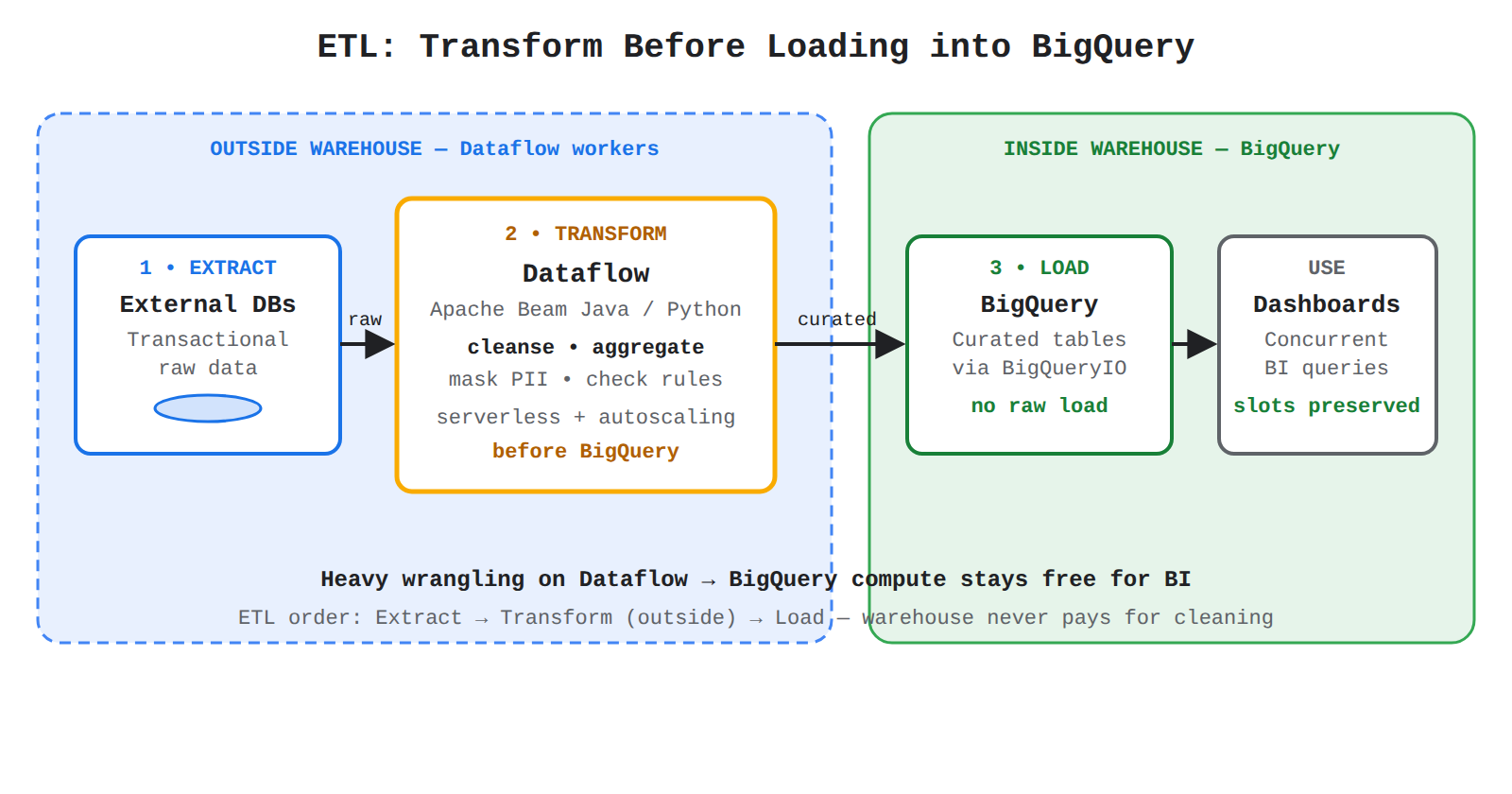
Dataflow is Google Cloud's fully managed, serverless stream and batch data processing service. It runs pipelines defined using the open-source Apache Beam SDK (supporting Java, Python, and Go), dynamically allocating and scaling worker compute instances to process and transform large volumes of data before writing final curated records into destination sinks like BigQuery.
How It Meets the Architecture Requirements
- Pre-load transformation (✓): In an ETL architecture, all business rules, data scrubbing, schema mappings, and aggregations take place in the intermediate processing stage (Dataflow) before any records are committed to BigQuery storage.
- Preserving data warehouse compute (✓): Because transformations execute on Dataflow worker instances outside the data warehouse, BigQuery does not expend processing slots or compute power on cleaning data. This reserves all BigQuery resources exclusively for concurrent business intelligence queries and end-user dashboards.
- Serverless Apache Beam processing (✓): Dataflow natively runs Apache Beam execution graphs with automated horizontal autoscaling, managed resource provisioning, and built-in fault tolerance.
Key Advantages of ETL with Dataflow
- Offloaded compute workload: Heavy computations, joins, and aggregations are isolated to ephemeral compute workers rather than degrading data warehouse query concurrency.
- Strict data governance: Sensitive data (such as Personally Identifiable Information, or PII) can be masked, tokenized, or scrubbed prior to entering enterprise data warehouse storage.
- Unified batch and streaming: Apache Beam provides identical APIs and constructs (windows, triggers, accumulators) across both scheduled batch ingestion and real-time streaming.
- Native BigQuery integration: Apache Beam includes dedicated I/O connectors (
BigQueryIO) that optimize batch file loading and streaming inserts directly into BigQuery tables.
Why This Is Optimal
When organizational requirements dictate that the data warehouse should only hold curated, compliant data and that analytical query capacity must not compete with daily batch processing workloads, the ETL pattern powered by Dataflow provides the ideal balance of isolation, elastic scalability, and robust data manipulation.
Try 10 interactive questions like this one, free
Answer them yourself and get your score the moment you finish. No account needed.
Full access includes
- 1,132 practice questions across all 4 exam domains
- Every answer explained: why it is right, and why the others are not
- Scout, an AI tutor that answers your follow-up questions
- Readiness tracking by domain, so you know when to book the exam
Related questions
Keep the momentum going with these hand-picked practice scenarios
FundamentalAssociate Data Practitioner
ELT
Differentiate between different data manipulation methodologies (e.g., ETL, ELT, ETLT)
FundamentalAssociate Data Practitioner
BigQuery Data Transfer Service and Dataform for ELT
Differentiate between different data manipulation methodologies (e.g., ETL, ELT, ETLT)
FundamentalAssociate Data Practitioner
Newline-Delimited JSON for Nested and Repeated Data
Distinguish the format of the data (e.g., CSV, JSON, Apache Parquet, Apache Avro, structured database tables)
FundamentalAssociate Data Practitioner
BigQuery Notebooks Variable Interpolation
Use Jupyter notebooks to analyze and visualize data (e.g., Colab Enterprise)
FundamentalAssociate Data Practitioner
BigQuery ML ML.FORECAST
Perform inference using BigQuery ML models
AdvancedProfessional Data Engineer
Looker Model, Row, and Field-Level Security
Publishing reports and visualizations
Last updated