Fundamental
Prepare and test your skills
Fundamental
Prepare and test your skills
Pandas Syntax at BigQuery Scale with BigFrames
Free sample question, answered and explained below. The Associate Data Practitioner practice bank has 1,132 more like it. Try 10 free: instant score, no account.
A data analyst is using a Colab Enterprise notebook in BigQuery to explore and analyze a multi-gigabyte retail dataset. The analyst needs to clean missing values, transform date columns, and calculate summary aggregations to identify customer purchasing trends over time. The analyst wants to write familiar Python code using pandas syntax, but the dataset is too large to fit into the memory of the notebook's local virtual machine runtime.
Which solution should the analyst implement?
Explanations
Use the %%bigquery magic command to load the entire dataset into a standard pandas DataFrame in the local notebook runtime.
Use the %%bigquery magic command to load the entire dataset into a standard pandas DataFrame in the local notebook runtime.
What the %%bigquery magic command does
The %%bigquery magic command is an IPython cell magic provided by the BigQuery client library for Python. It allows users to write standard SQL queries directly inside a notebook cell, automatically execute the query in BigQuery, and download the returned query results as an in-memory pandas DataFrame stored in a designated Python variable.
Why it doesn't meet the requirement
- Fails memory constraints (✗): The scenario explicitly specifies that the multi-gigabyte dataset is too large to fit in the memory of the notebook's local virtual machine runtime. The
%%bigquerycommand attempts to download the full result set into the notebook kernel's RAM. - Kernel crash risk (✗): Ingesting multi-gigabyte tables directly into a local pandas DataFrame frequently triggers Out of Memory (OOM) exceptions, which terminates the Python kernel and halts the notebook session.
- Network bandwidth overhead (✗): Transferring gigabytes of raw, unaggregated transactional data over the network to the client environment is slow and inefficient compared to processing the data in-place within BigQuery.
Key characteristics and limitations
- In-memory data representation: Once downloaded, standard pandas DataFrames reside entirely in the notebook VM's system memory.
- Execution location: While the initial SQL query executes in BigQuery, all subsequent pandas transformations and data cleaning steps run on the notebook VM's CPU and memory.
- Result set limits: While well suited for small tables or aggregated query outputs, it is not architected for large-scale data manipulation.
This answer would be correct if
This method would be appropriate if the analyst only needed to retrieve an already-aggregated, small summary dataset (such as top 100 sales days) using a LIMIT clause or grouped SQL query that fits comfortably within the notebook VM's memory.
Export the BigQuery table to Cloud Storage as CSV files and load them into the notebook runtime using pandas.read_csv().
Export the BigQuery table to Cloud Storage as CSV files and load them into the notebook runtime using pandas.read_csv().
What this approach does
This approach involves using BigQuery export features to write table contents out to Cloud Storage buckets as delimited CSV text files, and subsequently utilizing pandas.read_csv() within the notebook kernel to read the file contents into a local DataFrame.
Why it doesn't meet the requirement
- Does not solve memory limitations (✗): Loading large CSV files using
pandas.read_csv()still allocates memory within the local notebook VM runtime. Parsing raw CSV files in pandas often consumes significantly more memory (2x to 5x) than the raw file size due to Python object overhead and datatype inferences. - Unnecessary latency and complexity (✗): Staging data through Cloud Storage adds multi-step pipeline overhead: exporting table partitions, setting up storage paths, and downloading multi-gigabyte files into notebook storage.
- High storage redundancy (✗): Creating duplicate copies of large datasets in Cloud Storage increases cloud storage costs without providing analytical benefits over querying the native BigQuery storage.
Key characteristics and limitations
- Client-side parsing: Parsing textual CSV files into Python objects requires significant client CPU and RAM.
- Fragile schema handling: CSV formats lack native schema definitions, often causing parsing errors, truncated values, or incorrect type inference for dates and timestamps.
- No push-down compute: Standard pandas cannot push filtering, grouping, or aggregation back to BigQuery or Cloud Storage.
This answer would be correct if
This approach would be appropriate if the analyst needed to archive raw data for external third-party tools that do not support direct BigQuery connections, or if transferring small sample CSV files to an offline local machine for testing.
Use BigQuery DataFrames (bigframes.pandas) to perform data cleaning and transformations using pandas-compatible APIs executed directly in BigQuery.
Use BigQuery DataFrames (bigframes.pandas) to perform data cleaning and transformations using pandas-compatible APIs executed directly in BigQuery.
What BigQuery DataFrames is
BigQuery DataFrames (provided via the bigframes Python package, specifically bigframes.pandas) is an open-source library that implements the popular pandas and scikit-learn APIs on top of Google Cloud's distributed analytics engine. Rather than running computations in the local Python environment on a single virtual machine, BigQuery DataFrames translates Python operations into GoogleSQL queries and executes them directly inside BigQuery.
BigQuery DataFrames Push-Down Execution
System Architecture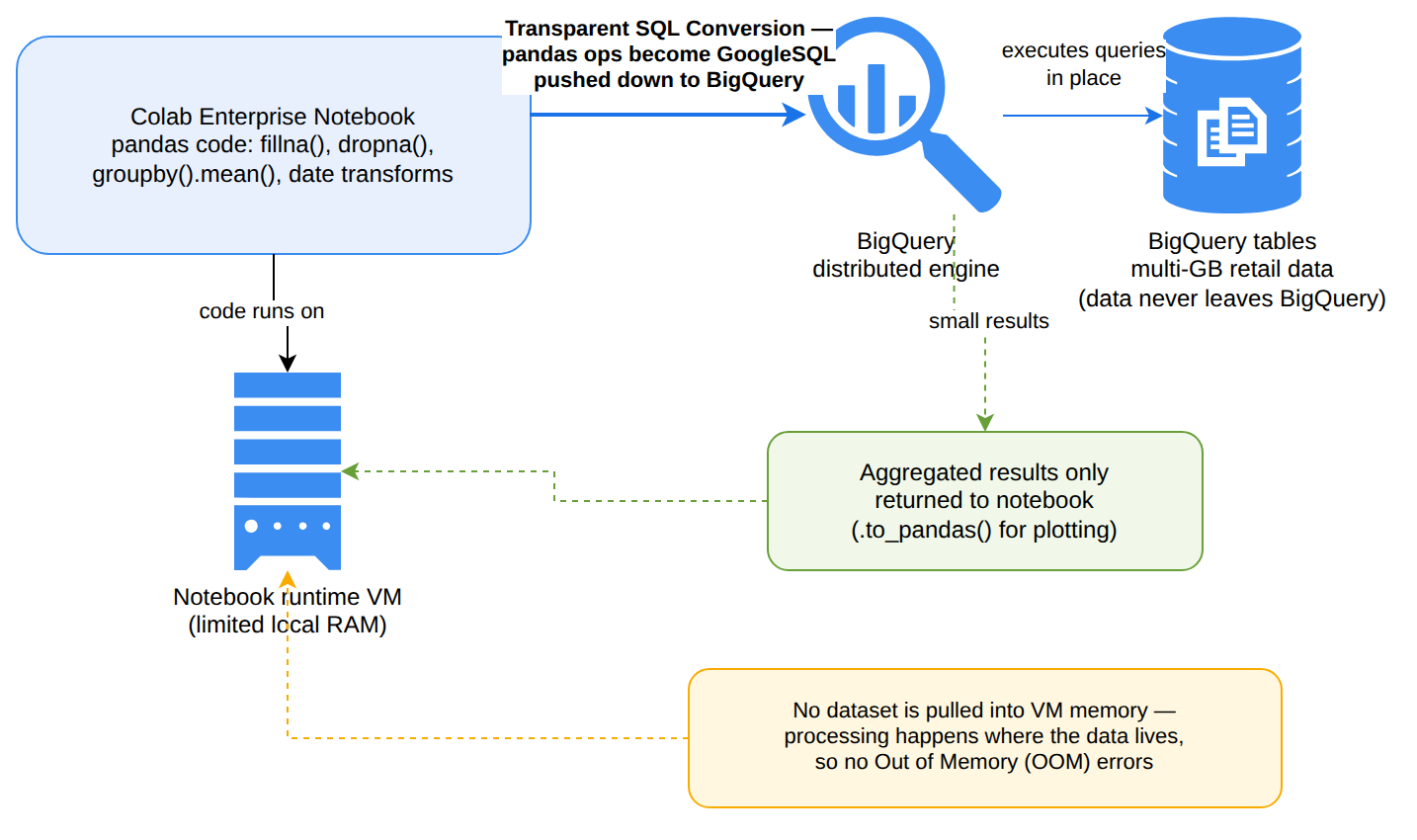
How it meets the requirements
- Overcomes memory limitations (✓): Because transformations execute remotely on BigQuery's scalable compute infrastructure, datasets of hundreds of gigabytes or terabytes can be processed without causing Out of Memory (OOM) errors on the notebook VM.
- Familiar pandas syntax (✓): Analysts can perform standard data cleaning (such as filling or dropping null values with
fillna()anddropna()), feature transformation (such as casting datatypes and date manipulation), and exploratory data analysis using more than 750 familiar pandas functions. - Trend and aggregation identification (✓): Complex grouping, aggregations, and windowing functions execute at cloud scale, allowing the analyst to uncover historical trends and behavioral patterns across the full dataset.
- Seamless Colab Enterprise integration (✓): In BigQuery Studio and Colab Enterprise notebooks, BigQuery DataFrames is integrated natively and ready to use without requiring manual infrastructure setup.
Key advantages and capabilities
- Push-down execution: Operations are converted to transparent SQL queries executed by BigQuery, taking advantage of massively parallel processing.
- Deferred execution: Calculations and transformations are evaluated lazily, optimizing query execution plans until an action or visualization explicitly requests materialized output.
- Interoperability with local tools: When data is filtered and aggregated to a manageable size, it can be exported to standard pandas using
.to_pandas()for local plotting with matplotlib or seaborn. - Integrated ML capabilities: In addition to pandas workflows,
bigframes.mlprovides scikit-learn-compatible APIs for feature engineering and machine learning model training directly in BigQuery ML.
Why this is optimal
Compared to moving raw data across the network into notebook memory, BigQuery DataFrames keeps the processing where the data lives. It eliminates local RAM constraints while preserving the flexibility, readability, and statistical capabilities of Python data manipulation.
Use Dataform inside the notebook to convert the table schema into a local pandas DataFrame for Python data manipulation.
Use Dataform inside the notebook to convert the table schema into a local pandas DataFrame for Python data manipulation.
What Dataform does
Dataform is a service within Google Cloud that enables data teams to develop, version-control, and orchestrate complex SQL-based data transformation pipelines (data modeling) in BigQuery. In BigQuery Studio, Dataform provides the underlying engine that manages code assets, repository versioning, and DAG execution.
Why it doesn't meet the requirement
- Not a Python DataFrame library (✗): Dataform is an orchestration and SQL modeling framework; it does not provide an interactive Python API or DataFrame objects for data manipulation in Jupyter cells.
- Cannot run pandas syntax (✗): Dataform workflows are authored in SQLX (an extension of SQL with JavaScript) and do not support executing pandas data cleaning and transformation code.
- Misunderstanding of notebook integration (✗): While BigQuery Studio notebooks are stored and tracked as code assets powered by Dataform behind the scenes, Dataform itself is not an in-notebook data manipulation tool for pandas operations.
Key characteristics and limitations
- SQLX-based transformation: Dataform manages tables, views, and data assertions using declarative SQL scripts and dependencies.
- Production ELT orchestration: Designed for scheduled batch transformation pipelines rather than exploratory, ad-hoc Python data analysis.
- No in-memory DataFrame conversion: Dataform cannot convert BigQuery tables into local pandas data structures or resolve VM memory constraints for interactive analysis.
This answer would be correct if
This approach would be correct if an organization needed to build a scheduled, version-controlled production ELT workflow that transforms raw data into dimensional models using SQL and data quality assertions across multiple BigQuery tables.
Try 10 interactive questions like this one, free
Answer them yourself and get your score the moment you finish. No account needed.
Full access includes
- 1,132 practice questions across all 4 exam domains
- Every answer explained: why it is right, and why the others are not
- Scout, an AI tutor that answers your follow-up questions
- Readiness tracking by domain, so you know when to book the exam
Related questions
Keep the momentum going with these hand-picked practice scenarios
FundamentalAssociate Data Practitioner
Seaborn Boxplot
Use Jupyter notebooks to analyze and visualize data (e.g., Colab Enterprise)
FundamentalAssociate Data Practitioner
BigQuery Notebooks Variable Interpolation
Use Jupyter notebooks to analyze and visualize data (e.g., Colab Enterprise)
FundamentalAssociate Data Practitioner
CMEK vs CSEK vs GMEK
Identify use cases for customer-managed encryption keys (CMEK), customer-supplied encryption keys (CSEK), and Google-managed encryption keys (GMEK)
FundamentalAssociate Data Practitioner
BigQuery Partition Expiration
Configure rules to delete objects after a specified period to automatically remove unnecessary data and reduce storage expenses (e.g., BigQuery, Cloud Storage)
FundamentalAssociate Data Practitioner
ELT vs ETL
Evaluate use cases for ELT and ETL
IntermediateProfessional Cloud Architect
Spot VMs and Multi-Region Standard Storage
Design decision trade-offs
Last updated