Diagram
Cloud Run Traffic Split in Motion
Process Flow
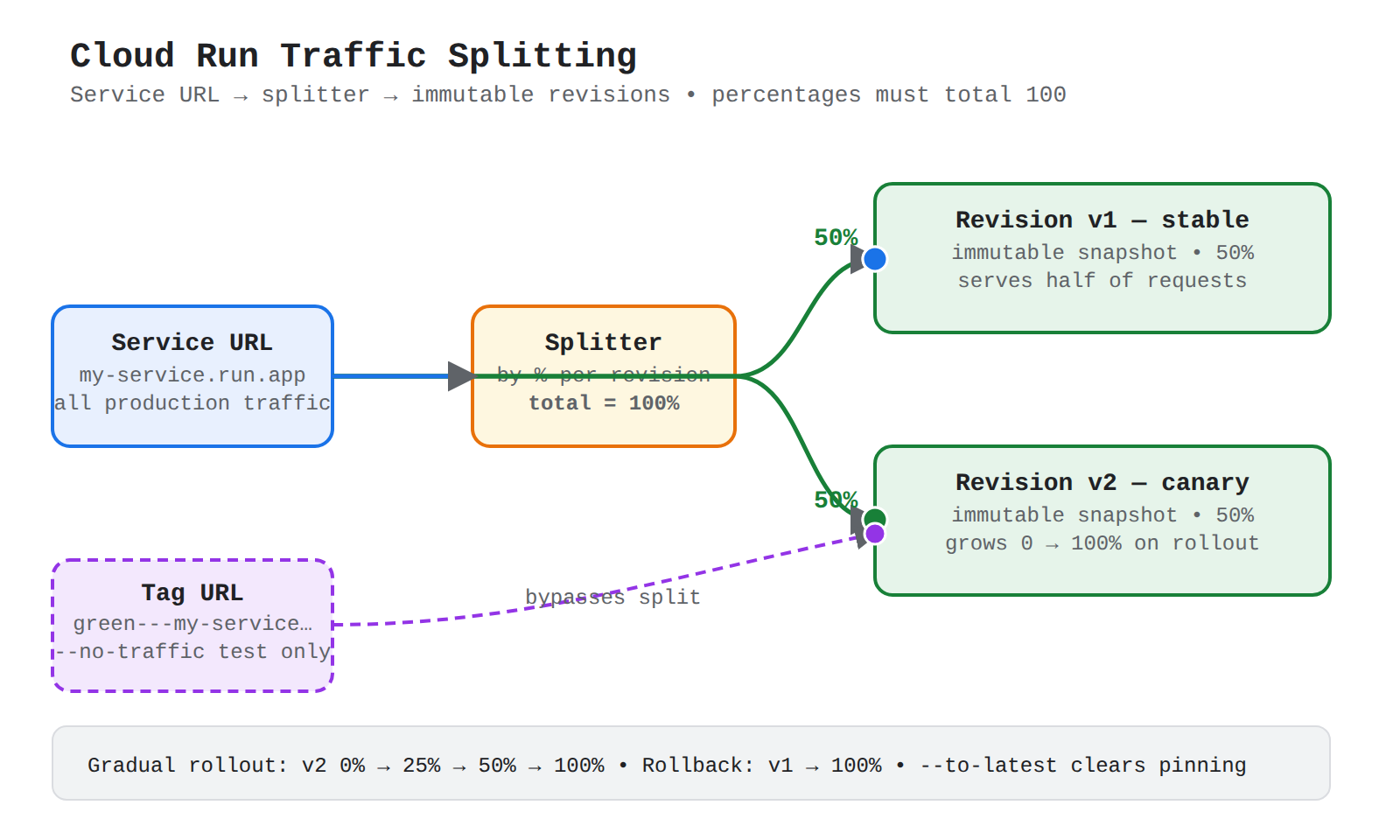
A process flow showing requests entering the Cloud Run service URL, splitting by percentage to two immutable revisions, with a tagged test URL bypassing the split directly to the canary revision.
In the Domain
Deploying Cloud Run Revisions, Traffic Splits, and Autoscaling
Deploying a Cloud Run service means creating immutable revisions and mapping traffic percentages that must total 100. A revision snapshots container image plus environment, memory, CPU, concurrency, networking, and scaling settings, and any change creates a new revision that cannot be edited. Traffic flows from the service URL to the splitter to the assigned revisions, where gradual rollout grows a canary from 0% to 100%, split traffic runs versions side by side, rollback returns 100% to a prior revision, and --to-latest resumes single-version operation. Revision tags such as green create test URLs like https://green---myservice-abcdef.a.run.app with --no-traffic so testers validate without production impact. Autoscaling adds instances before requests queue based on concurrency defaulting to 80 per instance with targets near 60% CPU and 60% concurrency, where request-based billing provides CPU only during requests and instance-based billing keeps CPU for background work. Minimum instances keep warm capacity to avoid cold starts with a default of 0 for scale-to-zero, while maximum instances default to 100 to cap cost and protect dependencies.
Domain 3 of 4
Section 3: Ensuring successful operation of a cloud solution (~27% of the exam)
Read the Domain summaryPractice this Domain
886 practice questions
Practice this DomainLast updated