Fundamental
Prepare and test your skills

Fundamental
Prepare and test your skills
Centralized configuration guardrails with Organization Policy
Free sample question with answers and detailed explanation below. The Associate Cloud Engineer practice bank has an additional 2,014 practice questions.Try 10 free realistic questions: instant score, no credit card, and no account required.
An enterprise is expanding its Google Cloud footprint across dozens of projects and environments. The cloud operations team needs to streamline resource management and enforce consistent governance policies across all projects without requiring manual review for every deployment. Specifically, they must restrict how resources are configured, such as limiting resource deployments to approved geographic locations and restricting service account usage.
Which Google Cloud solution should the team implement to enforce these centralized configuration guardrails?
Explanations
Configure Identity and Access Management (IAM) role bindings across projects to restrict administrative access
Configure Identity and Access Management (IAM) role bindings across projects to restrict administrative access
What Identity and Access Management (IAM) does
Identity and Access Management (IAM) enables administrators to manage access control by defining who (identities such as users, groups, and service accounts) has what permissions (roles) on specific Google Cloud resources. IAM ensures that only authorized entities can perform administrative actions, such as creating, updating, or deleting compute instances and storage buckets.
Why it doesn't meet the requirement
- Governs identity, not resource configuration: IAM determines authorization for actions, but it does not dictate how resources themselves must be configured once a permitted user executes a creation command.
- Cannot enforce location or structural constraints: A user with the
Compute Adminrole in IAM has full permission to deploy virtual machines anywhere in the world unless governed by an organization policy. IAM alone cannot restrict VM deployments to specific geographic regions or enforce resource configuration standards. - Requires complex per-project overhead: Managing granular permissions across dozens of projects to simulate configuration governance creates significant administrative burden and increases the risk of privilege escalation.
Key characteristics and limitations
- Role-based access control (RBAC): Groups granular permissions into primitive, predefined, or custom roles assigned to principals.
- IAM Conditions: Allows conditional access based on request attributes (such as date, time, or resource tags), but does not inspect resource configuration properties.
- Identity focus: Designed to establish least privilege access rather than enforce platform configuration baselines.
This answer would be correct if
This approach would be appropriate if the goal were to restrict which developers, service accounts, or administrative groups are authorized to create or modify cloud resources within specific projects.
Configure Cloud Billing budgets and automated threshold alerts across each project
Configure Cloud Billing budgets and automated threshold alerts across each project
What Cloud Billing budgets and alerts do
Cloud Billing budgets and alerts allow organizations to track their actual Google Cloud costs against planned financial targets. Administrators can establish monthly or quarterly spending caps and configure automated notifications (via email, Pub/Sub, or Cloud Monitoring) when spending reaches specified percentages (such as 50%, 90%, or 100%) of the allocated budget.
Why it doesn't meet the requirement
- Does not restrict resource configurations: Budgets and alerts are purely financial tracking and alerting mechanisms. They do not inspect resource configuration settings, prevent unauthorized resource creation, or enforce architectural policies.
- No location or identity governance: This feature cannot restrict the geographic locations where resources are deployed, nor can it govern the usage of service accounts.
- Reactive rather than preventive: By default, billing alerts merely inform administrators after expenses have accumulated; they do not natively halt resource provisioning or enforce compliant configuration states.
Key characteristics and limitations
- Financial visibility: Tracks aggregated costs and consumption trends over fixed time intervals.
- Alerting thresholds: Notifies stakeholders when actual or forecasted cloud expenditures exceed defined thresholds.
- Programmatic integration: Can trigger automated webhooks or Cloud Run functions via Pub/Sub for custom financial governance workflows.
- Lack of configuration controls: Incapable of denying non-compliant API calls during resource deployment.
This answer would be correct if
This option would be the ideal choice if the primary objective were to maintain fiscal discipline, monitor project-level expenditures, and receive early warning notifications when departmental spending approaches predetermined budget thresholds.
Execute imperative administrative scripts on a scheduled basis to inspect and reconfigure non-compliant resources
Execute imperative administrative scripts on a scheduled basis to inspect and reconfigure non-compliant resources
What imperative management scripts do
Imperative management scripts use command-line utilities (such as gcloud or custom API client libraries) to execute step-by-step procedures that inspect, modify, or delete existing cloud resources. Organizations sometimes schedule these scripts using cron jobs or Cloud Tasks to scan their environments and remediate unauthorized settings.
Why it doesn't meet the requirement
- High operational maintenance and brittle logic: Imperative scripting requires writing, testing, and maintaining custom code for every resource type and governance rule. Scripts often fail to handle edge cases, API rate limits, or concurrent deployments across dozens of projects.
- Reactive remediation creates security windows: Scripts execute periodically (e.g., hourly or daily), meaning non-compliant or insecure resources remain deployed and active until the next scan runs, introducing operational risk.
- Lacks native platform governance: Unlike declarative Infrastructure as Code (IaC) and native organization policies, imperative scripts do not provide a centralized, auditable source of truth or guaranteed state enforcement at the Google Cloud control plane.
Key characteristics and limitations
- Step-by-step execution: Specifies how to achieve a task rather than declaring the desired state of the environment.
- Prone to drift and inconsistency: Ad-hoc scripts lack native state management, rollback mechanisms, and version-controlled validation pipelines.
- Increased manual oversight: Requires ongoing engineering effort to maintain script health, update API versions, and troubleshoot execution errors.
This answer would be correct if
This approach would be acceptable for temporary, one-off operational remediation tasks or legacy environments where native policy engines and declarative configuration frameworks are not supported.
Implement Organization Policy Service constraints at the organization or folder level
Implement Organization Policy Service constraints at the organization or folder level
What the Organization Policy Service is
The Organization Policy Service provides centralized, programmatic control over an enterprise's cloud resources. While Identity and Access Management (IAM) governs who can access specific resources, the Organization Policy Service defines how those resources can be configured and managed across the entire resource hierarchy (Organization, Folders, and Projects).
How it meets the governance and automation requirements
- Enforces configuration guardrails: By applying predefined or custom constraints, administrators can programmatically restrict resource configurations, such as limiting the physical location of newly created resources (
constraints/gcp.resourceLocations) or restricting service account usage. - Reduces manual oversight: Policies are automatically evaluated and enforced at deployment time. If a developer attempts to create a resource that violates a constraint, the request is immediately rejected by the Google Cloud control plane, eliminating the need for manual approval workflows.
- Hierarchical inheritance: Defining policies at the organization or folder level automatically propagates guardrails down to all underlying projects, ensuring uniform governance across all development, staging, and production environments.
Key advantages and capabilities
- Preventive enforcement: Proactively prevents misconfigurations and non-compliant architectures before resources are provisioned.
- Granular policy inheritance: Supports inheritance, overriding, or merging constraints at lower levels of the resource hierarchy.
- Integration with Active Assist and governance: Complements tools like Active Assist Recommender, which provides continuous intelligence, insights, and automated remediation recommendations for cost, performance, and security across the fleet.
- Predefined and custom constraints: Offers turnkey constraints for common compliance baselines along with flexible custom constraints tailored to organizational needs.
Why this is optimal
The Organization Policy Service is the native Google Cloud solution specifically engineered for organization-wide configuration governance. It enforces rules deterministically at the resource level without administrative friction, providing the foundational guardrails needed to streamline cloud management at scale.
One Policy Inherits to All Projects
Hierarchy / Taxonomy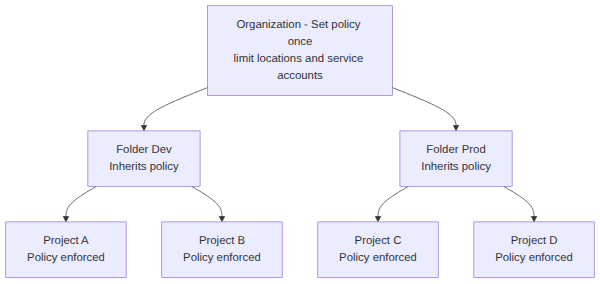
Try 10 interactive questions like this one, free
Answer them yourself and get your score the moment you finish. No account needed.
Full access includes
- 2,014 practice questions across all 4 exam domains
- Every answer explained: why it is right, and why the others are not
- Scout, an AI tutor that answers your follow-up questions
- Readiness tracking by domain, so you know when to book the exam
Related free sample questions
Keep the momentum going with these hand-picked practice scenarios
FundamentalAssociate Cloud Engineer
Compute Engine VM Machine Type Recommender
Using Active Assist to optimize resource utilization
FundamentalAssociate Cloud Engineer
Active Assist Insight Prioritization
Using Active Assist to optimize resource utilization
FundamentalAssociate Cloud Engineer
GKE Regional vs Zonal Cluster
Deploying a GKE cluster with different configurations (e.g., GKE Autopilot, regional clusters, private clusters)
FundamentalAssociate Cloud Engineer
NetApp Volumes Multiprotocol SMB NFS
Choosing and deploying storage products (e.g., Cloud Storage, Filestore, Google Cloud NetApp Volumes) and Cloud Storage options (e.g., Standard, Nearline, Coldline, Archive)
FundamentalAssociate Cloud Engineer
Premium Tier Global External IP
Differentiating Network Service Tiers
AdvancedProfessional Cloud Network Engineer
GKE Private Control Plane Peering Non-Transitivity
Choosing between public or private control plane endpoints.
Last updated