Fundamental
Prepare and test your skills

Fundamental
Prepare and test your skills
Premium Tier Global IPs for Multi-Region Load Balancing
Free sample question with answers and detailed explanation below. The Associate Cloud Engineer practice bank has an additional 2,014 practice questions.Try 10 free realistic questions: instant score, no credit card, and no account required.
An organization is deploying a web application across multiple Google Cloud regions to serve an international user base. The architecture requires a single external Application Load Balancer with a single external IP address that automatically distributes incoming user traffic to backend virtual machine (VM) instances located in both North America and Europe.
Which Network Service Tier and IP address configuration must be used to meet these requirements?
Explanations
Premium Tier with a regional external IP address
Premium Tier with a regional external IP address
What Premium Tier with a Regional External IP Address Is
This configuration uses Premium Tier routing with a regional external IP address, which is commonly assigned to individual Compute Engine instances, Cloud NAT gateways, or Regional external Application Load Balancers.
Why It Doesn't Meet the Requirement
- Regional backend constraint: When an external Application Load Balancer is deployed in regional mode using a regional external IP address, its forwarding rules, proxies, and backend services are confined to that single region. It cannot attach backends located in multiple different regions (e.g., North America and Europe).
- Fails single IP requirement: A regional IP address cannot serve as the frontend for backends in multiple regions. To distribute traffic across regions with regional load balancers, multiple IP addresses and regional balancers would be required alongside DNS traffic management.
Key Characteristics and Limitations
- High performance within a region: While regional Premium Tier traffic benefits from Google's high-speed backbone for ingress and egress, the load balancing scope remains bound to one region.
- Not global Anycast: Regional external IP addresses do not advertise Anycast routes across all global PoPs for cross-region server distribution.
- Use case: Regional external Application Load Balancers are typically used when strict regional data compliance or isolation is mandated.
This Answer Would Be Correct If
The scenario required a regional load balancer where all backend instances were located within a single region and strict regional control was necessary while retaining Premium Tier network performance.
Additional Context
To achieve true multi-region load balancing under a single frontend IP address on Google Cloud, the load balancer must be configured as a Global external Application Load Balancer, which strictly requires a global external IP address on Premium Tier.
Standard Tier with a global external IP address
Standard Tier with a global external IP address
What This Configuration Is
This option attempts to pair Standard Tier networking with a global external Anycast IP address to achieve multi-region routing.
Why It Doesn't Meet the Requirement
- Unsupported IP configuration: In Google Cloud, global external IP addresses (both IPv4 and IPv6) are not supported in Standard Tier. Standard Tier is strictly restricted to regional external IP addresses.
- Incompatible load balancing model: Standard Tier does not support Global external Application Load Balancers. Attempting to configure a global external IP address with Standard Tier will result in a validation error during resource provisioning.
Key Characteristics and Limitations
- Regional IP restriction: Standard Tier only allows regional external IPv4 addresses tied to resources located within that specific region.
- Transit network routing: Standard Tier routes traffic over third-party ISP/transit networks until it reaches a PoP in the destination region (hot-potato routing), making global Anycast IP management impossible.
- Feature availability: Advanced global features such as Cloud CDN and global external proxy load balancing are unavailable in Standard Tier.
This Answer Would Be Correct If
Standard Tier supported Anycast routing and global external IP allocation across Google's edge points of presence, which is an architectural feature reserved solely for Premium Tier.
Additional Context
A common misconception is that network tier only changes data egress pricing. In reality, choosing Standard Tier fundamentally changes resource compatibility and restricts resources to regional boundaries.
Premium Tier with a global external IP address
Premium Tier with a global external IP address
What Premium Tier with a Global External IP Address Is
Google Cloud Premium Tier delivers internet traffic over Google's extensive, high-performance private global fiber network. Under this tier, incoming client traffic enters Google's network at the Point of Presence (PoP) geographically closest to the user (cold-potato routing) and travels entirely across Google's backbone to the backend resource. A global external IP address is a publicly routable Anycast IP address supported exclusively on Premium Tier.
How It Meets the Requirements
- Single Load Balancer across multiple regions: Premium Tier supports Global external Application Load Balancers, allowing a single load balancer and forwarding rule to manage backends distributed across multiple Google Cloud regions (such as North America and Europe).
- Single external IP address: Premium Tier allows the reservation and attachment of a global external Anycast IP address, enabling worldwide users to reach the application using one consistent IP address that routes to the nearest healthy backend.
Global Anycast IP Load Balancing
System Architecture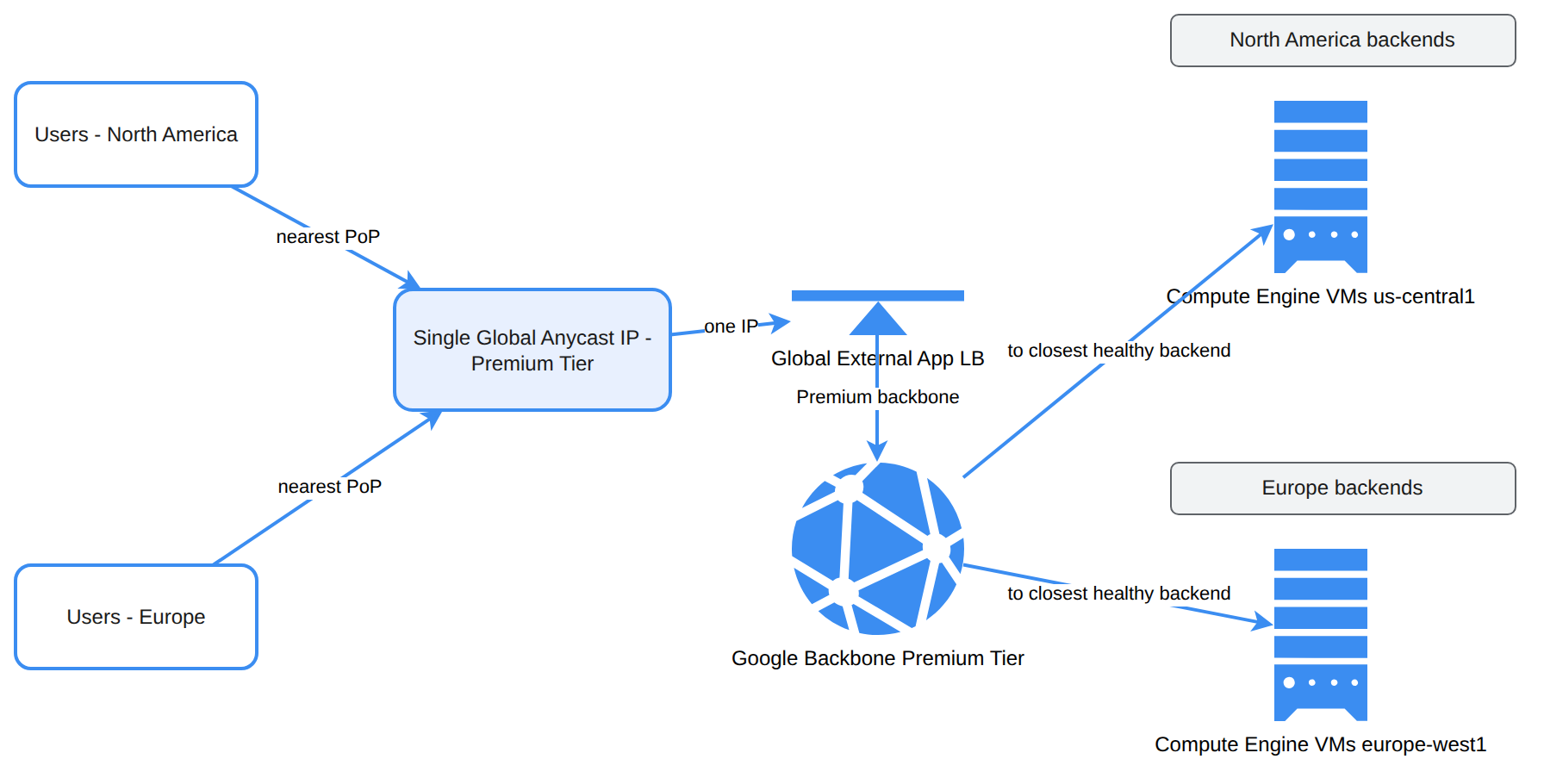
Key Advantages and Capabilities
- Global reach and performance: Traffic rides Google's private backbone for the majority of the transit path, minimizing latency, packet loss, and public internet hops.
- Simplified architecture: Eliminates the need to maintain separate regional load balancers and complex external DNS-based geo-routing systems.
- High availability and SLA: Premium Tier provides a 99.99% uptime SLA for VM network connectivity.
- Integrated edge services: Premium Tier enables compatibility with global edge services like Cloud CDN and Google Cloud Armor.
Why This Is Optimal
Premium Tier is the only network tier that supports global external IP addresses and multi-region backend load balancing under a single IP. It provides the lowest latency, maximum reliability, and native global traffic distribution required by worldwide applications.
Standard Tier with a regional external IP address
Standard Tier with a regional external IP address
What Standard Tier with a Regional External IP Address Is
Standard Tier is a cost-optimized networking tier that routes inbound and outbound traffic primarily over third-party peering and transit ISP networks rather than Google's private backbone. It uses regional external IP addresses that terminate traffic in the specific region where the Google Cloud resource resides.
Why It Doesn't Meet the Requirement
- Single-region backend limitation: A Standard Tier load balancer can only reference backend VM instances that reside in the same single region as the forwarding rule and IP address. It cannot balance traffic across backends in both North America and Europe simultaneously under one load balancer.
- Requires multiple load balancers and IPs: To serve multiple regions using Standard Tier, an organization must deploy a completely separate load balancer with its own unique regional external IP address in each region, and then implement external DNS-based routing (such as geolocation routing) to split the traffic.
Key Characteristics and Limitations
- Regional scope: Standard Tier load balancers are strictly regional resources and cannot natively direct global traffic to multi-region backends.
- Routing behavior: Outbound traffic exits Google's network at a transit/peering point in the originating region rather than traveling over Google's backbone to the user.
- SLA difference: Standard Tier provides a 99.9% uptime SLA, compared to the 99.99% uptime SLA offered by Premium Tier.
This Answer Would Be Correct If
The workload were located entirely within a single region, prioritized lower egress costs over performance, and did not require multi-region backend load balancing under a single IP.
Additional Context
Standard Tier is an excellent choice for batch processing, dev/test environments, or regionally contained applications, but it cannot satisfy global Anycast multi-region load balancing requirements.
Try 10 interactive questions like this one, free
Answer them yourself and get your score the moment you finish. No account needed.
Full access includes
- 2,014 practice questions across all 4 exam domains
- Every answer explained: why it is right, and why the others are not
- Scout, an AI tutor that answers your follow-up questions
- Readiness tracking by domain, so you know when to book the exam
Related free sample questions
Keep the momentum going with these hand-picked practice scenarios
FundamentalAssociate Cloud Engineer
Standard vs Premium Network Service Tiers
Differentiating Network Service Tiers
FundamentalAssociate Cloud Engineer
Service Accounts for Non-Human Workloads
Granting members Identity and Access Management (IAM) roles within a project
FundamentalAssociate Cloud Engineer
gcloud compute instances list --filter
Viewing current running Compute Engine instances
FundamentalAssociate Cloud Engineer
Cloud Billing Budget Scope Filters
Establishing billing budgets and alerts
FundamentalAssociate Cloud Engineer
Counter vs Distribution Log-Based Metrics
Creating and ingesting Cloud Monitoring custom metrics (e.g., from applications or logs)
AdvancedProfessional Cloud DevOps Engineer
Config Sync and Policy Controller
Making infrastructure changes using Google-recommended practices and blueprints
Last updated