Fundamental
Prepare and test your skills

Fundamental
Prepare and test your skills
Using Organizational Units and Google Groups for Access
Free sample question with answers and detailed explanation below. The Associate Cloud Engineer practice bank has an additional 2,014 practice questions.Try 10 free realistic questions: instant score, no credit card, and no account required.
An organization is setting up its Google Cloud solution environment for a newly onboarded engineering team. The cloud administrator needs to manually provision corporate identities, enforce organizational security policies such as multi-factor authentication for specific departments, and manage access to Google Cloud project resources efficiently at scale.
Which administrative approach should the administrator implement to meet these requirements?
Explanations
Create user accounts in Cloud Identity, organize them into Organizational Units (OUs) to apply security policies, and add users to Google Groups that are granted IAM roles on cloud resources.
Create user accounts in Cloud Identity, organize them into Organizational Units (OUs) to apply security policies, and add users to Google Groups that are granted IAM roles on cloud resources.
What Cloud Identity and Google Groups Administration Is
Cloud Identity provides a centralized platform to manage corporate identities, authentication policies, and organizational structure. Organizational Units (OUs) allow administrators to arrange user accounts hierarchically and apply specific configuration and security settings, such as 2-Step Verification requirements. Google Groups act as collections of user accounts that can be assigned Identity and Access Management (IAM) roles directly, enabling scalable access control across Google Cloud resources.
How It Meets the Organization's Requirements
- Corporate Identity Management: Creating corporate accounts in Cloud Identity establishes centrally managed employee identities rather than relying on unmanaged personal accounts.
- Departmental Policy Application: Placing users into distinct Organizational Units enables administrators to enforce specific security baselines, session controls, and authentication requirements tailored to specific departments.
- Scalable Resource Access: Adding users to Google Groups allows members to inherit IAM roles granted to the group across projects and folders. Access is easily managed by modifying group membership rather than updating individual IAM policies.
Group-Based IAM Inheritance at Scale
System Architecture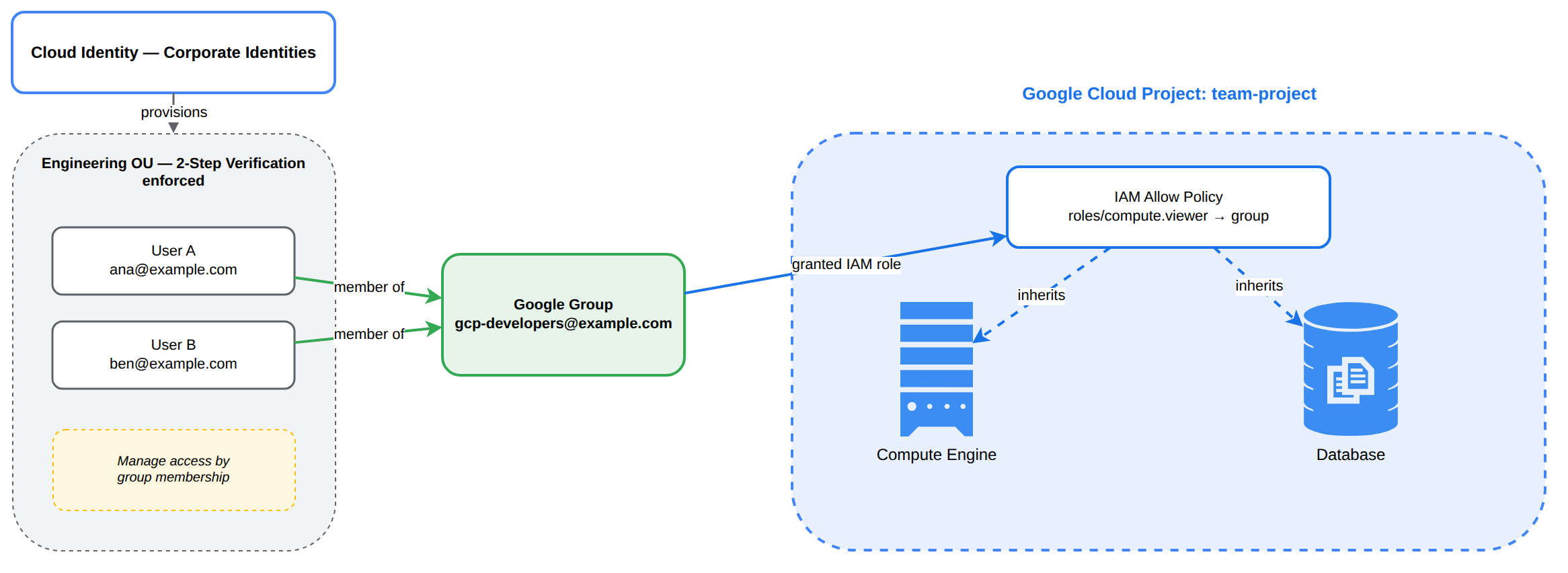
Key Advantages and Capabilities
- Role Inheritance: Group members automatically inherit IAM permissions granted to the group, reducing administrative overhead and permission drift.
- Granular Policy Application: OUs let administrators turn services on or off and enforce multi-factor authentication rules per department.
- Least-Privilege Management: Simplifies granting, auditing, and revoking permissions across project hierarchies from a single management plane.
- Streamlined Onboarding and Offboarding: Adding or removing an employee from a group immediately updates their access across all assigned Google Cloud resources.
Why This Is Optimal
This architecture follows Google-recommended best practices by decoupling identity governance (OUs and security settings in Cloud Identity) from access control (Google Groups bound to IAM roles). Assigning roles to groups instead of individual users ensures security controls remain maintainable, auditable, and scalable as teams expand.
Configure personal Gmail accounts for each team member, assign individual IAM roles directly on each cloud project, and enforce access restrictions using Deployment Manager type providers.
Configure personal Gmail accounts for each team member, assign individual IAM roles directly on each cloud project, and enforce access restrictions using Deployment Manager type providers.
What Personal Accounts and Deployment Manager Are
Personal Gmail accounts (consumer accounts) are managed directly by individuals rather than an enterprise administrator. Deployment Manager is an infrastructure-as-code automation service used to create and manage Google Cloud resources using declarative configuration files.
Why It Doesn't Meet the Requirement
- No corporate policy control: Consumer accounts (@gmail.com) fall outside the company's Cloud Identity domain. Administrators cannot enforce mandatory multi-factor authentication, manage account lifecycles, or control session policies through Organizational Units.
- High administrative overhead: Assigning IAM roles individually to each user across various projects does not scale and easily results in over-privileged access and configuration errors.
- Misuse of Deployment Manager: Deployment Manager type providers are used to expose external APIs to infrastructure deployment templates, not to enforce user identity or access policies.
Key Characteristics and Limitations
- Consumer accounts remain under individual user ownership, creating substantial security and data governance risks when employees leave the company.
- Direct assignment of roles to individual user emails violates the principle of managing role assignments via centralized security groups.
- Deployment Manager cannot replace Cloud Identity directory structures or identity access control mechanisms.
This Answer Would Be Correct If
A single independent developer were testing personal sandbox environments without enterprise governance or compliance requirements.
Create individual service accounts for each engineer, organize the service accounts into resource hierarchy folders, and grant IAM roles directly to each service account.
Create individual service accounts for each engineer, organize the service accounts into resource hierarchy folders, and grant IAM roles directly to each service account.
What Service Accounts and Resource Hierarchy Folders Are
Service accounts are special Google Cloud accounts intended for non-human identities, such as applications, workloads, or automated virtual machines, to authenticate and interact with Google Cloud APIs. Folders are resource hierarchy nodes used to organize projects and apply inherited IAM policies down the resource tree.
Why It Doesn't Meet the Requirement
- Service accounts are not for human users: Service accounts are meant for application workloads and lack essential end-user identity features such as corporate password management, self-service recovery, and interactive single sign-on.
- Organizational policies cannot be applied to service accounts via OUs: Security settings like multi-factor authentication (MFA) and departmental sign-in policies apply to human users in Cloud Identity Organizational Units, not service accounts.
- Direct IAM role assignment lacks scalability: Granting permissions directly to individual service accounts rather than groups leads to significant operational complexity and security risk.
Key Characteristics and Limitations
- Service accounts authenticate using key pairs or token exchange, not interactive user credentials.
- Resource hierarchy folders contain projects and other folders, but they do not contain user identities or service accounts directly.
- Managing individual user permissions directly creates permission sprawl and complicates compliance auditing.
This Answer Would Be Correct If
You needed to grant an automated backend application or deployment script access to specific project resources without human interaction.
Additional Context
Human employees should always authenticate using their own corporate Cloud Identity accounts. Service account impersonation can be used when developers need elevated access for specific automated tasks.
Create Cloud Monitoring resource groups for each engineer, define metric alerting policies on the groups, and attach project-level IAM roles to the alerting policies.
Create Cloud Monitoring resource groups for each engineer, define metric alerting policies on the groups, and attach project-level IAM roles to the alerting policies.
What Cloud Monitoring Resource Groups Are
Cloud Monitoring resource groups are logical collections of infrastructure resources (such as Compute Engine virtual machine instances, Cloud Storage buckets, or App Engine services) defined by criteria like tags, names, or regions. They are used to aggregate metrics, display dashboards, and trigger alerting policies when operational thresholds are breached.
Why It Doesn't Meet the Requirement
- Not an identity management tool: Monitoring resource groups aggregate cloud infrastructure components, not human user identities or corporate accounts.
- Cannot enforce identity policies: Resource groups cannot configure authentication mechanisms, enforce multi-factor authentication, or manage organizational units.
- Alerting policies cannot grant access: Alerting policies notify teams of operational anomalies; they do not serve as IAM principals and cannot grant permissions to Google Cloud resources.
Key Characteristics and Limitations
- Cloud Monitoring groups are limited to infrastructure and metrics scope administration.
- Membership in Monitoring resource groups is based on infrastructure criteria like resource names, regions, or network tags.
- Monitoring tools are designed for observability and reliability tracking, entirely separate from identity governance.
This Answer Would Be Correct If
You needed to track the health, uptime, and CPU utilization of a collection of virtual machines deployed across multiple environments and receive alerts when system limits are exceeded.
Try 10 interactive questions like this one, free
Answer them yourself and get your score the moment you finish. No account needed.
Full access includes
- 2,014 practice questions across all 4 exam domains
- Every answer explained: why it is right, and why the others are not
- Scout, an AI tutor that answers your follow-up questions
- Readiness tracking by domain, so you know when to book the exam
Related free sample questions
Keep the momentum going with these hand-picked practice scenarios
FundamentalAssociate Cloud Engineer
Google Cloud Directory Sync One-Way Synchronization
Managing users and groups in Cloud Identity (manually and automated)
FundamentalAssociate Cloud Engineer
Cloud Identity Groups For IAM
Managing users and groups in Cloud Identity (manually and automated)
FundamentalAssociate Cloud Engineer
gcloud spanner databases execute-sql
Executing queries to retrieve data from data instances (e.g., Cloud SQL, BigQuery, Bigtable, Spanner, Firestore, AlloyDB)
FundamentalAssociate Cloud Engineer
Static External IP with Cloud DNS A Record
Setting up cloud networking
FundamentalAssociate Cloud Engineer
Database Center Analyze System Performance
Using Database Center to manage the Google Cloud database fleet
AdvancedProfessional Data Engineer
Cloud Storage Dual-Region Turbo and BigQuery Cross-Region Replication
Regional considerations (data sovereignty) for data access and storage
Last updated