Fundamental
Prepare and test your skills

Fundamental
Prepare and test your skills
Right-Size GKE Autopilot CPU and Memory Requests
Free sample question with answers and detailed explanation below. The Associate Cloud Engineer practice bank has an additional 2,014 practice questions.Try 10 free realistic questions: instant score, no credit card, and no account required.
An administrator is deploying an in-memory data processing workload to a Google Kubernetes Engine (GKE) Autopilot cluster. During performance testing, the Pod encounters frequent Out-Of-Memory (OOMKilled) termination errors because memory allocation is insufficient for the working set, while CPU utilization remains near zero despite having several vCPUs requested.
The administrator wants to ensure workload stability while optimizing operational costs in GKE Autopilot.
What should the administrator do?
Explanations
Increase the Pod's memory request to fit the required working set and reduce the CPU request to match actual utilization
Increase the Pod's memory request to fit the required working set and reduce the CPU request to match actual utilization
What Pod Resource Request Optimization Is
Pod resource request optimization in Google Kubernetes Engine (GKE) Autopilot is the practice of tailoring container CPU, memory, and storage requests to reflect the true runtime resource profile of the workload.
How It Meets The Requirements
- Eliminates
OOMKilledcrashes: Increasing the memory request provides sufficient memory to accommodate the application's active working set, preventing the Linux kernel out-of-memory killer from terminating the container. - Prevents unnecessary billing: In GKE Autopilot, billing is based directly on the vCPU, memory, and storage resources requested by Pods rather than underlying node sizing. Reducing over-provisioned CPU requests directly lowers hourly cluster spend.
- Ensures accurate scheduling: Setting requests tailored to actual demand ensures GKE Autopilot places the Pod on an infrastructure node with guaranteed resources.
Key Advantages and Capabilities
- Predictable execution: Workloads maintain stability without experiencing throttling or sudden eviction during traffic spikes.
- Cost-efficient scaling: Resources are provisioned exactly where needed (higher memory-to-CPU ratio) without paying for idle compute cycles.
- Autopilot alignment: Seamlessly complies with Autopilot's resource model where requests define scheduling and billing boundaries.
- High availability: Eliminates recurring Pod restart loops caused by resource starvation.
Why This Is Optimal
GKE Autopilot operates on a per-Pod billing model where users pay specifically for the resources requested by running workloads. Adjusting requests to supply sufficient RAM for the working set while trimming idle vCPUs achieves both high reliability and minimal cost.
Right-Sizing Memory and CPU in Autopilot
Comparison Matrix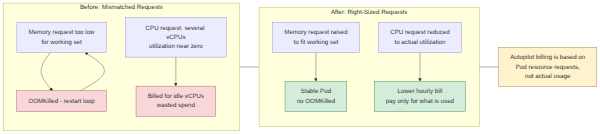
Over-provision both CPU and memory requests to the maximum allowable values because Autopilot only bills for actual process consumption
Over-provision both CPU and memory requests to the maximum allowable values because Autopilot only bills for actual process consumption
What This Option Is
This approach sets CPU and memory requests to excessively high values under the assumption that GKE Autopilot charges solely for real-time CPU cycles and RAM consumed by running processes.
Why It Doesn't Meet The Requirement
- Fundamental billing misconception: GKE Autopilot bills based on the Pod resource requests, not on real-time process utilization metrics.
- High financial waste: Over-provisioning CPU and memory requests results in substantial unnecessary charges for reserved but unused capacity.
- Scheduling constraints: Extremely large requests can make Pod scheduling harder and may hit Autopilot maximum resource per Pod limits.
Key Characteristics and Limitations
- Billing model: Autopilot pricing is calculated per second based on requested vCPU, memory, and storage quantities.
- Resource reservation: Requested resources are dedicated to the Pod to guarantee predictable performance.
- Best practice violation: Over-provisioning directly violates cloud cost optimization best practices.
This Answer Would Be Correct If
Google Cloud offered an execution mode where GKE Autopilot billed exclusively on telemetry-measured process consumption rather than declared Pod request reservations.
Omit CPU and memory requests from the Pod manifest so Autopilot dynamically allocates unlimited memory at runtime
Omit CPU and memory requests from the Pod manifest so Autopilot dynamically allocates unlimited memory at runtime
What This Option Is
This approach attempts to remove the resources.requests specification entirely from the container manifest, assuming Kubernetes will provide elastic, unbounded compute resources.
Why It Doesn't Meet The Requirement
- Default request injection: When requests are omitted in GKE Autopilot, the cluster automatically applies default resource requests (such as 500m vCPU and 2GiB memory per Pod).
- Fails to fix OOM issues: If the default memory allocation is smaller than the workload's working set, the Pod will continue to suffer
OOMKilledcrashes. - No unlimited memory: Kubernetes and Autopilot do not provide unbounded runtime memory without explicit resource specifications.
Key Characteristics and Limitations
- Autopilot defaults: Autopilot mutates manifests lacking resource requests by inserting predefined minimum resource values.
- Suboptimal sizing: Relying on system defaults often results in either under-provisioning memory-intensive apps or over-provisioning lightweight utilities.
- Lack of cost control: Defaults assign fixed CPU allocations that may exceed the needs of memory-heavy workloads.
This Answer Would Be Correct If
This option would be appropriate only for quick proof-of-concept testing of basic, generic workloads that naturally fit within standard default Kubernetes resource parameters.
Increase the CPU request to maximum while leaving memory requests unchanged so the OS can swap memory pages
Increase the CPU request to maximum while leaving memory requests unchanged so the OS can swap memory pages
What This Option Is
This configuration increases the container's compute request while keeping memory low, assuming the underlying operating system can swap active container memory to disk.
Why It Doesn't Meet The Requirement
- Does not prevent crashes: Standard Kubernetes container runtimes enforce hard cgroup memory limits; exceeding assigned container memory limits triggers an
OOMKilledtermination regardless of available CPU. - Extreme cost inflation: Requesting excess CPU cores significantly inflates GKE Autopilot billing costs because compute requests are billed continuously per vCPU-hour.
- Misaligned architecture: Additional CPU cannot compensate for insufficient RAM when storing in-memory working sets.
Key Characteristics and Limitations
- Strict memory enforcement: In GKE Autopilot, memory limits are automatically enforced based on requests.
- No swap mitigation: Kubernetes node configurations typically disable or tightly restrict traditional swap for standard container memory isolation.
- Resource imbalance: Creating a severe imbalance between compute and memory leads to inefficient resource utilization.
This Answer Would Be Correct If
The workload was CPU-bound and experiencing computational throttling during intensive calculations rather than memory exhaustion.
Try 10 interactive questions like this one, free
Answer them yourself and get your score the moment you finish. No account needed.
Full access includes
- 2,014 practice questions across all 4 exam domains
- Every answer explained: why it is right, and why the others are not
- Scout, an AI tutor that answers your follow-up questions
- Readiness tracking by domain, so you know when to book the exam
Related free sample questions
Keep the momentum going with these hand-picked practice scenarios
FundamentalAssociate Cloud Engineer
Shared VPC Subnet-Level IAM
Creating a VPC with subnets (e.g., custom mode VPC, Shared VPC)
FundamentalAssociate Cloud Engineer
Private Google Access and VPC Flow Logs
Adding a subnet to an existing VPC
FundamentalAssociate Cloud Engineer
Logs Explorer Resource Log Name Severity Filters
Viewing and filtering logs in Cloud Logging
FundamentalAssociate Cloud Engineer
Windows Sysprep Specialize Script Metadata
Launching a compute instance (e.g., availability policy, SSH keys)
FundamentalAssociate Cloud Engineer
OS Login Ignores Metadata SSH Keys
Configuring OS Login
AdvancedProfessional Data Engineer
Migration Wave Planning
Analyzing current stakeholder needs, users, processes, and technologies, and creating a plan to get to desired state
Last updated