Fundamental
Prepare and test your skills

Fundamental
Prepare and test your skills
External Application Load Balancer Frontend and Backend Setup
Free sample question with answers and detailed explanation below. The Associate Cloud Engineer practice bank has an additional 2,014 practice questions.Try 10 free realistic questions: instant score, no credit card, and no account required.
Your company is deploying a public web application across multiple Compute Engine instances in a managed instance group (MIG). You are configuring an External Application Load Balancer and must satisfy two key requirements:
- Provide a single, public entry point that terminates client HTTPS traffic using a Google-managed SSL certificate and an external IP address.
- Ensure client traffic is automatically routed only to healthy VM instances that are actively responding to web requests.
Which combination of load balancer components should you configure?
Explanations
Configure the SSL certificate and public IP directly on the backend service, and enable VPC firewall logging to filter out traffic to unhealthy instances.
Configure the SSL certificate and public IP directly on the backend service, and enable VPC firewall logging to filter out traffic to unhealthy instances.
What Backend Services and Firewall Rules Do
A backend service in Google Cloud manages backend capacity, session affinity, and connections to backend resources like instance groups or network endpoint groups (NEGs). VPC firewall logging records metadata for network flows that match specific firewall rules for auditing and security analysis.
Why It Doesn't Meet the Requirement
- SSL and IP configuration: Backend services do not bind external IP addresses or terminate client SSL certificates; those are frontend responsibilities handled by forwarding rules and target proxies.
- Health monitoring and traffic routing: Firewall logging is purely a passive monitoring tool. It cannot assess application health or dynamically steer client requests away from failing VM instances.
Key Characteristics and Limitations
- Backend services direct traffic to backends based on health checks and capacity metrics, but do not listen directly on external public IPs.
- Firewall rules permit or deny traffic based on IP protocol, ports, and network tags, but do not perform Layer 7 application routing.
- Logging captures packet metadata without providing automated load-balancing redirection.
This Answer Would Be Correct If
The requirement were to audit network packet drops or inspect accepted network connections across subnets for compliance purposes.
Configure a frontend forwarding rule and target HTTPS proxy for the IP address and SSL certificate, and associate a health check with the backend service containing the MIG.
Configure a frontend forwarding rule and target HTTPS proxy for the IP address and SSL certificate, and associate a health check with the backend service containing the MIG.
What Load Balancer Frontend and Backend Configurations Are
In Google Cloud, an External Application Load Balancer is structured into distinct frontend and backend architectural layers. The frontend configuration consists of a global forwarding rule and a target HTTPS proxy, while the backend configuration includes a backend service, instance groups, and a health check.
How It Meets the Requirements
- Terminating HTTPS and managing IP addresses: The forwarding rule assigns a static public external IP address and directs incoming traffic on port 443 to a target HTTPS proxy. The target HTTPS proxy holds the Google-managed SSL certificate, decrypts incoming SSL/TLS connections, and passes HTTP requests to the URL map.
- Routing only to healthy instances: The backend service defines how traffic is distributed across backends such as the managed instance group (MIG). Associating a centralized health check with the backend service causes Google Cloud's health check probers to query instances at defined intervals. If an instance fails consecutive checks, the load balancer automatically stops directing new requests to that instance until it becomes healthy again.
Key Advantages and Capabilities
- Separation of concerns: Frontend components handle connection termination, encryption, and routing, while backend components handle capacity, auto-scaling, and health monitoring.
- Automated high availability: Unhealthy backend instances are seamlessly removed from load balancing pools with zero disruption to end users.
- Simplified certificate management: Google-managed SSL certificates automatically provision, deploy, and renew certificates without manual intervention.
- Flexible backend distribution: Backend services allow fine-grained traffic distribution algorithms (e.g., utilization or request rate) across regional or multi-zone instance groups.
Why This Is Optimal
This architecture adheres strictly to Google Cloud's standard design pattern for external Layer 7 load balancers, ensuring secure frontend termination and resilient, health-aware backend distribution.
Health Checks Route Traffic to Healthy VMs
Sequence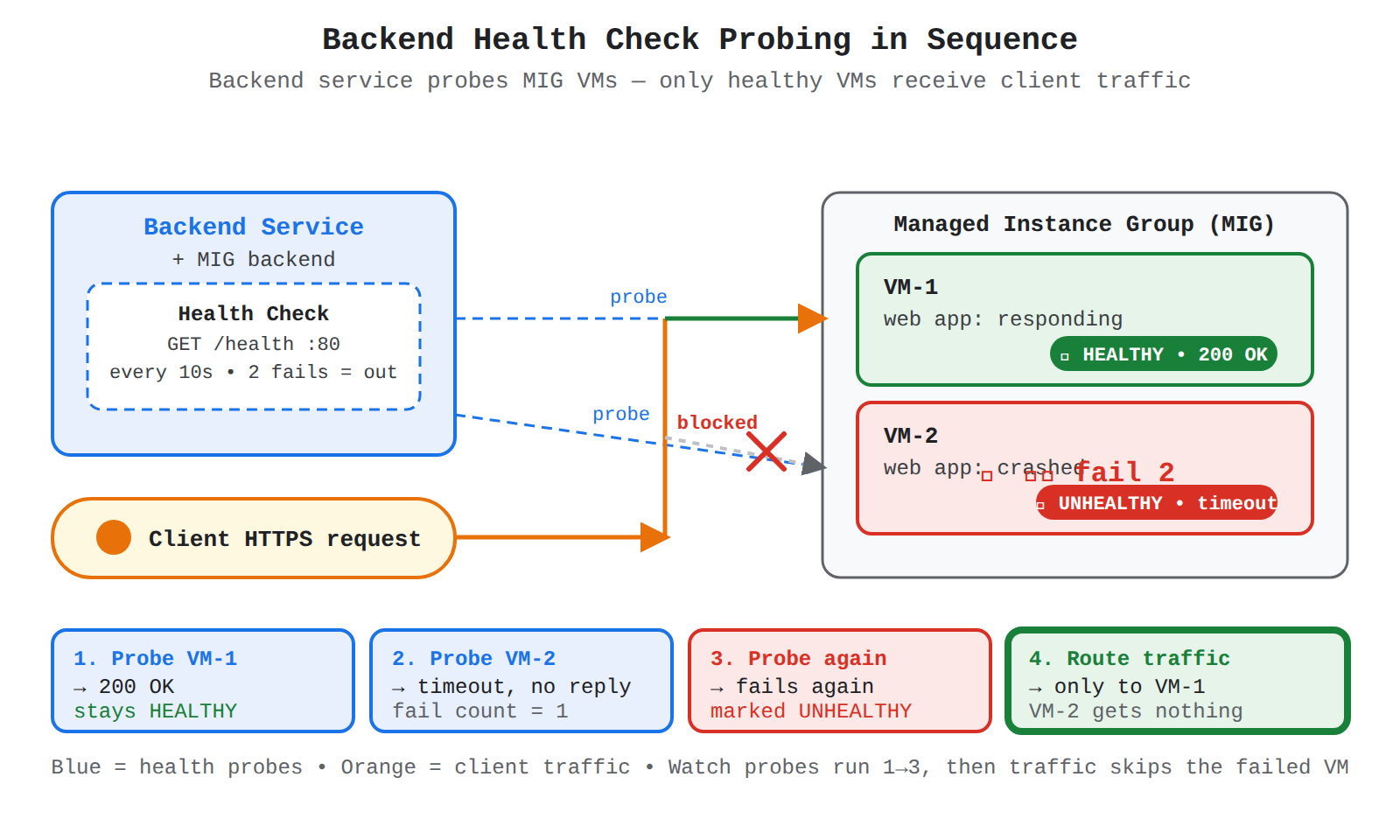
Configure a Cloud Armor security policy to terminate SSL connections, and attach an autohealing policy directly to the load balancer URL map.
Configure a Cloud Armor security policy to terminate SSL connections, and attach an autohealing policy directly to the load balancer URL map.
What Cloud Armor and URL Maps Are
Google Cloud Armor provides Web Application Firewall (WAF) filtering and DDoS mitigation for external HTTP(S) load balancers. A URL map provides Layer 7 request routing based on HTTP hostnames and URL path patterns to specific backend services or backend buckets.
Why It Doesn't Meet the Requirement
- SSL termination: Cloud Armor evaluates request attributes and enforces allow/deny security rules, but it does not act as an SSL termination endpoint or bind SSL certificates.
- Health monitoring: URL maps define routing paths (such as sending
/videoto a video backend service), but they do not support health checks or autohealing policies directly.
Key Characteristics and Limitations
- Cloud Armor policies attach to backend services or security gateway rules, not to the frontend IP directly for TLS termination.
- Autohealing policies are configured on managed instance groups (MIGs), not on load balancer URL maps.
- URL maps route requests between backend services but do not evaluate individual VM instance health.
This Answer Would Be Correct If
The objective were to inspect HTTP request headers and block SQL injection or cross-site scripting (XSS) attacks before requests reach the backends.
Configure a target pool with an attached SSL certificate, and set up Cloud Monitoring uptime checks directly on the forwarding rule.
Configure a target pool with an attached SSL certificate, and set up Cloud Monitoring uptime checks directly on the forwarding rule.
What Target Pools and Cloud Monitoring Uptime Checks Do
A target pool is a legacy backend resource used specifically with External Passthrough Network Load Balancers (Layer 4). Cloud Monitoring uptime checks verify external availability of public endpoints from multiple global locations for alerting and monitoring dashboards.
Why It Doesn't Meet the Requirement
- Layer 7 SSL termination: Target pools only handle Layer 4 TCP/UDP traffic and do not terminate HTTPS traffic or support SSL certificates.
- Automated traffic redirection: Cloud Monitoring uptime checks generate alerts and notifications, but they do not dynamically guide load balancer traffic away from failed instances in real time.
Key Characteristics and Limitations
- Target pools cannot be used as backends for External Application Load Balancers.
- Target pools require regional HTTP health checks and cannot use modern global backend services.
- Uptime checks operate asynchronously outside the load balancer data plane.
This Answer Would Be Correct If
You were configuring a legacy Layer 4 Network Load Balancer that forwards raw TCP traffic directly to backend instances without terminating SSL.
Try 10 interactive questions like this one, free
Answer them yourself and get your score the moment you finish. No account needed.
Full access includes
- 2,014 practice questions across all 4 exam domains
- Every answer explained: why it is right, and why the others are not
- Scout, an AI tutor that answers your follow-up questions
- Readiness tracking by domain, so you know when to book the exam
Related free sample questions
Keep the momentum going with these hand-picked practice scenarios
FundamentalAssociate Cloud Engineer
External Application Load Balancer URL Routing
Choosing and deploying load balancers
FundamentalAssociate Cloud Engineer
Global External Application Load Balancer
Choosing and deploying load balancers
FundamentalAssociate Cloud Engineer
Premium Tier Global External IP
Differentiating Network Service Tiers
FundamentalAssociate Cloud Engineer
Predefined vs Basic IAM Roles
Managing IAM permissions of a service account
FundamentalAssociate Cloud Engineer
MIG Autohealing Initial Delay
Creating an autoscaled managed instance group by using an instance template
AdvancedProfessional Cloud Network Engineer
Cloud NGFW Enterprise MTU Limit
Planning the firewall strategy (e.g., VPC firewall rules, Cloud NGFW, hierarchical firewall rules, and third-party integration).
Last updated