Fundamental
Prepare and test your skills

Fundamental
Prepare and test your skills
Automated Storage Class Transitions by Object Age
Free sample question with answers and detailed explanation below. The Associate Cloud Engineer practice bank has an additional 2,014 practice questions.Try 10 free realistic questions: instant score, no credit card, and no account required.
A financial analytics company generates daily transaction audit files and stores them in Google Cloud Storage. The access pattern and retention policy for these files are defined as follows:
- First 30 days: Read and analyzed frequently by analysts.
- Day 31 to 90: Accessed at most once a month for monthly reconciliations.
- Day 91 to 365: Accessed at most once a year for annual compliance checks.
- After 365 days: Retained for long-term compliance for 5 years, accessed less than once a year.
You need to design a cost-effective storage strategy that requires no ongoing manual intervention.
Which solution should you implement?
Explanations
Upload files initially to Archive storage to minimize storage costs immediately, and configure an Object Lifecycle Management rule to restore objects to Standard storage upon each read request.
Upload files initially to Archive storage to minimize storage costs immediately, and configure an Object Lifecycle Management rule to restore objects to Standard storage upon each read request.
What Archive Storage Is and How It Operates
Archive storage is Google Cloud's lowest-cost at-rest storage class designed strictly for cold data accessed less than once a year, such as long-term backups and regulatory archives. It incurs substantial data retrieval fees per gigabyte read and carries a 365-day minimum storage duration requirement.
Why It Doesn't Meet the Requirement
- Excessive retrieval costs during the first 30 days: During the initial period when data is read frequently by analysts, every read from Archive storage incurs high data access charges that quickly eliminate any at-rest storage savings.
- Unsupported lifecycle trigger: Object Lifecycle Management does not support reactive triggers based on user read events or access requests; lifecycle actions are evaluated based on metadata attributes such as
age,createdBefore, orisLive. - Early modification penalties: Moving or rewriting an object out of Archive before 365 days can incur early deletion and rewrite charges.
Key Characteristics and Limitations
- Designed for cold archiving: Intended for data that may never be accessed during its lifecycle.
- High retrieval costs: Cost structure heavily penalizes frequent reads and operational queries.
- 365-day commitment: Modifying, overwriting, or deleting objects before 365 days triggers early delete fees.
This Answer Would Be Correct If
The files were historical compliance records created strictly for disaster recovery or regulatory mandates that are never expected to be queried under normal operations.
Upload files initially to Coldline storage, and deploy a Cloud Function triggered by Cloud Logging to rewrite objects to Nearline and Archive buckets based on custom daily scans.
Upload files initially to Coldline storage, and deploy a Cloud Function triggered by Cloud Logging to rewrite objects to Nearline and Archive buckets based on custom daily scans.
What This Approach Entails
This architecture involves starting data in Coldline storage and building a custom automation pipeline using Cloud Functions, Cloud Logging, and multiple storage buckets to manually copy and delete objects across tiers.
Why It Doesn't Meet the Requirement
- Inappropriate initial storage class: Starting in Coldline storage subjects active 30-day analytics workloads to high data retrieval fees and a 90-day minimum storage duration commitment.
- Unnecessary architectural complexity: Replacing native Object Lifecycle Management with custom code, event logs, and scheduled Cloud Functions introduces maintenance overhead, operational failure points, and compute execution costs.
- Multi-bucket fragmentation: Moving files across separate buckets changes their URIs and complicates application read paths compared to lifecycle transitions within a single bucket.
Key Characteristics and Limitations
- Coldline access economics: Coldline requires at least 90 days of retention and charges higher per-GB retrieval fees than Standard or Nearline.
- Custom infrastructure burden: Requires maintaining Cloud Functions code, IAM permissions, error handling, retry logic, and monitoring.
- Compute costs: Invoking Cloud Functions to scan millions of objects periodically incurs billable compute time and Cloud Storage API operation charges.
This Answer Would Be Correct If
Class transitions depended on complex external business metadata or external database state not captured in standard Cloud Storage object properties.
Upload files initially to Standard storage, and schedule a monthly Cloud Scheduler job invoking a Cloud Run service that runs batch scripts to change each object's storage class.
Upload files initially to Standard storage, and schedule a monthly Cloud Scheduler job invoking a Cloud Run service that runs batch scripts to change each object's storage class.
What This Approach Entails
This approach uses Cloud Scheduler to trigger a containerized application hosted on Cloud Run, which iterates through bucket objects and executes batch API calls or commands to update storage classes manually.
Why It Doesn't Meet the Requirement
- High implementation and maintenance effort: Building and hosting a bespoke application to perform basic storage tiering creates unnecessary infrastructure overhead when the platform already provides automated lifecycle policies natively.
- Added runtime costs: Running periodic batch jobs on Cloud Run incurs compute charges and high-volume Class A operations (
storage.objects.update/rewrite) for every individual file processed. - Scalability bottlenecks: As the number of audit files grows into millions, batch scanning scripts risk exceeding timeouts, hitting API rate limits, or failing midway through reconciliation cycles.
Key Characteristics and Limitations
- Redundant operational overhead: Reinvents functionality that Cloud Storage handles natively and for free.
- API operation expenses: Explicitly changing an object's storage class via script generates Class A API operations, whereas native lifecycle actions do not incur custom script execution fees.
- Potential synchronization errors: Scheduled scripts might miss newly uploaded files or fail to handle partial batch failures cleanly without robust tracking mechanisms.
This Answer Would Be Correct If
An enterprise required specialized throttling, cross-cloud orchestration, or non-standard regulatory logging of every single class transition event through third-party compliance platforms.
Upload files initially to Standard storage, and configure an Object Lifecycle Management policy to transition objects to Nearline storage at age 30, Coldline storage at age 90, and Archive storage at age 365.
Upload files initially to Standard storage, and configure an Object Lifecycle Management policy to transition objects to Nearline storage at age 30, Coldline storage at age 90, and Archive storage at age 365.
What Cloud Storage Classes and Lifecycle Management Are
Google Cloud Storage provides four primary storage classes tailored to different data access patterns: Standard, Nearline, Coldline, and Archive. Object Lifecycle Management is a native, automated feature that applies defined rules to inspect metadata (such as object age) and automatically perform actions like changing storage classes or deleting objects without requiring external compute or scripts.
How It Meets the Requirements
- First 30 days (Frequent access): Storing objects initially in Standard storage avoids data retrieval fees and per-operation surcharges during the intensive daily analysis phase.
- Days 31 to 90 (Monthly access): Transitioning to Nearline storage at age 30 optimizes cost for data accessed at most once per month (with a 30-day minimum storage duration).
- Days 91 to 365 (Annual access): Transitioning to Coldline storage at age 90 lowers the at-rest storage rate for data accessed at most once a year (with a 90-day minimum storage duration).
- After 365 days (Rare access): Transitioning to Archive storage at age 365 provides the lowest at-rest storage pricing for long-term retention and disaster recovery (with a 365-day minimum storage duration).
- No manual intervention: The lifecycle management policy executes automatically in the background across all matching objects in the bucket.
Lifecycle Age-Based Transitions Timeline
Timeline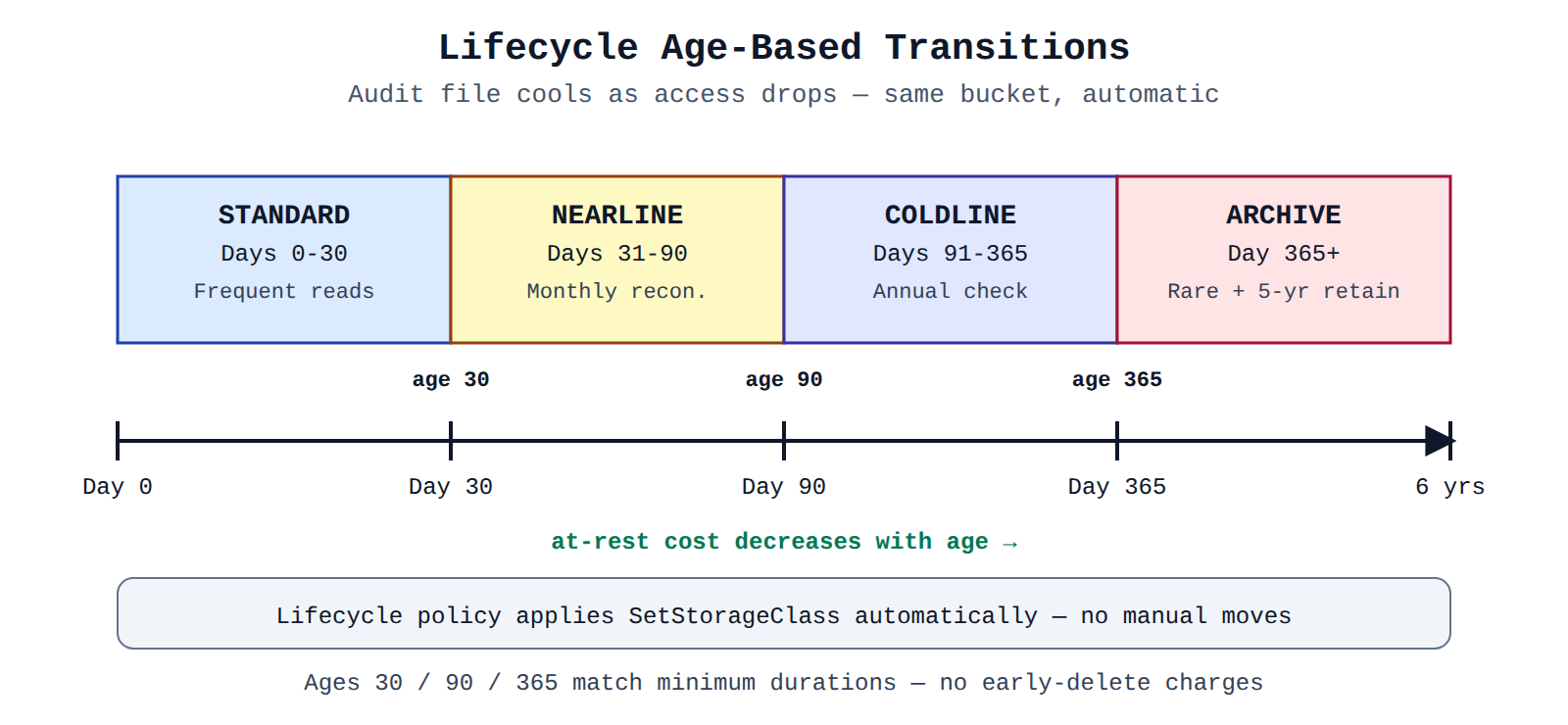
Key Advantages and Capabilities
- Zero operational overhead: Rule evaluation and class transitions are managed internally by Google Cloud Storage.
- Precise alignment with minimum retention durations: The transition ages (30, 90, 365 days) match the exact minimum storage duration requirements of Nearline, Coldline, and Archive classes, preventing early delete charges.
- Predictable cost optimization: Ensures that data at-rest storage unit costs continuously decrease as data matures and access frequency declines.
- Single bucket namespace: Objects remain in the same bucket location and retain their URLs and metadata throughout all lifecycle transitions.
Why This Is Optimal
This configuration perfectly matches each lifecycle stage with its ideal storage class based on access frequency. Because Google Cloud Storage evaluates lifecycle rules daily at zero extra cost, it delivers maximum cost efficiency without provisioning custom schedulers, functions, or manual operator effort.
Try 10 interactive questions like this one, free
Answer them yourself and get your score the moment you finish. No account needed.
Full access includes
- 2,014 practice questions across all 4 exam domains
- Every answer explained: why it is right, and why the others are not
- Scout, an AI tutor that answers your follow-up questions
- Readiness tracking by domain, so you know when to book the exam
Related free sample questions
Keep the momentum going with these hand-picked practice scenarios
FundamentalAssociate Cloud Engineer
NetApp Volumes Multiprotocol SMB NFS
Choosing and deploying storage products (e.g., Cloud Storage, Filestore, Google Cloud NetApp Volumes) and Cloud Storage options (e.g., Standard, Nearline, Coldline, Archive)
FundamentalAssociate Cloud Engineer
Cloud Storage Dual-Region Location
Choosing and deploying storage products (e.g., Cloud Storage, Filestore, Google Cloud NetApp Volumes) and Cloud Storage options (e.g., Standard, Nearline, Coldline, Archive)
FundamentalAssociate Cloud Engineer
External Application Load Balancer URL Routing
Choosing and deploying load balancers
FundamentalAssociate Cloud Engineer
Cloud Run Functions with Functions Framework
Selecting appropriate compute choices for a given workload (e.g., Compute Engine, Google Kubernetes Engine [GKE], Cloud Run, Cloud Run functions, Knative serving)
FundamentalAssociate Cloud Engineer
Private Logs Viewer Role
Configuring audit logs
FundamentalGenerative AI Leader
Google Cloud Enterprise Security and Data Privacy Architecture
Describing how Google Cloud has an enterprise-ready AI platform (e.g., responsible, secure, private, reliable, scalable)
Last updated