Fundamental
Prepare and test your skills

Fundamental
Prepare and test your skills
Restoring Cloud SQL to a Specific Timestamp
Free sample question with answers and detailed explanation below. The Associate Cloud Engineer practice bank has an additional 2,014 practice questions.Try 10 free realistic questions: instant score, no credit card, and no account required.
An operations team manages a production Cloud SQL instance supporting a critical web service. At 2:15 PM, an operator accidentally runs a query that corrupts table data. The team needs to restore the database state to 2:14 PM—one minute prior to the corruption—with minimal data loss.
Automated daily backups run every midnight.
Which strategy should the team implement to restore the database to the specified timestamp?
Explanations
Promote an existing read replica to a standalone primary database instance.
Promote an existing read replica to a standalone primary database instance.
What promoting a read replica does
Promoting a read replica converts an asynchronous read-only database replica into an independent, read-write primary instance. It is primarily used during regional failovers, database migrations, or for testing.
Why it doesn't meet the requirement
- Replicates data corruption: Read replicas continuously stream changes from the primary instance with minimal latency (often milliseconds). When the destructive query executed at 2:15 PM, the change was almost immediately applied to the replica as well.
- Cannot revert to a prior timestamp: Promoting a replica does not roll back data; it simply disconnects the replica from the primary at its current corrupted state.
Key characteristics and limitations
- Designed for scaling and failover: Read replicas offload analytical read queries and facilitate high availability during regional outages.
- Real-time replication: Replicas do not hold historical states or delay transactions to protect against operator errors unless explicitly configured with delayed replication.
This answer would be correct if
The primary database suffered a catastrophic hardware or zone outage and the goal was to achieve quick failover to an uncorrupted secondary replica.
Restore the instance directly from the midnight automated backup without transaction logs.
Restore the instance directly from the midnight automated backup without transaction logs.
What restoring from a base backup is
Restoring from an automated backup rolls the database state back to the exact moment that specific snapshot was taken—in this case, midnight (00:00 AM).
Why it doesn't meet the requirement
- Causes severe data loss: Rolling back to midnight discards more than 14 hours of valid customer transactions recorded between 00:00 AM and 2:14 PM.
- Fails the timestamp requirement: A standalone base backup cannot reconstruct intermediate states or recover to a custom timestamp like 2:14 PM without replaying subsequent transaction logs.
Key characteristics and limitations
- Coarse granularity: Standard automated backups capture the database state once per day during the configured backup window.
- No incremental log replay: Without enabling transaction logging for PITR, changes made after the backup window cannot be reconstructed automatically.
- High Recovery Point Objective (RPO): Relying solely on daily snapshots yields an RPO of up to 24 hours.
This answer would be correct if
The goal was simply to revert the database to the start of the business day, or if transaction logging had been disabled and the midnight snapshot was the only existing recovery point.
Enable Point-in-Time Recovery (PITR) with transaction logging, and perform a restoration by specifying the 2:14 PM timestamp.
Enable Point-in-Time Recovery (PITR) with transaction logging, and perform a restoration by specifying the 2:14 PM timestamp.
What Point-in-Time Recovery (PITR) is
Point-in-Time Recovery (PITR) is a database recovery feature that allows administrators to restore an instance to an exact target time, down to the second. It relies on a combination of regular database backups and continuous transaction logs (such as binary logs in MySQL or write-ahead logs in PostgreSQL) to replay changes up to the specified moment.
How it meets the requirements
- Restores to exact timestamp (2:14 PM): PITR uses the latest base backup prior to 2:14 PM and replays transaction logs sequentially up to 2:14 PM, stopping right before the 2:15 PM corruption.
- Minimizes data loss: Rather than rolling back to the midnight backup and losing more than 14 hours of valid transactions, PITR preserves all legitimate modifications up to the target minute.
- Supports disaster recovery workflows: Cloud SQL creates a new instance or restores data to the chosen timestamp seamlessly without manual SQL log parsing.
PITR: Backup Plus Log Replay to 2:14 PM
Timeline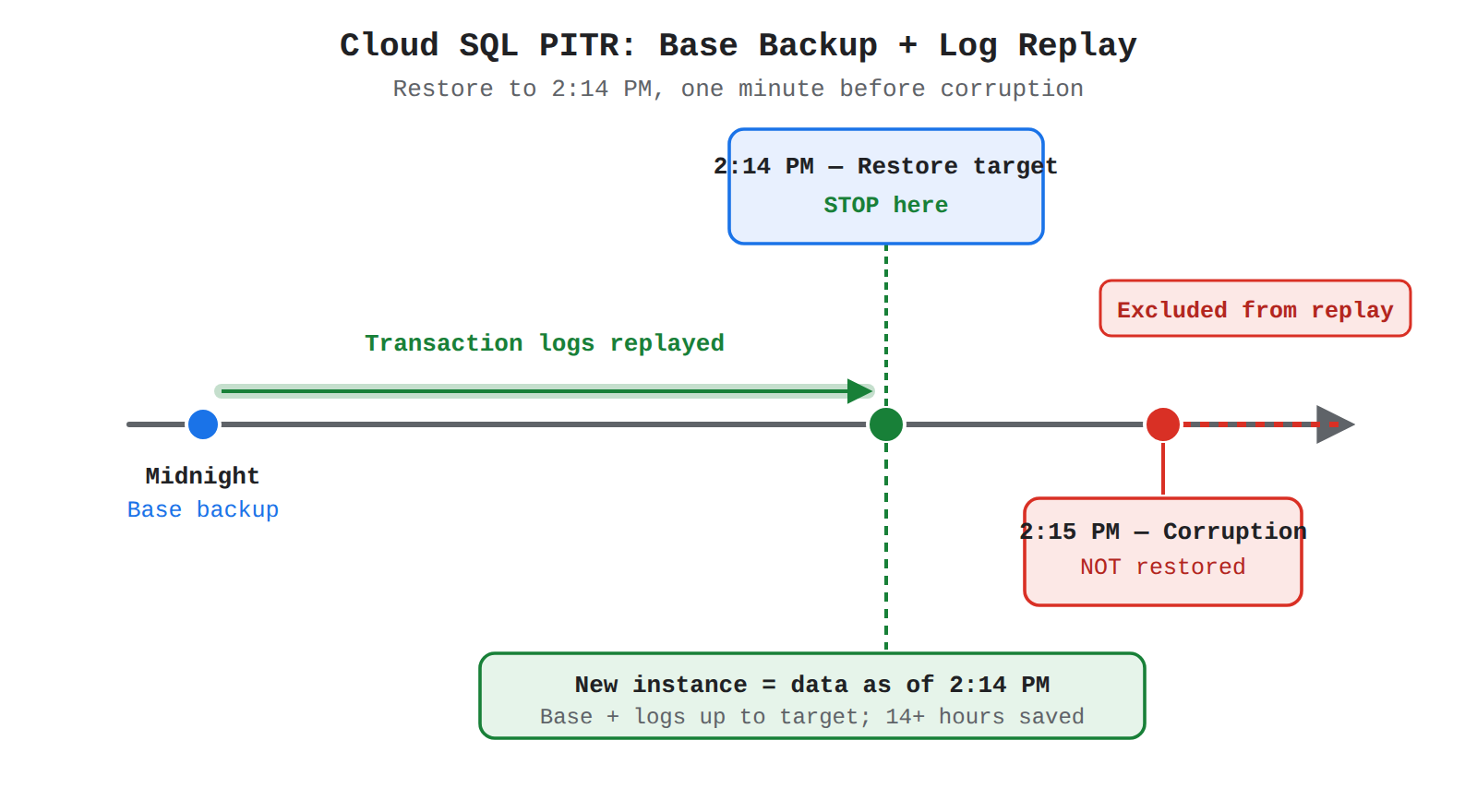
Key advantages and capabilities
- Granular recovery: Enables restoration to any second within the retention window (typically up to 7 days).
- Automated log management: Cloud SQL automatically manages, retains, and applies binary/write-ahead transaction logs.
- Independent instance creation: Restoring to a point in time creates a new instance by default, allowing verification before directing traffic.
- High data durability: Ensures business continuity against human error, data corruption, and failed schema migrations.
Why this is optimal
PITR is the only native mechanism designed to recover from intra-day human error without forfeiting hours of intermediate data modifications. Restoring a standard snapshot or midnight backup causes massive data loss, whereas PITR restores exact database state up to the second before failure.
Export the current database schema to Cloud Storage and execute a table repair script on the active instance.
Export the current database schema to Cloud Storage and execute a table repair script on the active instance.
What schema export and table repair scripts do
Exporting database schemas captures table definitions (DDL) to Cloud Storage, and repair scripts attempt to reconstruct lost data or fix broken indexes directly in place.
Why it doesn't meet the requirement
- Cannot reconstruct missing row data: A schema export contains table structures, not historical row values. If data rows were modified or deleted at 2:15 PM, the schema export will not contain the missing data.
- High manual overhead and risk: Writing custom repair scripts against a corrupted production database increases the risk of further data corruption and requires extensive downtime.
- Fails automated timestamp recovery: Schema definitions do not store transaction history or enable precise timestamp rollbacks.
Key characteristics and limitations
- DDL only: Schema exports contain structural metadata rather than point-in-time data states.
- No transactional rollback: Repair scripts cannot undo uncommitted or committed corrupt queries without a source of historical records.
This answer would be correct if
The table structure itself were corrupted at the storage layer and needed recreation from DDL scripts without restoring historical transaction data.
Try 10 interactive questions like this one, free
Answer them yourself and get your score the moment you finish. No account needed.
Full access includes
- 2,014 practice questions across all 4 exam domains
- Every answer explained: why it is right, and why the others are not
- Scout, an AI tutor that answers your follow-up questions
- Readiness tracking by domain, so you know when to book the exam
Related free sample questions
Keep the momentum going with these hand-picked practice scenarios
FundamentalAssociate Cloud Engineer
Dataflow Spanner Bigtable Export Formats
Backing up and restoring database instances (e.g., Cloud SQL, Firestore, Spanner, AlloyDB, Bigtable)
FundamentalAssociate Cloud Engineer
AlloyDB Automated vs On-Demand Backups
Backing up and restoring database instances (e.g., Cloud SQL, Firestore, Spanner, AlloyDB, Bigtable)
FundamentalAssociate Cloud Engineer
Regional vs Global Static External IP
Reserving static external or internal IP addresses
FundamentalAssociate Cloud Engineer
Gcloud Custom VPC Subnet Creation
Creating a VPC with subnets (e.g., custom mode VPC, Shared VPC)
FundamentalAssociate Cloud Engineer
OS Login Ignores Metadata SSH Keys
Configuring OS Login
FundamentalCloud Digital Leader
Monolith to Microservices Refactoring
Discuss the main benefits of containers and microservices for application modernization.
Last updated