Fundamental
Prepare and test your skills

Fundamental
Prepare and test your skills
Independent Scaling With Loosely Coupled Microservices
Free sample question with answers and detailed explanation below. The Cloud Digital Leader practice bank has an additional 3,070 practice questions.Try 10 free realistic questions: instant score, no credit card, and no account required.
A retail company currently operates a large, monolithic e-commerce application. During promotional sales, spikes in checkout traffic force the engineering team to scale the entire application, which significantly increases infrastructure costs. Additionally, a minor bug in the product recommendation feature recently caused the entire website to crash, and deploying new features requires coordinating all development teams for a single monthly release.
The company wants to modernize its application to achieve the following business and technical goals:
- Scale individual application features independently based on specific traffic demands
- Enable separate development teams to build, update, and deploy features on independent release cycles
- Isolate faults so that a failure in a non-critical component does not cause a system-wide outage
Which architectural approach should the company adopt to meet these requirements?
Explanations
Transition the application to a stateful architecture that relies on local data caching
Transition the application to a stateful architecture that relies on local data caching
What a stateful architecture is
A stateful architecture is a system design in which an application or server retains local persistent data or session state—such as user shopping cart contents, active transaction progress, or local data caches—directly on the compute instance handling the request. Subsequent requests from the same user must be routed back to the exact same server instance to access that locally stored state.
Why it doesn't meet the requirements
- Fails to scale components independently: Stateful designs actively hinder autoscaling and independent component scaling. Because instances hold local state, an autoscaler cannot easily terminate under-utilized instances or spin up new ones without risking data loss or session disruption.
- Fails to enable modular deployment cycles: Introducing local state dependencies makes deployments more complex and risky, as servers must drain active sessions and capture in-flight progress before any code update can occur.
- Fails to isolate faults: If a server holding local state crashes due to a software bug, all in-progress user requests and locally cached data on that machine are lost, increasing downtime and degrading the user experience.
Key characteristics and limitations
- Complicates horizontal scaling: Adding or removing compute nodes requires complex state-synchronization mechanisms or sticky sessions at the load balancer layer.
- Reduces recoverability: Stateful applications require specialized recovery logic to capture progress and restart gracefully after an unexpected crash.
- Increases boot dependencies: Instances often take longer to come online because they must initialize and synchronize local data stores before serving traffic.
This answer would be correct if
This option represents an architectural anti-pattern for elastic cloud workloads, though stateful configurations are occasionally necessary for specialized workloads like legacy relational databases or persistent media-streaming servers that must maintain continuous local file locks.
Additional context
Best practices for application modernization emphasize designing stateless architectures rather than stateful ones. By offloading state and caching to managed external services like Memorystore for Redis or Cloud Spanner, stateless microservices can scale up, scale down, and restart instantaneously without losing critical data.
Refactor the monolithic application into loosely coupled microservices
Refactor the monolithic application into loosely coupled microservices
What a loosely coupled microservices architecture is
A microservices architecture is a modular software design pattern that decomposes a large, monolithic application into a collection of smaller, independent, and loosely coupled services. Each microservice is built around a specific business capability—such as user authentication, product recommendations, shopping cart management, or payment processing—and communicates with other services through well-defined interfaces like APIs or asynchronous event routers.
How it meets the requirements
- Independent scaling of components: Because each business function operates as a standalone service, engineering teams can use targeted scaling to provision compute and memory resources solely for high-demand components (such as the checkout service during a flash sale) without over-allocating resources to less-demanding components.
- Modular deployment cycles: Decoupling the codebase allows autonomous development teams to build, test, and deploy updates to their specific services on independent release schedules, eliminating the bottleneck of coordinating a single, high-risk monthly release across the entire organization.
- Effective isolation of faults: Separating components eliminates single points of failure. By combining loose coupling with resiliency patterns such as circuit breakers and graceful degradation, a bug or failure in a non-critical service (like product recommendations) is contained and will not trigger a cascading failure across the primary checkout workflow.
Microservices Independent Scaling on GKE
System Architecture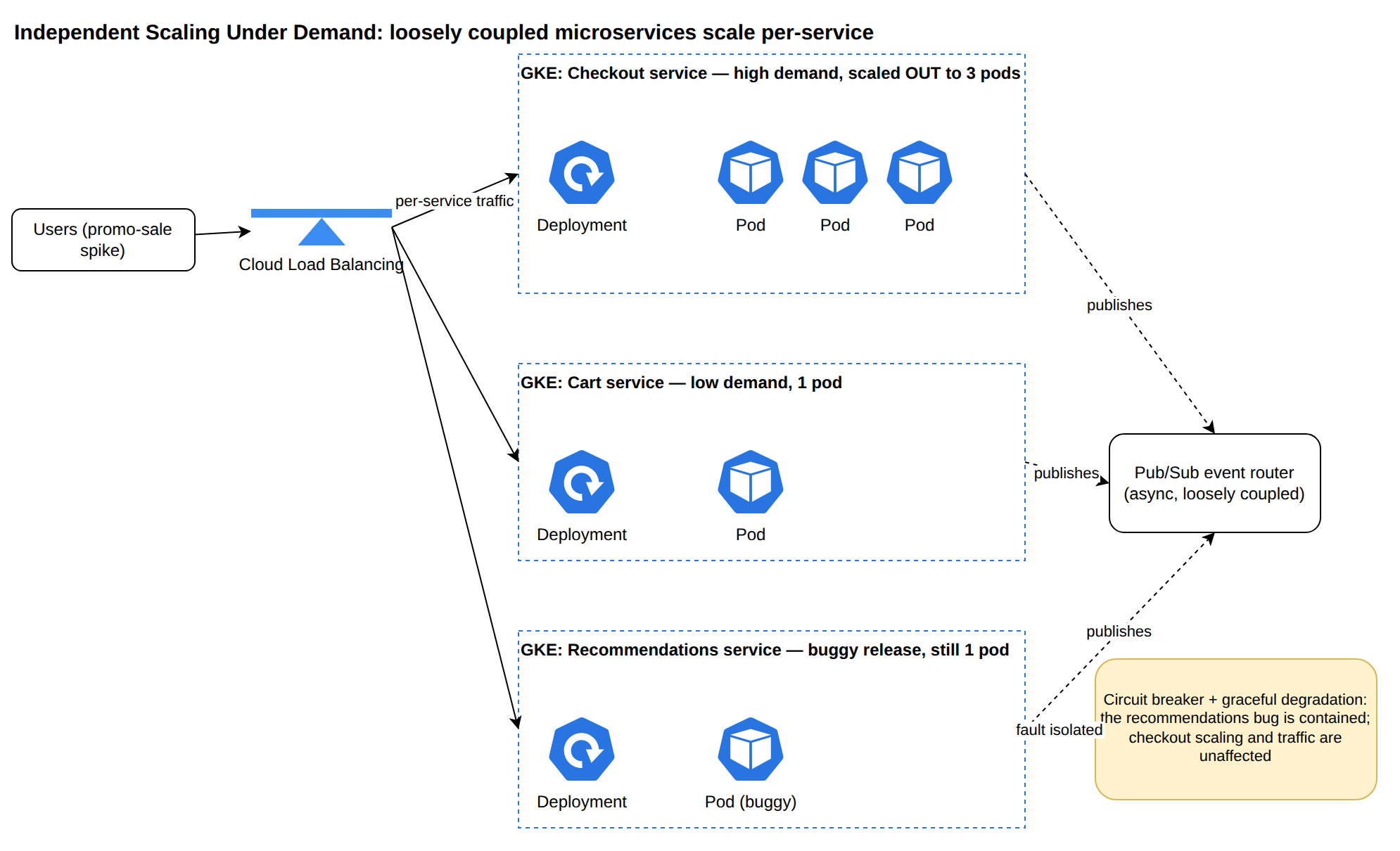
Key advantages and capabilities
- Optimized resource utilization and cost control: Allocates infrastructure capacity dynamically where demand exists and scales down under-utilized services automatically.
- Accelerated developer agility: Smaller, self-contained codebases are easier to understand, debug, and maintain, reducing time-to-market for new features.
- Technology stack flexibility: Different teams can select the most appropriate programming languages, frameworks, and databases (heterogeneous storage) for their individual service requirements.
- Granular observability and reliability goals: Teams can establish tailored Service Level Objectives (SLOs), security controls, and health monitoring for each subsystem.
- Seamless container orchestration: Microservices pair naturally with containers running on platforms like Google Kubernetes Engine (GKE) or Cloud Run for rapid startup and automated horizontal scaling.
Why this is optimal
Unlike infrastructure-level adjustments that keep the tightly coupled codebase intact, refactoring into loosely coupled microservices directly resolves the architectural root cause of the company's scaling, deployment, and reliability bottlenecks. It transforms a rigid monolith into an agile, resilient, and cost-efficient distributed system.
Create a custom virtual machine image and instance template for the monolithic application
Create a custom virtual machine image and instance template for the monolithic application
What custom VM images and instance templates do
A custom image is a pre-configured virtual machine boot disk that contains an operating system along with application-specific software, libraries, and settings. An instance template combines this custom boot disk image with a specific machine type and network configuration, allowing Managed Instance Groups (MIGs) on Compute Engine to rapidly provision identical VM instances when scaling out.
Why it doesn't meet the requirements
- Fails to scale components independently: Because the entire monolithic application is baked into a single custom image, every new VM spun up from the instance template duplicates the entire application stack rather than scaling only the checkout feature.
- Fails to enable modular deployment cycles: Updating any single feature requires rebuilding the entire custom image and redeploying the whole monolith, keeping all development teams locked into coordinated, monolithic release cycles.
- Fails to isolate faults: Every VM instance created from the template runs the same tightly coupled code. A fatal bug in the recommendation feature will still exist inside every running instance and can crash the application process across the fleet.
Key characteristics and limitations
- Improves VM startup speed: Pre-baking dependencies into a custom image is faster than running complex startup scripts every time a new VM boots.
- Increases image maintenance overhead: Frequent code changes require constantly building, testing, and managing new custom VM images, which increases operational maintenance costs.
- Heavier footprint than containers: Virtual machine images include a full guest operating system, making them much larger, less portable, and slower to start than lightweight containers.
- Coarse-grained scaling: Scaling occurs at the full virtual machine level rather than at the granular microservice level.
This answer would be correct if
The organization wanted to reduce the boot and configuration time of Compute Engine virtual machines in a Managed Instance Group without changing the underlying monolithic architecture of their legacy application.
Additional context
When modernizing applications for agility, organizations typically move away from VM-level custom images toward containers and microservices. Containers package only the application code and its runtime dependencies, enabling fast startup and independent component deployment.
Migrate the monolithic application to larger virtual machines using vertical scaling
Migrate the monolithic application to larger virtual machines using vertical scaling
What vertical scaling on virtual machines is
Vertical scaling (scaling up) is an infrastructure approach where an organization increases the capacity of an existing server or virtual machine (VM) by adding more processing power (CPU) and memory (RAM). In a monolithic environment, migrating to a larger machine type on Compute Engine provides the entire application stack with a bigger pool of shared hardware resources on a single host.
Why it doesn't meet the requirements
- Fails to scale components independently: Vertical scaling increases capacity for the entire monolithic application as a single unit. The company would still pay for extra compute and memory across all features just to handle spikes in the checkout process.
- Fails to enable modular deployment cycles: Hosting the application on a larger VM does not alter the tightly coupled codebase. All development teams remain bound to the same shared release schedule and deployment pipeline.
- Fails to isolate faults: Running the monolith on a larger VM preserves a major single point of failure. A critical software bug or memory leak in the recommendation module can still exhaust system resources and crash the entire application instance.
Key characteristics and limitations
- Hard hardware limits: Virtual machine sizes are finite, meaning an application will eventually hit a ceiling where no additional CPU or RAM can be added to a single instance.
- Exponential cost increases: High-capacity machine types often incur disproportionately higher costs compared to distributing workloads horizontally across smaller instances.
- System-wide outage risk: Any hardware, operating system, or application-level failure on the primary VM impacts all users and all application features simultaneously.
- Downtime during resizing: Upgrading a VM to a larger machine type typically requires stopping and restarting the instance, causing service interruptions.
This answer would be correct if
The scenario asked for a quick, short-term way to increase the CPU and memory capacity of a legacy relational database or a tightly coupled third-party application that cannot be refactored or scaled horizontally across multiple instances.
Additional context
Modern cloud-native architectures favor horizontal scalability (adding more instances or containers) combined with modular design over vertical scaling, as horizontal scaling offers virtually unlimited growth potential and far superior fault tolerance.
Try 10 interactive questions like this one, free
Answer them yourself and get your score the moment you finish. No account needed.
Full access includes
- 3,070 practice questions across all 6 exam domains
- Every answer explained: why it is right, and why the others are not
- Scout, an AI tutor that answers your follow-up questions
- Readiness tracking by domain, so you know when to book the exam
Related free sample questions
Keep the momentum going with these hand-picked practice scenarios
FundamentalCloud Digital Leader
Containerized Microservices Benefits
Discuss the main benefits of containers and microservices for application modernization.
FundamentalCloud Digital Leader
OLTP vs OLAP Workload Separation
Describe the ways that an organization can migrate or modernize their current database in the cloud.
FundamentalCloud Digital Leader
Dataflow vs BigQuery Sharing
Describe how the cloud unlocks business value from all types of data, including structured data and previously untapped unstructured data.
FundamentalCloud Digital Leader
Cloud Run vs GKE Containerization
Discuss benefits of infrastructure modernization and application modernization by using Google Cloud.
FundamentalCloud Digital Leader
API Abstraction and Productization
Explain how organizations can create new business opportunities by exposing and monetizing public-facing APIs.
AdvancedProfessional Cloud Security Engineer
Context-Aware Access Access Levels and Session Bindings
Creating a password and session management policy for user accounts.
Last updated