Are you a guardian of your domain? Lean how to leverage your aptitude in security to protect Microsoft Azure technologies, with a goal of earning the Microsoft Certified: Azure Security Engineer Associate certification!
Prepare and test your skills
Prepare and test your skills
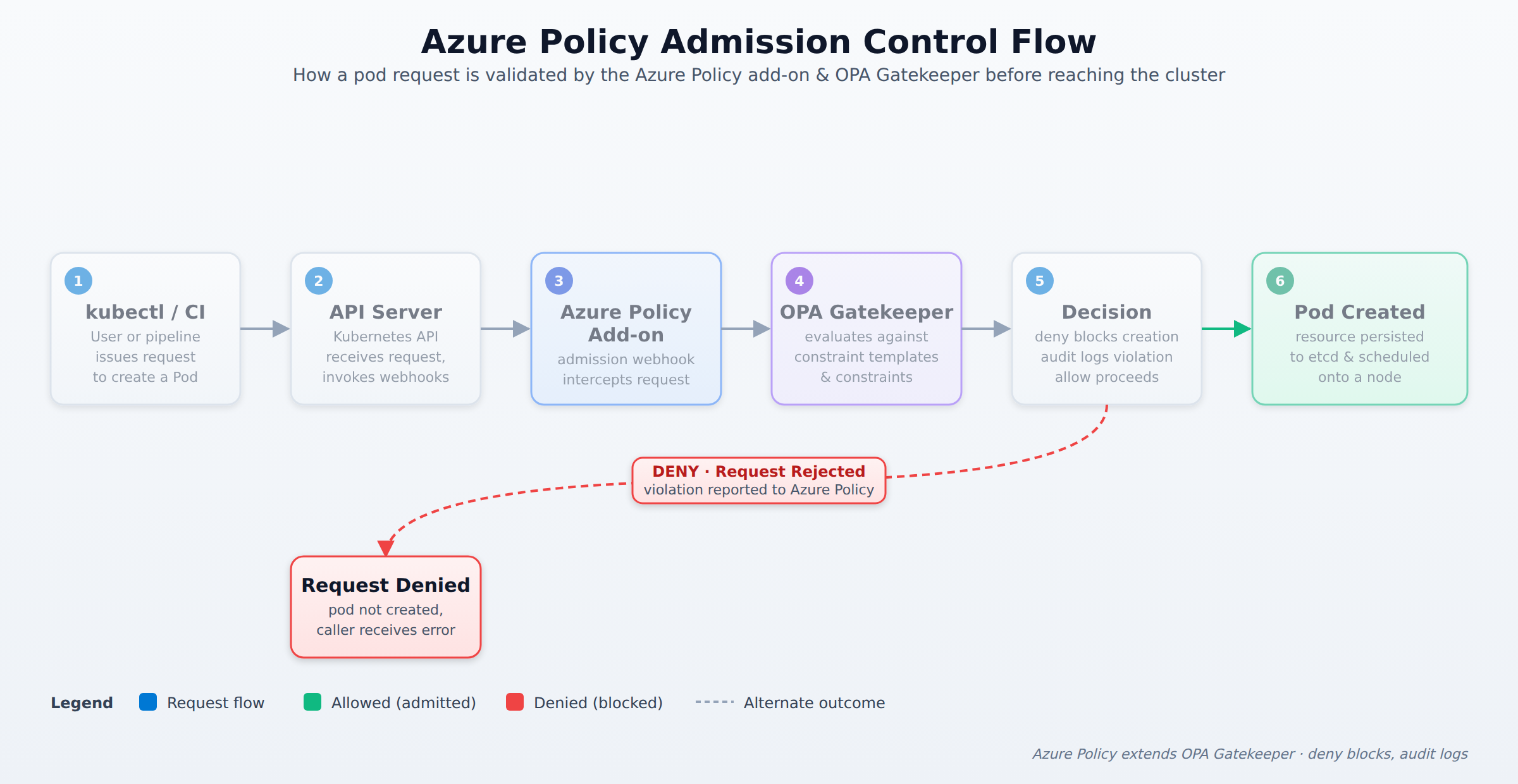
A horizontal process flow showing a pod request entering the AKS API server, being intercepted by the Azure Policy add-on and OPA Gatekeeper, evaluated against constraint templates, and either denied or admitted and created in the cluster. Animated packet motion conveys the order of the admission control sequence.
Azure AD-based RBAC integrates cluster identity management with Azure Active Directory, allowing you to assign roles at either the cluster or namespace scope. This ensures only authorized users and service principals can perform administrative or development tasks, centralizing control and reducing the risk of over-permissioned accounts.
Microsoft Defender for Containers performs vulnerability assessments by scanning container images in your registry for known CVEs before deployment. For running workloads, it offers runtime protection that monitors for suspicious activities like shell access from a container or connections to known malicious IP addresses, generating alerts or blocking these behaviors.
Azure Policy for Kubernetes extends OPA Gatekeeper by deploying policy definitions that act as constraint templates and constraints. The add-on continuously evaluates resources like pods and namespaces against these policies, blocking resource creation in deny mode or logging violations in audit mode.
Custom alert rules can detect specific security anomalies such as pods scheduled with privileged security context or excessive failed authentication attempts against the cluster API. These alerts can notify security teams via email, SMS, or incident management platform integrations for rapid response.
To enforce least-privilege access and container isolation, start by configuring Azure AD–based RBAC for your AKS cluster. This integrates cluster identity management with Azure Active Directory, allowing you to assign roles at either the cluster or namespace scope. This ensures only authorized users and service principals can perform administrative or development tasks, centralizing control and reducing the risk of over-permissioned accounts. You can use Azure Policy to audit and automatically block any RBAC configurations that violate your security rules.
Applying network policies controls the flow of traffic between pods, isolating workloads within the cluster. Simultaneously, Pod Security Standards (or Pod Security Admission) define baseline or restricted security profiles that pods must meet to be scheduled. Together, these controls limit the attack surface by enforcing rules like blocking pods from mounting sensitive host paths or requiring containers to run with read-only root filesystems. This isolation is crucial for multi-tenant clusters or workloads processing sensitive data.
Microsoft Defender for Containers provides layered security for your AKS environment. It performs vulnerability assessments by scanning container images in your registry for known Common Vulnerabilities and Exposures (CVEs) before they are deployed. For running workloads, it offers runtime protection, which monitors for suspicious activities like shell access from a running container or connections to known malicious IP addresses and can generate alerts or block these behaviors. Enabling this service integrates threat detection directly into your cluster's operational lifecycle.
For continuous monitoring, integrate your AKS cluster with Azure Monitor and Log Analytics. This involves deploying data collection agents to gather logs and metrics from the cluster control plane, nodes, and pods. These logs flow into a Log Analytics workspace, where you can query them to understand cluster health, performance, and security events. This centralized log store is the foundation for building a comprehensive monitoring dashboard and is essential for forensic investigations after a security incident.
Using the data collected in Azure Monitor, you can define custom alert rules to detect specific security anomalies in real time. For example, you might create an alert that triggers when a pod is scheduled with a privileged security context or when an excessive number of failed authentication attempts occur against the cluster API. These alerts can be configured to notify your security team via email, SMS, or integration into an incident management platform, enabling a rapid response to potential threats. This turns passive logging into an active security monitoring system.
Azure Policy for Kubernetes extends the Open Policy Agent (OPA) Gatekeeper to enforce security and compliance rules directly inside your AKS cluster. By installing the Azure Policy add-on, you deploy policy definitions that act as constraint templates and constraints. The add-on continuously evaluates resources like pods and namespaces against these policies. If a resource violates a policy set to deny mode, its creation is blocked; if the policy is in audit mode, the violation is logged. This provides real-time enforcement and centralized compliance reporting without manual checks, ensuring security configurations are uniformly applied.
 StudyCerts
 StudyCerts