Are you a guardian of your domain? Lean how to leverage your aptitude in security to protect Microsoft Azure technologies, with a goal of earning the Microsoft Certified: Azure Security Engineer Associate certification!
Prepare and test your skills

Prepare and test your skills
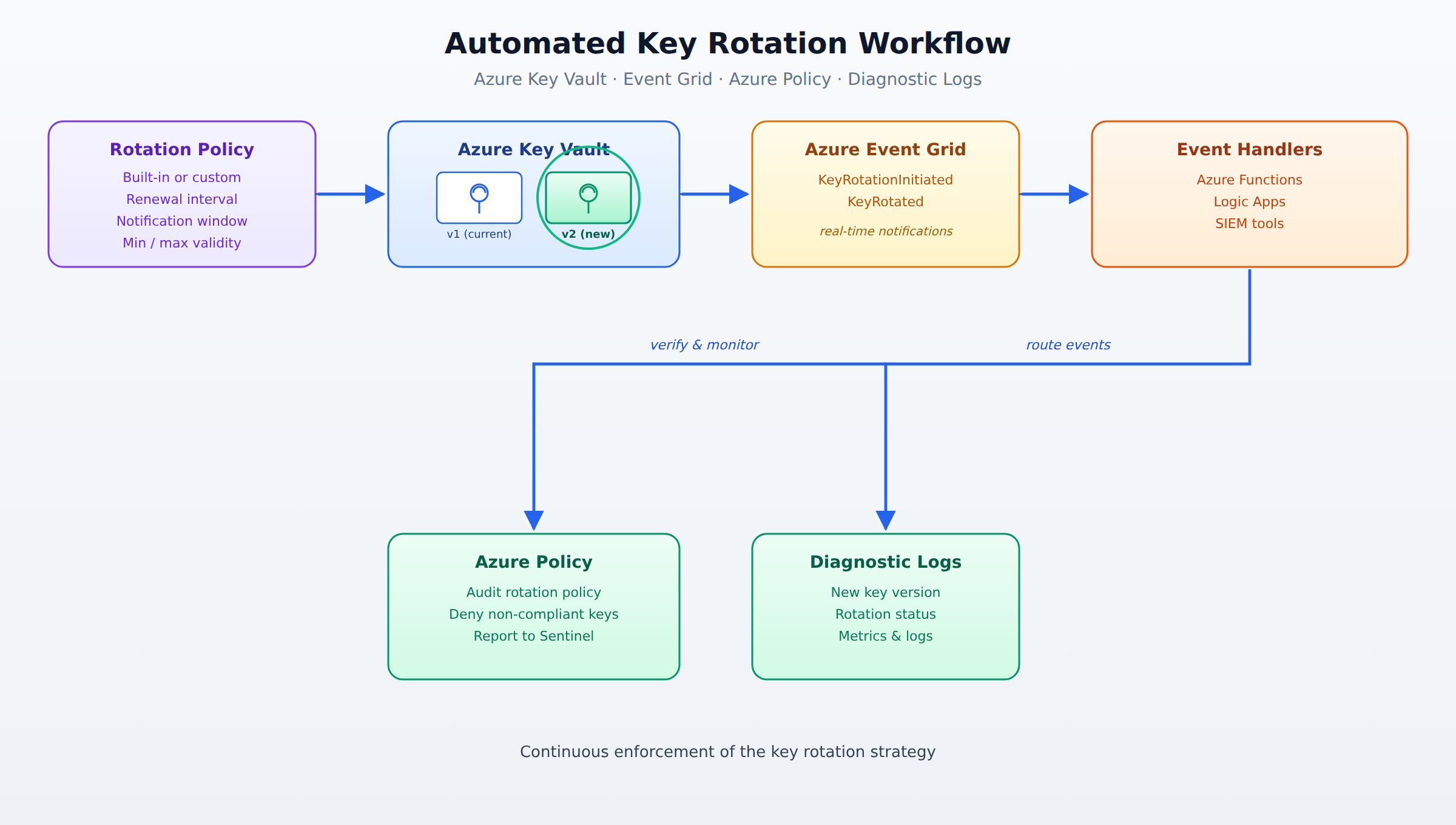
A horizontal process flow showing how Azure Key Vault automatically rotates a cryptographic key: a rotation policy triggers creation of a new key version, Azure Event Grid emits KeyRotationInitiated and KeyRotated events to handlers, and Azure Policy with diagnostic logs verifies compliance.
Automated key rotation in Azure Key Vault helps reduce the risk of compromised keys by ensuring cryptographic keys are replaced at regular intervals to meet compliance requirements and enforce cloud governance policies without manual intervention.
Azure Key Vault offers built-in rotation policies that come preconfigured with standard schedules and custom rotation policies where you define the number of days until expiration and reminder periods.
You can integrate rotation events with Azure Event Grid or Azure Monitor to receive real-time notifications and alerts for key lifecycle events, such as KeyRotationInitiated and KeyRotated.
You can confirm successful rotations using diagnostic logs and Azure Policy compliance checks, which capture detailed logs and can audit whether keys have a valid rotation policy or deny creation of keys that don't meet requirements.
Automated key rotation in Azure Key Vault helps reduce the risk of compromised keys by ensuring that cryptographic keys are replaced at regular intervals. Organizations use this feature to meet compliance requirements and to enforce cloud governance policies without manual intervention. Automated rotation can be enabled with built-in or custom rotation policies that define when and how often keys should be renewed. By automating this process, teams can focus on higher-level security controls rather than manual key management tasks.
Rotation policies let you specify renewal intervals and notification windows for key updates. You can choose from built-in policies that come preconfigured with standard schedules, or custom policies where you define the number of days until expiration and reminder periods. Minimum and maximum validity settings prevent keys from remaining active too long. These policy definitions enforce periodic rotation by automatically creating new key versions based on your organization's schedule.
Integrating rotation events with Azure Event Grid or Azure Monitor provides real-time notifications and alerts for every key lifecycle event. Key Vault emits events such as KeyRotationInitiated and KeyRotated, which can be routed to Azure Functions for custom processing, Logic Apps for automated workflows, or security information and event management (SIEM) tools for centralized monitoring. This integration ensures that security teams are immediately aware of key rotations and can verify that processes run smoothly.
To confirm successful rotations, use diagnostic logs and Azure Policy compliance checks. Diagnostic settings in Key Vault capture detailed logs and metrics that show each new key version and rotation status. With Azure Policy, you can audit whether keys have a valid rotation policy, deny creation of keys that don't meet rotation requirements, and send compliance reports to Microsoft Sentinel for deeper security analytics. These monitoring practices ensure continuous enforcement of your key rotation strategy and support proactive security operations.
 StudyCerts
 StudyCerts