Seeking the thrill of transformative tech? Explore the art of designing and implementing DevOps solutions on Azure. Master the shift towards CI/CD, testing, and delivery, while preparing for the Designing and Implementing Microsoft DevOps Solutions exam!
Prepare and test your skills

Prepare and test your skills
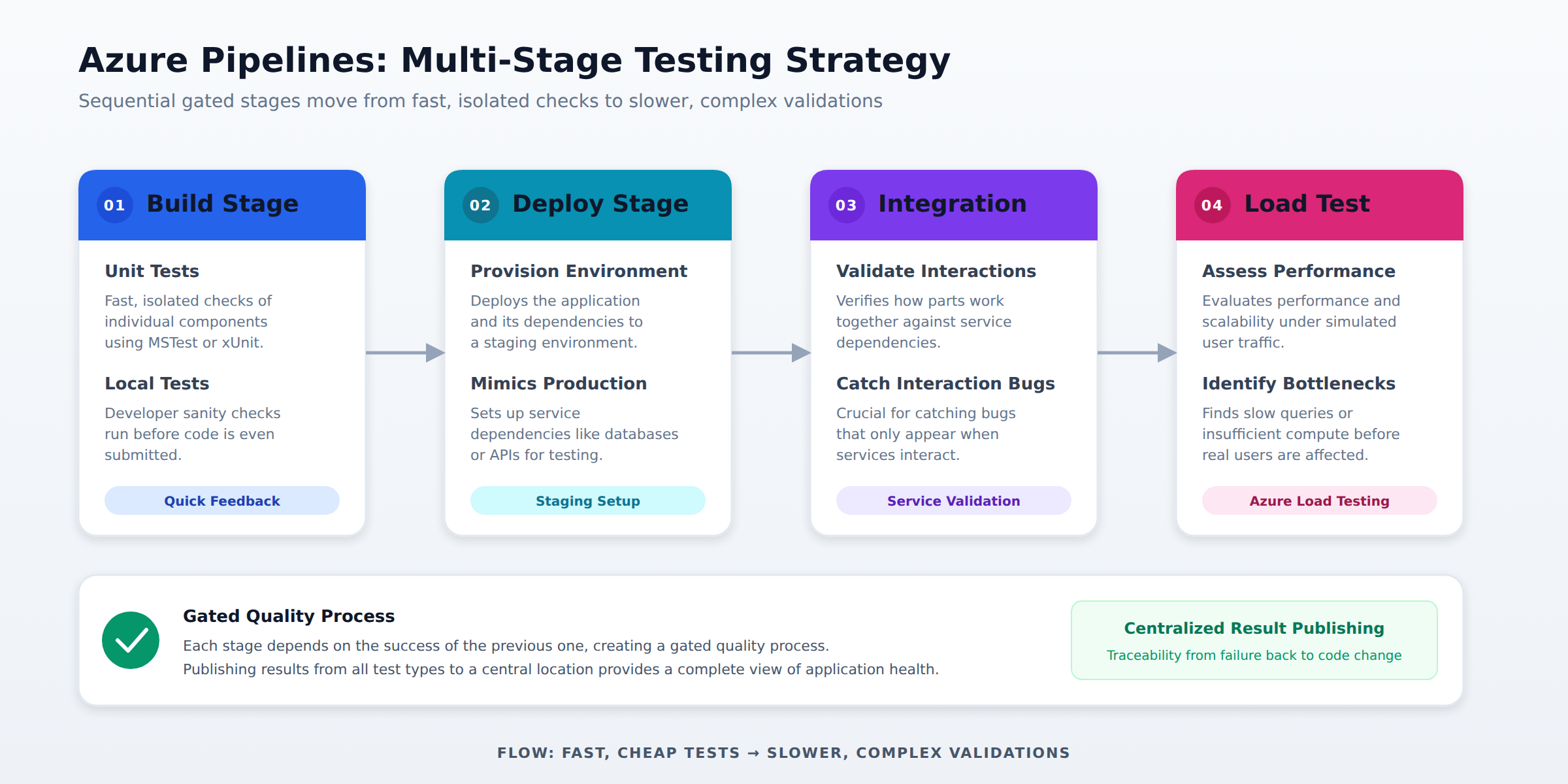
A horizontal process flow diagram showing four sequential Azure Pipelines stages: Build with unit tests, Deploy to staging, Integration tests, and Load tests. An animated dot travels along the connecting lines between stages to indicate the direction of progression.
Unit tests verify individual components or functions in isolation using frameworks like MSTest or xUnit, while integration tests verify how those components work together against service dependencies in a staging environment. Unit tests run in a build stage for quick feedback, whereas integration tests run after deployment to a staging environment.
Load tests should be run at specific points, such as before a major release, to validate that the system can handle expected peak loads without performance degradation. They assess performance and scalability under simulated user traffic, identifying bottlenecks like slow database queries or insufficient compute resources.
Azure Pipelines configures multiple sequential stages: a build stage runs unit tests, a deployment stage sets up a staging environment, an integration test stage validates service interactions, and a load test stage assesses performance. Each stage depends on the success of the previous one, creating a gated quality process, and results from all test types are published to a central location for traceability.
Testing begins with fast, isolated checks to catch problems early. Developer-local sanity checks run on a programmer's machine before code is even submitted. Automated unit tests take this further by verifying individual components or functions using frameworks like MSTest or xUnit. In Azure Pipelines, these tests are configured to run automatically in a build stage, providing quick feedback on whether a code change broke existing functionality. Their speed and isolation make them ideal for frequent execution, forming the first line of defense in a quality strategy.
While unit tests check parts in isolation, integration tests verify how those parts work together. These tests run against service dependencies, like databases or APIs, in a staging environment that mimics production. Orchestrating these tests in a pipeline stage ensures that the combined components function correctly before deployment. The pipeline manages the order of operations: it first deploys the application and its dependencies to the staging environment, then runs the integration test suite, and finally reports the results. This step is crucial for catching bugs that only appear when services interact.
Load testing assesses an application's performance and scalability under simulated user traffic. Using Azure Load Testing, you can configure a pipeline to generate high load against your application, often deployed in a staging environment. This test identifies bottlenecks, such as slow database queries or insufficient compute resources, before they affect real users. The pipeline publishes the test results—like response times and error rates—making them traceable for the team. You choose to run load tests at specific points, like before a major release, to validate that the system can handle expected peak loads without performance degradation.
A comprehensive testing strategy is implemented by configuring multiple, sequential stages within an Azure Pipeline. The typical flow moves from fast, cheap tests to slower, more complex ones: a build stage runs unit tests, a deployment stage sets up a staging environment, an integration test stage validates service interactions, and finally, a load test stage assesses performance. Each stage depends on the success of the previous one, creating a gated quality process. Publishing results from all test types to a central location provides a complete view of application health and enables traceability from any failure back to the specific code change that introduced it.
 StudyCerts
 StudyCerts