Seeking the thrill of transformative tech? Explore the art of designing and implementing DevOps solutions on Azure. Master the shift towards CI/CD, testing, and delivery, while preparing for the Designing and Implementing Microsoft DevOps Solutions exam!
Prepare and test your skills

Prepare and test your skills
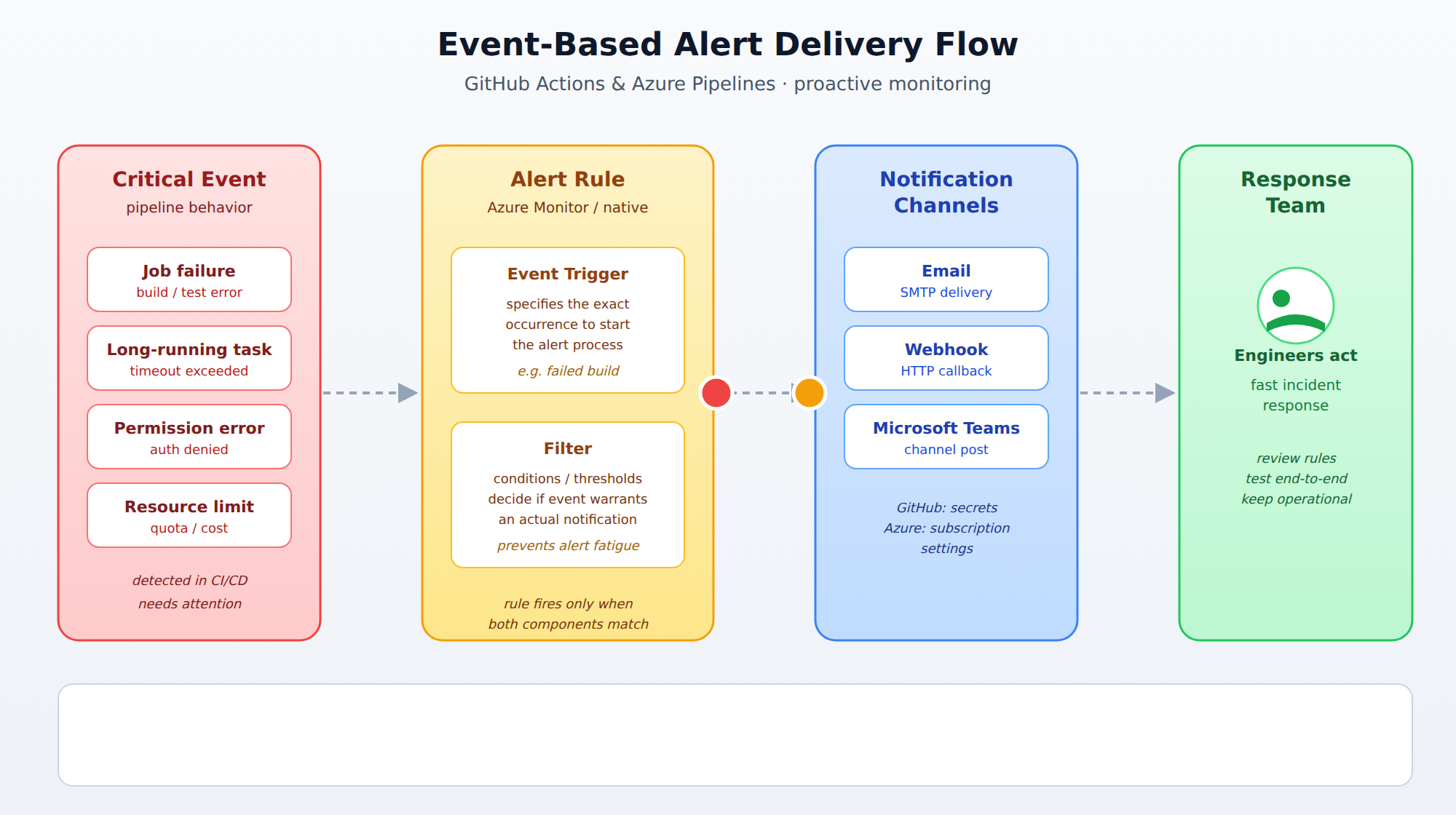
A horizontal process flow showing a critical pipeline event moving through an alert rule with event triggers and filters, then routing to notification channels like email, webhooks, and Microsoft Teams. Animated packets travel left to right along the connectors to show the direction of alert delivery.
An alert rule relies on event triggers, which specify the exact occurrences such as a failed build that start the alert process, and filters, which apply conditions or thresholds to determine if the event warrants an actual notification.
In GitHub Actions, teams secure integrations by saving credentials as GitHub secrets, whereas Azure Pipelines uses built-in subscription settings to route alerts.
Teams should periodically review their alert rules to match changing project needs and learn from past incidents, regularly test the end-to-end flow to ensure notifications reach destination channels when a real failure occurs, and keep notification channels operational for a fast, reliable incident response lifecycle.
Critical events often involve job failures, long-running tasks, permission errors, or resource utilization limits, which teams must identify to prevent broken code from reaching production environments and help manage cloud costs.
Event-based alerts enable proactive monitoring within a CI/CD environment. This setup allows teams to respond quickly to critical pipeline events, which keeps deployments reliable and efficient. Implementing these alerts bridges the gap between detecting an issue and resolving it.
Teams must first identify which pipeline behaviors require immediate attention. In both GitHub Actions and Azure Pipelines, critical events often involve job failures, long-running tasks, permission errors, or resource utilization limits. Detecting these issues early prevents broken code from reaching production environments and helps manage cloud costs.
To monitor these events, administrators configure alert rules using Azure Monitor or native pipeline settings. An alert rule relies on two main components:
By combining these elements, the monitoring system only notifies engineers when a real intervention is necessary, which prevents alert fatigue.
Once an alert triggers, the system must route the information to the correct response team. You can integrate notification channels such as email, webhooks, or Microsoft Teams to guarantee rapid communication. In GitHub Actions, teams secure these integrations by saving credentials as GitHub secrets, whereas Azure Pipelines uses built-in subscription settings to route alerts. This automation ensures that the alert moves instantly from the build environment to the communication tool.
Maintaining an effective alert system requires ongoing updates and testing. Teams should periodically review their alert rules to match changing project needs and learn from past incidents. Regularly testing the end-to-end flow ensures that notifications successfully reach the destination channels when a real failure occurs. Keeping these notification channels operational is essential for maintaining a fast, reliable incident response lifecycle.
 StudyCerts
 StudyCerts