professional-cloud-data-engineer
Prepare and test your skills
Prepare and test your skills
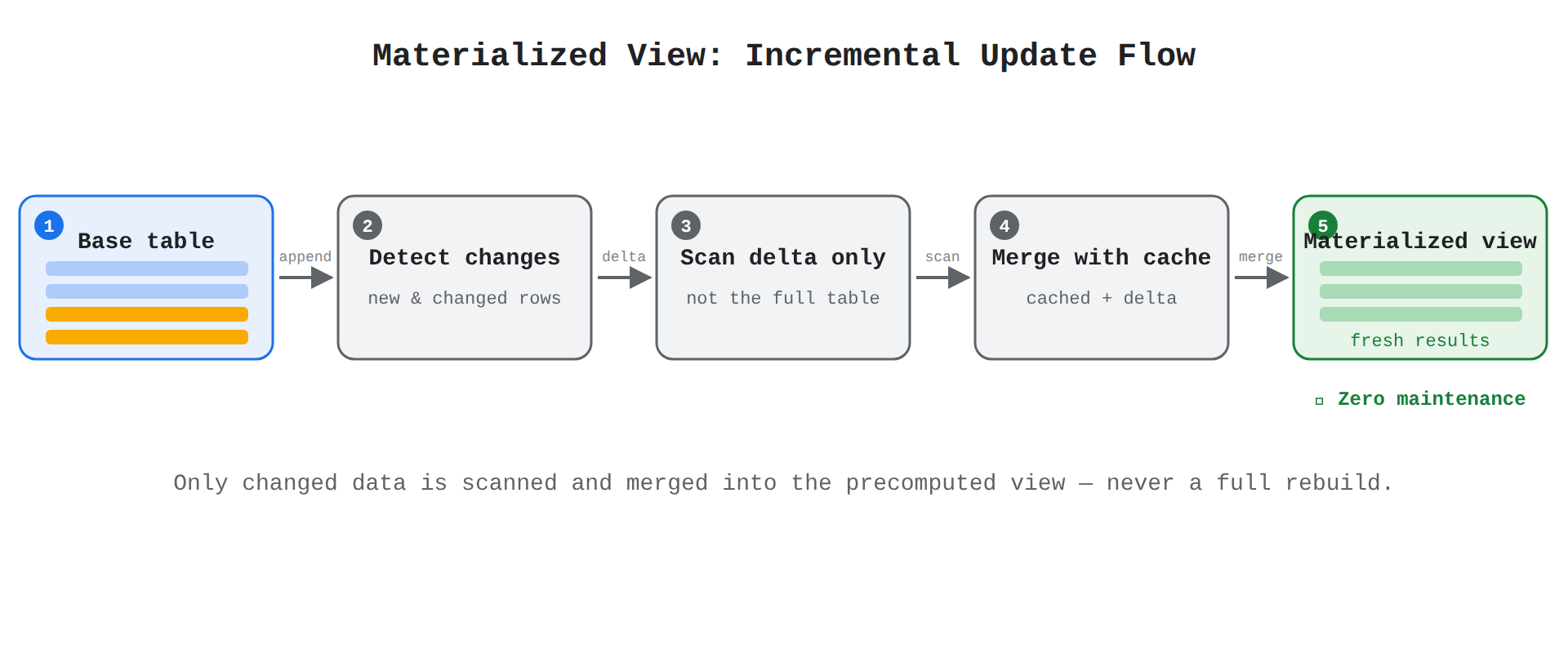
A five-step process flow showing how BigQuery incrementally updates a materialized view: new rows land in the base table, changes are detected, only the changed data is scanned, it is merged with the cached results, and the materialized view ends up fresh with zero manual maintenance. The animation moves a data packet left to right through the steps in order.
Materialized views are precomputed views that periodically store the results of a SQL query, drastically reducing processing time and data scanning costs. BigQuery maintains these through automatic incremental updates that only scan changed data in the base tables rather than rebuilding the entire view, and smart tuning automatically reroutes queries to the materialized view when it can serve the request more efficiently.
The three common use cases are data pre-aggregation, which combines streaming or transactional data to compute metrics like sums, averages, or counts in advance; pre-filtering, which reads only a specific subset of a table to reduce scanned data volume; and pre-joining, which combines large and small tables beforehand to avoid expensive runtime joins.
Idempotent transformations produce the same result regardless of how many times they run, meaning running the pipeline multiple times will not create duplicate or inconsistent data. This property is crucial for pipelines that need to be re-run due to failures or for regular refresh schedules.
Precalculated fields shift computational work from visualization tools to the data processing layer, reducing the processing load during report rendering and ensuring faster response times for end-users. This approach also ensures data remains consistent across different analysis and reporting tools.
Materialized views are precomputed views that periodically store the results of a SQL query, drastically reducing processing time and data scanning costs in BigQuery. BigQuery maintains these views through automatic background processing called incremental updates, which only scan changed data in the base tables rather than rebuilding the entire view. This automatic maintenance requires zero manual intervention from the data engineer. BigQuery also includes smart tuning, an optimization feature that automatically reroutes queries to the materialized view when it can serve the request more efficiently.
Data engineers must analyze query patterns to identify candidates for precalculation, focusing on high-cost analytical queries that would benefit from precomputation. Three common use cases drive this optimization:
Beyond materialized views, developers can use scheduled queries to write precalculated results directly into standard tables through stored procedures that execute on a set frequency. Google Cloud also offers continuous materialized views in Cloud Bigtable, which are pre-computed results of continuously running SQL queries that incrementally update. These continuous views are ideal for real-time streaming pipelines because they restructure data into schemas optimized for specific lookup patterns.
Precalculated fields are precomputed data values such as aggregations, transformations, or complex metrics that are stored within a data warehouse like BigQuery. Integrating these fields into visualization tools like Looker or Looker Studio shifts computational work from the visualization layer to the data processing layer, reducing the processing load during report rendering and ensuring faster response times for end-users.
To configure visualization tools for precalculated fields, you must first define these fields within your data model by creating materialized views, scheduled queries, or persistent derived tables that house the precomputed results. In Looker, this is achieved by building calculations into the LookML model using derived_table or measure definitions that reference the pre-aggregated BigQuery tables. The key consideration is balancing data freshness, storage cost, and query performance—for example, a daily sales total can be precalculated overnight, trading slight latency for massive query speed improvements during business hours.
You must manage the trade-offs between storage overhead and computational savings when implementing precalculated fields. Storing precalculated results consumes additional storage, but this cost is often justified by the reduction in repetitive, expensive queries against raw data. BigQuery BI Engine, an in-memory acceleration service, can cache these precalculated fields for ultra-fast dashboard performance, and configuring BI Engine reservations allows you to control costs while guaranteeing the performance needed to meet specific business intelligence SLAs.
Establishing a robust pipeline for updating precalculated fields involves using orchestration tools like Cloud Composer or scheduled queries to refresh the data at appropriate intervals—hourly, daily, or near real-time—depending on business requirements. By centralizing calculations in the data warehouse, you ensure data integrity and consistency across all reports and dashboards while simplifying governance and maintenance, since all business logic is codified in a single, version-controlled data layer.
Precalculated fields improve query performance and maintain data consistency by computing and storing aggregated or derived values in advance, reducing computational load during analysis. This approach is particularly valuable for visualization, as dashboards and reports can load quickly without performing complex calculations on the fly, and it ensures data remains consistent across different analysis and reporting tools.
Maintaining data integrity requires robust data pipelines built on services like Cloud Composer or Dataflow that automate the refresh process while ensuring synchronization with source systems. The key to maintaining consistency is implementing incremental updates that only process new or changed data rather than rebuilding everything from scratch, which reduces processing time and minimizes the risk of data discrepancies.
Idempotent transformations are essential for ensuring consistent results when refreshing precalculated fields. An idempotent transformation produces the same result regardless of how many times it runs, meaning that running the pipeline multiple times will not create duplicate or inconsistent data. This property is crucial for pipelines that need to be re-run due to failures or for regular refresh schedules, and organizations should design transformations to handle both initial loads and subsequent updates predictably.
Monitoring plays a critical role in maintaining data integrity over time by detecting when precalculated fields become outdated or when source data changes significantly. Cloud Monitoring and Cloud Logging provide tools to track pipeline execution, identify failures, and alert administrators when data quality issues arise. Regular validation using the Data Validation Tool (DVT) can compare source and target systems to ensure accuracy, while testing before deployment should cover data completeness, initial loads, incremental updates, and edge cases like missing or malformed data.
An enterprise data engineering team uses Cloud Composer to orchestrate batch pipelines that compute daily sales aggregates and precalculate key business metrics. The precalculated datasets are stored in Cloud Storage and must be loaded into an external relational reporting database accessed by visualization dashboards.
To ensure data integrity, the pipeline must support automated task retries and backfilling historical dates without creating duplicate aggregate records or causing inconsistent metric states in the target database.
How should the team configure the Dataproc Serverless for Apache Spark Cloud Storage to JDBC template to achieve idempotent updates?
 StudyCerts
 StudyCerts