Intermediate
Prepare and test your skills
Intermediate
Prepare and test your skills
Local Pub/Sub and Firestore Emulators for CI
Free sample question, answered and explained below. The Professional Cloud Architect practice bank has 2,335 more like it. Try 10 free: instant score, no account.
A software engineering team is building an event-driven microservices application that reads from and writes to Google Cloud Pub/Sub and Cloud Firestore. During continuous integration (CI) pipeline executions on self-hosted runners, the team wants to run automated integration tests to validate end-to-end message flows and data persistence logic.
The CI environment has strict operational constraints:
- Tests must run in an isolated environment without requiring outbound internet connectivity or access to live Google Cloud APIs.
- Pipeline execution must not incur Google Cloud resource usage or API consumption costs.
- The test framework should interact with standard Google Cloud client libraries without altering the core application codebase.
Which strategy should the team implement in their CI pipeline?
Explanations
Use Terraform in the CI pipeline to dynamically create live Pub/Sub topics and Firestore databases before testing and run a terraform destroy command after test completion.
Use Terraform in the CI pipeline to dynamically create live Pub/Sub topics and Firestore databases before testing and run a terraform destroy command after test completion.
What This Option Is
This pattern uses Infrastructure as Code (IaC) with Terraform to dynamically provision ephemeral Google Cloud cloud resources for each CI pipeline job and tear them down immediately following test execution.
Why It Doesn't Meet the Requirement
- Incurs Cloud Costs: Creating and using live cloud resources still incurs API usage fees, network egress, and compute/storage costs during the pipeline runtime.
- Requires External Access and Credentials: Terraform must authenticate with Google Cloud APIs and manage remote state, requiring active external network connectivity and broad administrative IAM privileges.
- Pipeline Latency: Provisioning and destroying cloud infrastructure on every test run adds several minutes of overhead to CI pipeline duration, severely slowing down deployment feedback loops.
Key Characteristics and Limitations
- High Operational Complexity: Failed test runs or interrupted pipelines can leave orphaned cloud resources running, accumulating unexpected costs.
- API Rate Limiting: Repeatedly provisioning and deleting projects or database instances can trigger Google Cloud resource quota and API rate limits.
- Violates Offline Constraints: Cannot execute in strictly isolated, air-gapped, or network-restricted CI environments.
This Answer Would Be Correct If
The team needed to validate Infrastructure as Code definitions, module configurations, and cloud deployment pipelines prior to merging pull requests into production branches.
Run local Google Cloud emulators for Pub/Sub and Firestore within the CI environment and export the corresponding emulator host environment variables for the test process.
Run local Google Cloud emulators for Pub/Sub and Firestore within the CI environment and export the corresponding emulator host environment variables for the test process.
What Google Cloud Emulators Are
Google Cloud emulators (such as the Cloud Pub/Sub emulator and Cloud Firestore emulator) are local software instances provided via the Google Cloud CLI and official container images. They replicate the API behavior, in-memory state management, and messaging semantics of Google Cloud services locally without connecting to live cloud backends.
How It Meets the Requirements
- No External Connectivity Required: Emulators run locally within the test container or CI runner as background processes, listening on
localhostor local container networks without making external network calls. - Zero Cloud Resource Costs: All operations execute entirely in local memory or ephemeral local storage, eliminating API request charges and cloud resource billing.
- Unmodified Application Code: Official Google Cloud Client Libraries automatically detect standardized environment variables (such as
PUBSUB_EMULATOR_HOST=localhost:8085andFIRESTORE_EMULATOR_HOST=localhost:8080). When these variables are exported, client libraries bypass production authentication checks and redirect all gRPC/REST calls directly to the local emulator endpoints.
Emulator Traffic Redirection in CI
System Architecture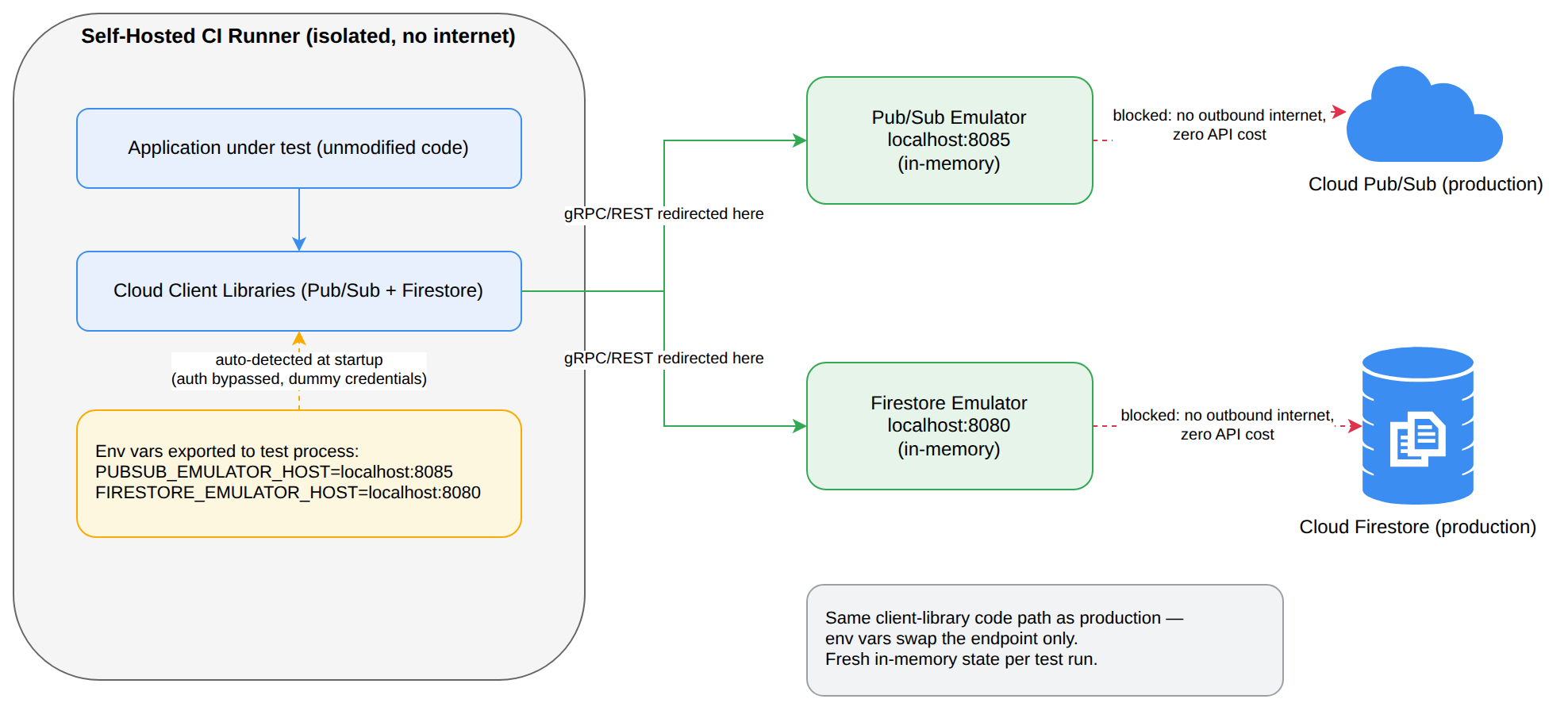
Key Advantages and Capabilities
- Deterministic Testing: Allows fresh, isolated database and messaging states for every test run by starting and stopping clean emulator instances.
- Fast Execution: In-memory execution eliminates network latency associated with remote cloud API round-trips.
- Local Authentication Bypass: Emulators accept dummy credentials, avoiding the security risk of storing live service account keys in CI runners.
- Streamlined CI/CD Integration: Emulators can be easily packaged into containerized sidecars or background services in tools like Cloud Build, GitHub Actions, or GitLab CI.
Why This Is Optimal
Using local emulators directly solves the isolation, cost, and developer-experience challenges of running automated integration tests in CI pipelines while maintaining exact API parity with production services.
Configure Private Google Access and VPC Service Controls around a shared testing VPC to redirect live client API traffic through a private internal endpoint.
Configure Private Google Access and VPC Service Controls around a shared testing VPC to redirect live client API traffic through a private internal endpoint.
What This Option Is
Private Google Access allows virtual machine instances inside a Google Cloud Virtual Private Cloud (VPC) to reach Google APIs using private internal IP addresses rather than public internet IPs, while VPC Service Controls establishes security perimeters around cloud resources to prevent data exfiltration.
Why It Doesn't Meet the Requirement
- Still Connects to Live Services: Private Google Access simply modifies the network routing path to production Google Cloud API endpoints; it does not eliminate cloud resource usage, API costs, or cloud authentication requirements.
- Inapplicable to Isolated Runners: Private Google Access requires a Google Cloud VPC infrastructure and does not enable local offline testing on non-cloud or air-gapped CI runner environments.
- Does Not Emulate Services: It provides secure transport to live multi-tenant cloud services rather than running lightweight local mock instances.
Key Characteristics and Limitations
- Network Security Focus: Designed for perimeter defense, data governance, and private enterprise routing rather than local unit/integration test automation.
- Requires Valid IAM Authentication: Requests traversing Private Google Access must still present valid OAuth2 tokens from authenticated cloud identities.
This Answer Would Be Correct If
The requirement was to secure network communication between production workloads running on Compute Engine/GKE and Google APIs to ensure traffic does not traverse the public internet.
Provision a dedicated testing project in Google Cloud, inject service account keys into the CI runner, and run tests against live cloud resources with budget alerts configured.
Provision a dedicated testing project in Google Cloud, inject service account keys into the CI runner, and run tests against live cloud resources with budget alerts configured.
What This Option Is
This approach configures the CI pipeline to authenticate against real Google Cloud services in a sandbox or dedicated staging Google Cloud project using an Identity and Access Management (IAM) service account key and monitors costs using Cloud Billing budget alerts.
Why It Doesn't Meet the Requirement
- Incurs Billing Costs: Even in a sandbox project, publishing messages to live Pub/Sub topics and performing Firestore read/write operations generates billable API requests and storage usage.
- Requires Outbound Network Connectivity: The CI runner must be able to reach Google Cloud public API endpoints over the internet or dedicated interconnects, violating the isolated offline CI requirement.
- Security Overhead: Distributing long-lived service account keys to CI runners introduces potential security vulnerabilities and credential rotation overhead.
Key Characteristics and Limitations
- Live API Dependencies: Network latency and transient network drops can cause flaky integration test runs.
- Resource Cleanup Burden: Test datasets must be explicitly cleaned up between test suites to avoid data pollution and ongoing storage charges.
- Budget Alerts Do Not Prevent Costs: Billing budget alerts only notify administrators when thresholds are exceeded; they do not cap or prevent real-time charges.
This Answer Would Be Correct If
The goal was to perform end-to-end synthetic testing or pre-production staging validation that requires testing real Google Cloud IAM permission boundaries, multi-region replication latency, or live hardware integrations.
Try 10 interactive questions like this one, free
Answer them yourself and get your score the moment you finish. No account needed.
Full access includes
- 2,335 practice questions across all 6 exam domains
- Every answer explained: why it is right, and why the others are not
- Scout, an AI tutor that answers your follow-up questions
- Readiness tracking by domain, so you know when to book the exam
Related questions
Keep the momentum going with these hand-picked practice scenarios
IntermediateProfessional Cloud Architect
Pub/Sub Emulator PUBSUB_EMULATOR_HOST
Cloud Emulators (e.g., Bigtable, Spanner, Pub/Sub, and Firestore)
IntermediateProfessional Cloud Architect
Cloud Emulator IAM and Performance Limitations
Cloud Emulators (e.g., Bigtable, Spanner, Pub/Sub, and Firestore)
IntermediateProfessional Cloud Architect
BigQuery Table Clones for Test Data Isolation
Testing frameworks (load/unit/integration)
IntermediateProfessional Cloud Architect
Cloud SQL Cross-Region Replica Failover
Disaster recovery
IntermediateProfessional Cloud Architect
Partner Interconnect vs Dedicated Interconnect
Integration patterns with external systems
AdvancedProfessional Cloud Security Engineer
Environment-First Folder Hierarchy with Shared VPC
Managing folders and projects at scale.
Last updated