Intermediate
Prepare and test your skills
Intermediate
Prepare and test your skills
Isolating IAM Administration from Workload Access
Free sample question, answered and explained below. The Professional Cloud Architect practice bank has 2,335 more like it. Try 10 free: instant score, no account.
Your company is designing the access control architecture for its production Google Cloud environment. To comply with regulatory standards and enforce separation of duties, the organization must establish strict administrative isolation.
The security policy mandates the following requirements:
- The Cloud Security Administration team must be able to assign, update, and audit IAM access policies across project resources.
- The Cloud Security Administration team must NOT have direct operational access to view, create, modify, or delete workload data or provision runtime infrastructure (such as Compute Engine instances or Cloud Storage objects).
- Access must be scalable and manageable according to Google Cloud identity best practices.
Which IAM role configuration should you implement to satisfy these requirements?
Explanations
Assign the Editor (roles/editor) role combined with the Security Reviewer (roles/iam.securityReviewer) role to the security administrators
Assign the Editor (roles/editor) role combined with the Security Reviewer (roles/iam.securityReviewer) role to the security administrators
What These Roles Do
The Editor (roles/editor) role provides broad permissions to create, modify, and delete most cloud resources, but does not grant permissions to modify IAM allow policies. The Security Reviewer (roles/iam.securityReviewer) role provides read-only access to review IAM policies, organization policies, and asset configurations across the organization or project.
Why It Doesn't Meet the Requirement
- Lacks IAM Modification Permissions: Neither role allows security administrators to modify or assign IAM policies. The Security Reviewer role is strictly read-only, while Editor intentionally excludes policy administration.
- Grants Unwanted Operational Access: The Editor role gives administrators write and modify access to project workloads, compute instances, disks, and databases, directly violating the requirement to prevent operational workload modifications.
Key Characteristics and Limitations
- Inversion of Intent: Grants operational modify rights while withholding the administrative policy delegation rights required by the security team.
- Violates Least Privilege: Exposes production workloads to accidental deletion or data modification by security staff.
This Answer Would Be Correct If
A developer or operations engineer needed permission to deploy application components while a compliance officer only needed to inspect and review security configurations.
Additional Context
Security Reviewer is intended for audit and security analysis teams (grp-gcp-security-reviewer), not for administrators responsible for active policy enforcement and role assignments.
Assign the Owner (roles/owner) role to a dedicated Google Group containing the security administrators
Assign the Owner (roles/owner) role to a dedicated Google Group containing the security administrators
What the Owner Role Is
The Owner (roles/owner) role is a legacy basic role that provides full administrative and operational control over all Google Cloud resources in a project, including managing IAM policies, creating/deleting resources, and modifying billing configurations.
Why It Doesn't Meet the Requirement
- Excessive Operational Control: The Owner role combines control plane permissions (IAM management) with comprehensive data plane permissions. It allows members to deploy, modify, and delete virtual machines, storage buckets, databases, and read application data.
- Violates Separation of Duties: It completely fails the core requirement that security administrators must not possess operational access to view or modify workload resources and data.
Key Characteristics and Limitations
- Overly Broad Scope: Includes thousands of permissions spanning almost every Google Cloud API and service.
- High Risk of Privilege Escalation: Can be leveraged for lateral movement and unintended modifications in production environments.
- Antithetical to Least Privilege: Strongly discouraged for regular day-to-day access in enterprise production projects.
This Answer Would Be Correct If
The organization required universal, emergency break-glass administrative capabilities where an identity must hold unrestricted control over all project resources and policies.
Additional Context
Google Cloud security best practices advise replacing primitive basic roles (Owner, Editor, Viewer) with fine-grained predefined roles.
Assign the Organization Administrator (roles/resourcemanager.organizationAdmin) role to individual administrator user accounts
Assign the Organization Administrator (roles/resourcemanager.organizationAdmin) role to individual administrator user accounts
What the Organization Administrator Role Is
The Organization Administrator (roles/resourcemanager.organizationAdmin) role grants full administrative authority over the entire Google Cloud organization resource, including resource hierarchy reorganization, organization policy enforcement, and root-level IAM delegation.
Why It Doesn't Meet the Requirement
- Excessive Organization-Wide Authority: Organization Administrator provides global authority over all folders, projects, and policies in the company, exceeding the project-scoped administrative requirements.
- Improper Identity Management Pattern: Granting roles directly to individual user accounts rather than Google Groups violates Google Cloud best practices, introducing management complexity, auditing difficulties, and onboarding/offboarding vulnerabilities.
Key Characteristics and Limitations
- Super-Privileged Scope: Intended for root organization management and break-glass administrative functions, not for day-to-day project IAM administration.
- Management Overhead: Direct assignment to individual identities complicates IAM policy reviews and scalability.
This Answer Would Be Correct If
A centralized cloud foundation team needed root-level authority to structure folders, apply organization policies, and establish initial resource hierarchy boundaries across the entire enterprise.
Additional Context
To ensure scalability and security hygiene, always bind predefined roles to Google Groups federated from your identity provider rather than directly attaching privileges to individual user accounts.
Assign the Project IAM Admin (roles/resourcemanager.projectIamAdmin) role to a dedicated Google Group containing the security administrators
Assign the Project IAM Admin (roles/resourcemanager.projectIamAdmin) role to a dedicated Google Group containing the security administrators
What the Project IAM Admin Role Is
The Project IAM Admin (roles/resourcemanager.projectIamAdmin) role is a predefined Identity and Access Management role in Google Cloud. It provides permissions to administer allow policies and manage IAM access controls at the project level without granting direct access to resource workloads or data planes.
How It Meets the Requirements
- Administrative Isolation: Assigning
roles/resourcemanager.projectIamAdminallows security administrators to manage role bindings, update allow policies, and control access delegation without inheriting operational privileges to interact with workload data or modify runtime resources. - Prevents Over-Privileged Access: Unlike broad basic roles, it isolates the control plane administrative duty (IAM policy management) from operational resources such as Compute Engine instances, Cloud Storage buckets, and BigQuery datasets.
- Scalable Group-Based Management: Assigning the role to a Google Group aligns with identity management best practices, streamlining auditing and access onboarding without editing project allow policies directly for individual users.
Control Plane vs Data Plane Isolation
Set Relationship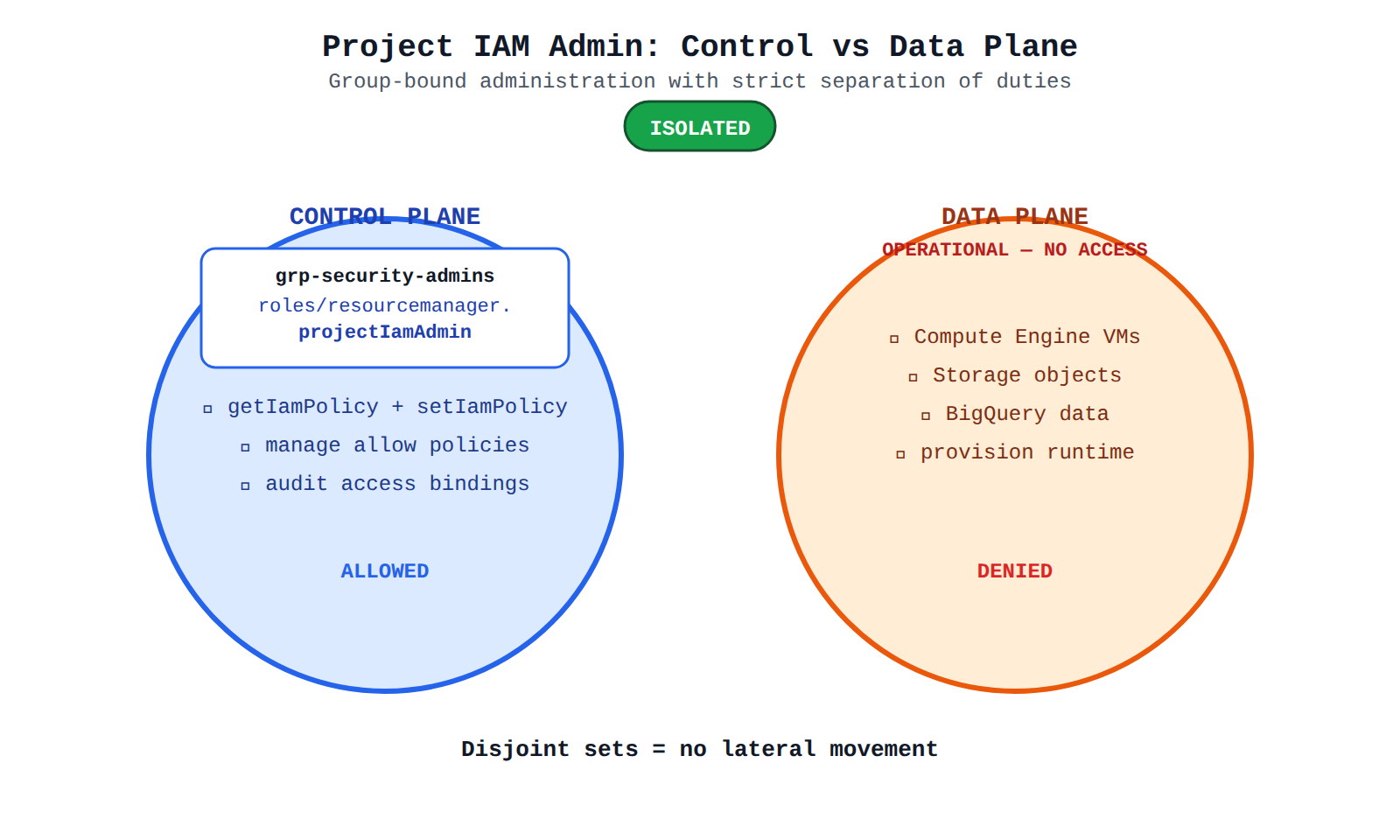
Key Advantages and Capabilities
- Granular Control Plane Management: Grants
resourcemanager.projects.getIamPolicyandresourcemanager.projects.setIamPolicyspecifically. - Prevents Lateral Movement: Restricts administrative personnel from directly reading customer data or altering runtime application states.
- Operational Efficiency: Eliminates overhead by managing team membership centrally within an identity provider or Google Groups.
- Audit Alignment: Simplifies compliance audits by maintaining distinct boundaries between infrastructure operators and access governors.
Why This Is Optimal
Using roles/resourcemanager.projectIamAdmin bound to a group isolates administrative policy functions from data plane access. It avoids the excessive operational power of basic roles like Owner while satisfying strict separation of duties.
Try 10 interactive questions like this one, free
Answer them yourself and get your score the moment you finish. No account needed.
Full access includes
- 2,335 practice questions across all 6 exam domains
- Every answer explained: why it is right, and why the others are not
- Scout, an AI tutor that answers your follow-up questions
- Readiness tracking by domain, so you know when to book the exam
Related questions
Keep the momentum going with these hand-picked practice scenarios
IntermediateProfessional Cloud Architect
Privileged Access Manager Just-in-Time Access and Approval
Separation of duties
IntermediateProfessional Cloud Architect
Separation of Duties with Resource Hierarchy and IAM
Separation of duties
IntermediateProfessional Cloud Architect
Rolling Compliance Period and Error Budget
Monitoring and logging
IntermediateProfessional Cloud Architect
BigQuery Table Clones for Test Data Isolation
Testing frameworks (load/unit/integration)
IntermediateProfessional Cloud Architect
Cross-Region Internal Application Load Balancer
VPC design and load balancing (e.g., access to cloud, internet, and cloud adjacent services)
AdvancedProfessional Cloud DevOps Engineer
Artifact Registry Virtual Repository Priority
Artifact Registry configuration
Last updated