Intermediate
Prepare and test your skills
Intermediate
Prepare and test your skills
Handling Foreign Keys and Triggers in DMS Migrations
Free sample question, answered and explained below. The Professional Cloud Architect practice bank has 2,335 more like it. Try 10 free: instant score, no account.
An enterprise is planning a live migration from an on-premises Microsoft SQL Server environment to Cloud SQL for PostgreSQL using Google Cloud Database Migration Service (DMS) with continuous Change Data Capture (CDC).
During pre-production migration testing, the team encounters two critical issues on the destination database:
- Foreign key constraint errors occur because tables are loaded out of order.
- Destination database triggers execute and inadvertently duplicate or alter replicated records.
Which strategy should the cloud architect recommend to ensure data integrity and prevent migration job failures?
Explanations
Configure the source database max text repl size parameter to 100 MB and force single-threaded synchronous CDC execution.
Configure the source database max text repl size parameter to 100 MB and force single-threaded synchronous CDC execution.
What the option is and does
The max text repl size parameter in Microsoft SQL Server controls the maximum size (in bytes) of Large Object (LOB) data types (such as text, ntext, varchar(max), and image) that can be added to a replicated column in a single INSERT, UPDATE, or WRITETEXT statement. Modifying this setting allows larger LOB fields to pass through CDC.
Why it doesn't meet the requirement
- Unrelated to Foreign Key Checks: Increasing the LOB replication size does not change how Database Migration Service ingests tables. Because DMS transfers tables in non-transactional batches, child records will still arrive before parent records, causing foreign key failures.
- Fails to Stop Trigger Execution: Adjusting LOB buffer sizes does not prevent active triggers on the Cloud SQL destination from firing when CDC inserts arrive, leaving the data duplication issue unaddressed.
- No Single-Thread Ordering Control: DMS does not offer a configuration setting to force synchronous, cross-table transactional ordering across entire relational schemas during initial load.
Key characteristics and limitations
- LOB Data Scope: Only affects Large Object column data limits during SQL Server replication capture.
- Default Value: Defaults to 65,536 bytes in SQL Server.
- No Constraint Management: Does not manage relational constraints or destination trigger behavior.
This answer would be correct if
The scenario specifically involved replication failures caused by Large Objects (varchar(max) or image data types) exceeding the default 65,536-byte CDC size threshold during source change capture.
Enable memory-optimized and temporal table features on the target instance to buffer out-of-order relational transactions.
Enable memory-optimized and temporal table features on the target instance to buffer out-of-order relational transactions.
What the option is and does
Memory-optimized tables (In-Memory OLTP) and temporal tables (system-versioned tables) are specialized table architectures in relational database engines designed for high-throughput memory processing and historical data point-in-time tracking, respectively.
Why it doesn't meet the requirement
- Unsupported Objects in DMS: In Database Migration Service, temporal tables and memory-optimized tables are explicitly not supported for replication from SQL Server sources.
- No Relational Dependency Management: In-memory tables do not alter foreign key enforcement mechanisms or resolve table ingestion sequence mismatches during data loading.
- Does Not Suppress Triggers: Memory-optimized configurations still evaluate triggers upon DML operations, which would not resolve the issue of destination triggers firing on replicated CDC records.
Key characteristics and limitations
- Temporal Tables: Maintain a complete history of data changes for auditing, but cannot be replicated directly via DMS replication pipelines.
- Memory-Optimized Tables: Use memory-centric storage and non-blocking multi-version concurrency control, but are excluded from DMS replication scopes.
- Schema Constraints: Destination database engines like Cloud SQL for PostgreSQL do not natively map SQL Server proprietary in-memory OLTP structures.
This answer would be correct if
The objective was to design an on-premises database schema for real-time audit logging and high-speed in-memory transaction processing prior to considering cloud migration.
Add synthetic md5_hash primary key columns to all tables on the source SQL Server database before starting CDC replication.
Add synthetic md5_hash primary key columns to all tables on the source SQL Server database before starting CDC replication.
What the option is and does
In Database Migration Service conversion workspaces, when a source table lacks an explicit primary key, DMS can automatically generate an md5_hash column based on all column values in each row to enable unique row identification and tracking during CDC replication.
Why it doesn't meet the requirement
- Irrelevant to Existing Foreign Keys: Adding synthetic hash primary keys to source tables does not resolve foreign key constraint failures caused by child tables loading before parent tables on the destination.
- No Impact on Triggers: Generating primary key hashes does not suppress or manage triggers on the target Cloud SQL instance. Destination triggers will still execute and manipulate data upon insertion.
- Source Alteration: Manually injecting
md5_hashcolumns into the live production source database is unnecessary and disruptive, as DMS conversion workspaces handle key generation automatically only for tables lacking primary keys.
Key characteristics and limitations
- Destination Schema Conversion Feature: The
md5_hashgeneration is an automated feature within the DMS conversion workspace for keyless tables, not a manual source modification technique. - CDC Tracking Mechanism: Primarily ensures that tables without natural primary keys can be tracked during incremental replication.
- Row Merging Behavior: Duplicate identical rows in keyless tables are merged into a single row based on the generated hash.
This answer would be correct if
The primary problem was migrating tables that lacked primary keys, resulting in CDC replication failure or inability to track unique row updates.
Drop foreign keys and triggers on the destination database during migration or bypass them using the REPLICATION role option, then re-enable them after cutover.
Drop foreign keys and triggers on the destination database during migration or bypass them using the REPLICATION role option, then re-enable them after cutover.
What the recommended solution is
During homogeneous and heterogeneous migrations using Database Migration Service (DMS), managing secondary database objects such as foreign keys and triggers on the target database is essential for smooth data replication. Disabling or dropping these constraints during the initial dump and continuous CDC replication ensures that dependencies and automated logic do not disrupt data movement.
How it addresses the migration requirements
- Resolves Foreign Key Violations: Database Migration Service does not guarantee transactional ordering across multiple tables during data ingestion. Consequently, child tables may load before parent tables, triggering constraint violations if foreign keys are active. Dropping foreign keys on the destination (or utilizing the
REPLICATIONrole privilege) avoids these constraint validation errors. - Prevents Duplicate Trigger Execution: Replicated data captured by Change Data Capture (CDC) on the source database already reflects the business logic and state changes produced by source triggers. If triggers are left enabled on the destination database, they will execute a second time upon record insertion, leading to data corruption or duplicate rows.
- Ensures Integrity Post-Cutover: Re-creating foreign keys and triggers once migration and final cutover are complete restores full relational integrity and business rule enforcement for application traffic.
Defer FKs and Triggers Until Cutover
Timeline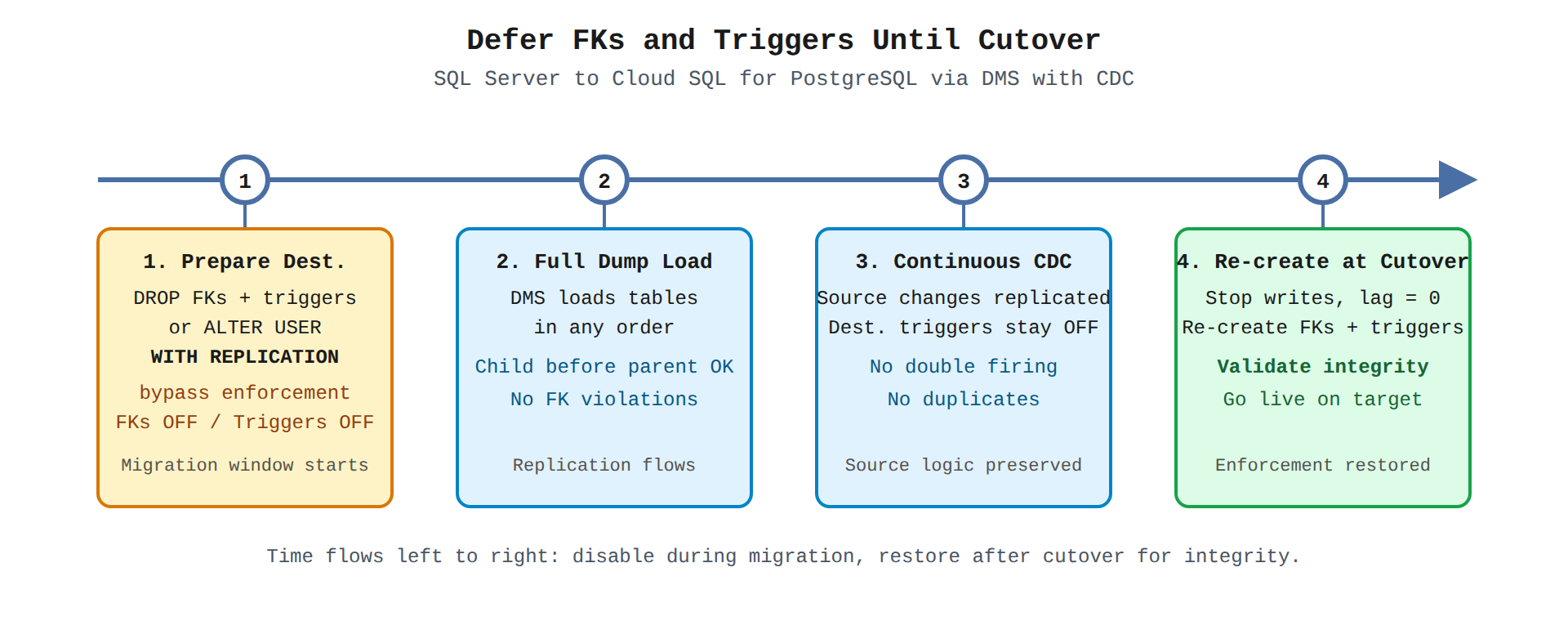
Key advantages and capabilities
- Prevents Replication Halts: Eliminates blocking errors caused by parent-child relational dependencies during parallel table loading.
- Maintains Consistent State: Avoids unauthorized mutations or data duplication on destination tables by suppressing double execution of triggers.
- Streamlined Workflow: Supports bypassing enforcement via built-in PostgreSQL database options such as the
REPLICATIONattribute for the migration user.
Why this is optimal
This approach directly targets the architectural mechanics of DMS, which streams table snapshots and log changes independently. By deferring foreign key validation and trigger execution until data transfer stabilizes, the migration pipeline completes reliably without data corruption.
Try 10 interactive questions like this one, free
Answer them yourself and get your score the moment you finish. No account needed.
Full access includes
- 2,335 practice questions across all 6 exam domains
- Every answer explained: why it is right, and why the others are not
- Scout, an AI tutor that answers your follow-up questions
- Readiness tracking by domain, so you know when to book the exam
Related questions
Keep the momentum going with these hand-picked practice scenarios
IntermediateProfessional Cloud Architect
Migration Wave Planning
Assessing and migrating systems and data to support the solution (e.g., Google Cloud Migration Center)
IntermediateProfessional Cloud Architect
Cloud Run CPU Allocation and Startup CPU Boost
Mapping compute needs to platform products (e.g., Google Kubernetes Engine [GKE], Cloud Run, and Cloud Run functions)
IntermediateProfessional Cloud Architect
SOC 2 Type II vs PCI-DSS
Industry certifications (e.g., SOC 2)
IntermediateProfessional Cloud Architect
MIG Auto-healing and Simulate Maintenance Event
Testing and validation of software and infrastructure
IntermediateProfessional Cloud Architect
bq load Time Partitioning Field Expiration Filter
Google Cloud SDKs (e.g., gcloud, gsutil, and bq)
AdvancedProfessional Cloud DevOps Engineer
Cloud Build Terraform Ephemeral Environments
Managing ephemeral environments
Last updated