Intermediate
Prepare and test your skills
Intermediate
Prepare and test your skills
BigQuery ELT with Visual Preparation in Cloud Dataprep
Free sample question, answered and explained below. The Professional Cloud Architect practice bank has 2,335 more like it. Try 10 free: instant score, no account.
A retail company ingests terabytes of raw transactional and customer activity data daily into Cloud Storage. Business analysts need an intuitive, code-free way to visually explore, clean, and profile ad-hoc datasets before reporting. Concurrently, the data engineering team needs to run automated, large-scale transformations across petabytes of historical data with minimal operational overhead and infrastructure management.
Which architecture should you recommend to meet these requirements?
Explanations
Deploy an unmanaged Apache Spark cluster on Compute Engine to transform raw files into partitioned CSVs, and load the final outputs into Cloud SQL for analyst access.
Deploy an unmanaged Apache Spark cluster on Compute Engine to transform raw files into partitioned CSVs, and load the final outputs into Cloud SQL for analyst access.
What the Compute Engine and Cloud SQL Solution Is
This architecture builds a self-managed Apache Spark environment hosted on Compute Engine virtual machines to run custom batch jobs that parse, clean, and transform raw files before loading curated datasets into a Cloud SQL relational database.
Why It Doesn't Meet the Requirement
- High operational overhead: Managing Spark on Compute Engine requires the operations team to handle VM provisioning, OS patching, cluster scaling, node failure recovery, and software upgrades, violating the requirement for minimal operational overhead.
- Lacks visual data preparation: This approach does not offer business analysts an intuitive, visual profiling or cleaning tool, forcing them to rely on technical scripts or database queries.
- Scalability bottlenecks: Cloud SQL is designed for transactional (OLTP) workloads and cannot efficiently store or perform analytical aggregations across petabytes of historical data.
Key Limitations
- Manual infrastructure maintenance: Requires dedicated cluster administrators and custom auto-scaling scripts.
- OLTP vs. OLAP mismatch: Relational databases like Cloud SQL lack the columnar, distributed architecture needed for massive data warehousing.
- Rigid ETL dependency: Downstream users must wait for batch jobs to complete before accessing any data.
This Answer Would Be Correct If
The workload consisted of small transactional datasets requiring strict ACID guarantees and specific legacy Spark configurations on custom VM images.
Build custom Dataflow streaming pipelines in Java with embedded UDFs to execute all transformations before writing final aggregates directly to Cloud Bigtable.
Build custom Dataflow streaming pipelines in Java with embedded UDFs to execute all transformations before writing final aggregates directly to Cloud Bigtable.
What the Dataflow and Bigtable Architecture Is
This design constructs a rigid ETL streaming architecture using Dataflow pipelines written in Java to process incoming data, apply business transformations via User-Defined Functions (UDFs), and persist the resulting records into Cloud Bigtable.
Why It Doesn't Meet the Requirement
- Excessive development and maintenance: Writing and maintaining custom Java pipelines with UDFs for ad-hoc business requests requires dedicated software engineering effort, significantly increasing operational overhead.
- No visual data exploration: Cloud Bigtable is a NoSQL wide-column database that does not offer a visual interface for business analysts to explore, profile, or clean ad-hoc data.
- Unsuitable query model for analytics: Cloud Bigtable is optimized for low-latency, high-throughput single-key lookups, not multi-dimensional analytical SQL queries across petabytes of historical data.
Key Limitations
- Rigid data schemas: Pre-transforming data via ETL before ingestion strips the flexibility to re-query raw attributes when requirements change.
- High developer overhead: Every change in business logic requires updating, testing, and redeploying Java Dataflow code.
- Lack of standard SQL: Business analysts cannot use standard SQL or familiar BI tools natively against Bigtable.
This Answer Would Be Correct If
The primary goal was real-time, low-latency streaming ingestion supporting millions of single-key lookups per second rather than analytical reporting and exploration.
Adopt an ELT pattern by loading raw data directly into BigQuery for scheduled SQL transformations, and provide Cloud Dataprep for visual data exploration and preparation.
Adopt an ELT pattern by loading raw data directly into BigQuery for scheduled SQL transformations, and provide Cloud Dataprep for visual data exploration and preparation.
What the ELT and Cloud Dataprep Solution Is
An Extract, Load, Transform (ELT) architecture leverages the massive parallel processing power of BigQuery by loading raw data directly into the data warehouse and executing transformations using standard SQL. Combined with Cloud Dataprep, it provides an intelligent, visual data preparation interface for analysts that requires zero infrastructure management.
ELT Flow: Load Raw Data First, Then Transform in BigQuery
Process Flow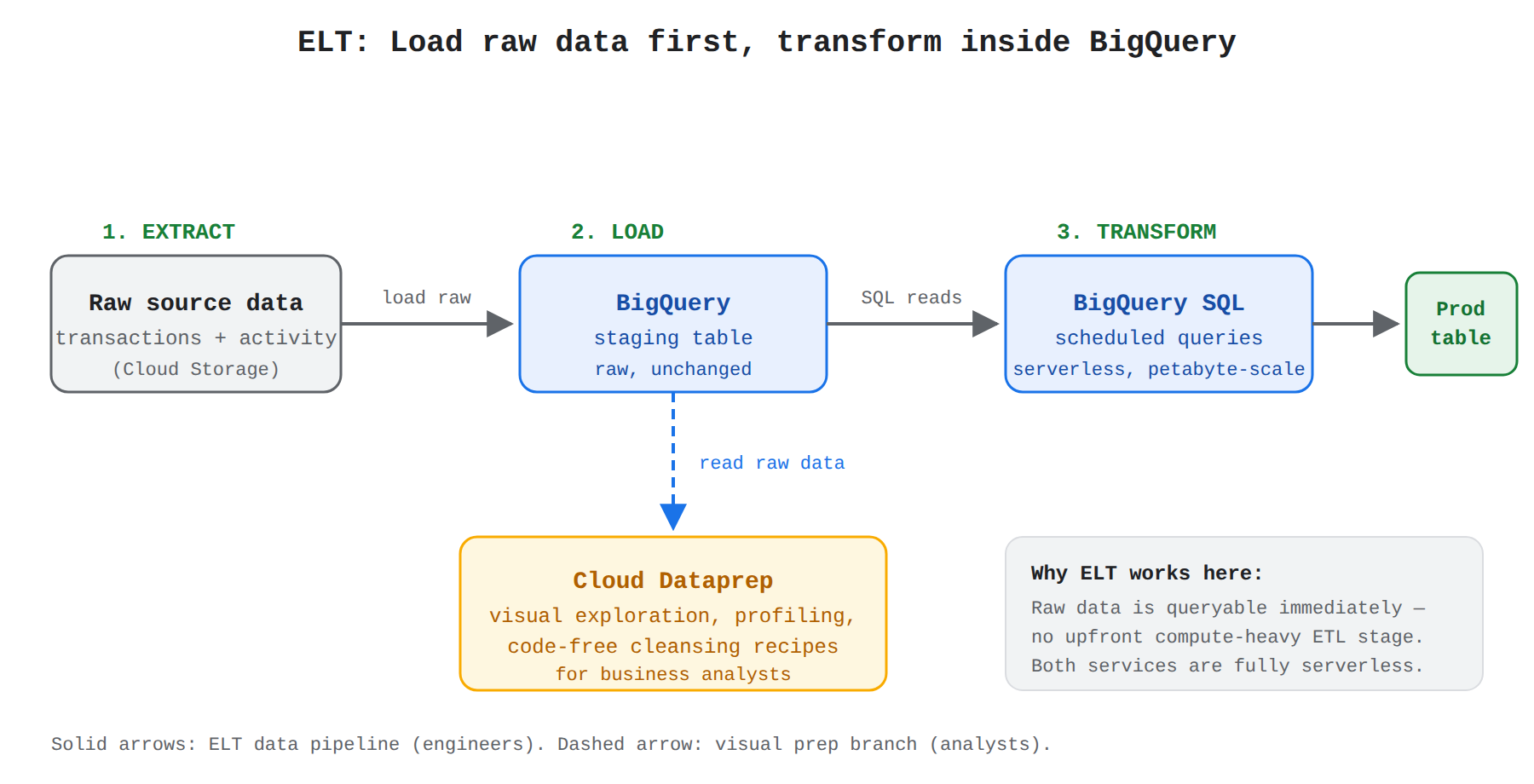
How It Meets the Requirements
- Visual exploration and cleansing: Cloud Dataprep provides an intuitive, browser-based UI that allows business analysts to explore data distributions, identify anomalies, and build cleansing recipes visually without writing code.
- High-performance large-scale transformations: Storing raw data in BigQuery enables engineers to execute complex transformations, aggregations, and joins across petabytes of historical data using optimized SQL queries and scheduled queries.
- Minimal operational overhead: Both BigQuery and Cloud Dataprep are fully managed, serverless services. Teams do not need to provision virtual machines, tune clusters, or manage pipeline infrastructure.
Key Advantages
- Serverless elasticity: Computes resources automatically scale to match query complexity and data volume.
- Reduced pipeline lag: Raw data is immediately accessible for querying upon ingestion rather than waiting for upfront compute-heavy ETL stages.
- Separation of roles: Empowers non-technical analysts with visual tools while data engineers maintain robust SQL pipelines.
- Data democratization: Historical and raw datasets remain queryable in BigQuery without duplicating data storage.
Why This Is Optimal
This solution cleanly aligns workload types to native Google Cloud services: visual, interactive profiling in Cloud Dataprep and ultra-fast, serverless analytical transformations in BigQuery, achieving maximum operational efficiency.
Export raw data from Cloud Storage into a replicated Cloud SQL instance using parallel dump files, and write stored procedures for all data cleansing and transformation tasks.
Export raw data from Cloud Storage into a replicated Cloud SQL instance using parallel dump files, and write stored procedures for all data cleansing and transformation tasks.
What the Cloud SQL Stored Procedures Solution Is
This approach uses database import and export mechanisms to load raw dumps into a Cloud SQL database, relying on relational database stored procedures to clean, aggregate, and transform data inside the database engine.
Why It Doesn't Meet the Requirement
- Inadequate for petabyte scale: Cloud SQL instances have storage limits and are optimized for transactional workloads. Petabyte-scale transformations will exhaust database capacity and degrade performance.
- No visual preparation tool: Business analysts are not provided with a visual, code-free preparation UI; they would need to write or execute complex SQL and stored procedures.
- Maintenance complexity: Writing and maintaining business logic inside procedural SQL functions introduces technical debt and limits pipeline maintainability compared to modern data warehousing patterns.
Key Limitations
- Limited parallel processing: Cloud SQL instances cannot distribute analytical workloads across hundreds of nodes like BigQuery.
- Administrative burden: Managing read replicas, database exports, and transaction log space requires regular maintenance.
- Export/Import constraints: Database exports and parallel imports add operational latency and failure points to standard analytics workflows.
This Answer Would Be Correct If
The goal was to clone or migrate a traditional MySQL or PostgreSQL database for OLTP reporting under moderate data volumes.
Try 10 interactive questions like this one, free
Answer them yourself and get your score the moment you finish. No account needed.
Full access includes
- 2,335 practice questions across all 6 exam domains
- Every answer explained: why it is right, and why the others are not
- Scout, an AI tutor that answers your follow-up questions
- Readiness tracking by domain, so you know when to book the exam
Related questions
Keep the momentum going with these hand-picked practice scenarios
IntermediateProfessional Cloud Architect
Cloud Dataproc vs Cloud Dataflow
Choosing data processing solutions
IntermediateProfessional Cloud Architect
Cloud Pub/Sub to Dataflow to BigQuery Streaming
Choosing data processing solutions
IntermediateProfessional Cloud Architect
Cloud SQL Automatic Storage Increase Limit
Data storage allocation
IntermediateProfessional Cloud Architect
Cloud SQL DR Replica Failover
Data protection (e.g., backup and recovery)
IntermediateProfessional Cloud Architect
Privileged Access Manager Just-in-Time Access and Approval
Separation of duties
AdvancedProfessional Data Engineer
Cloud SQL Cross-Region Read Replicas
Planning for storage costs and performance
Last updated