Fundamental
Prepare and test your skills

Fundamental
Prepare and test your skills
Pre-Trained APIs, AutoML and Custom AI Value
AutoML (opens in a new tab) in Vertex AI is a managed training option that builds high-quality, custom machine learning models from an organization's own data without extensive coding or machine learning expertise. The organization provides labeled examples from its business, and AutoML handles model selection, training, and tuning to produce a model tailored to that specific use case. This approach creates business value when a general pre-trained API is not accurate enough for specialized needs but the team does not have the time or skills for fully custom development.
How AutoML Builds Custom Models
AutoML turns proprietary business data into a custom predictive or classification model for a specific business task. Data flows from the organization's labeled dataset into the AutoML training service, and the service outputs a trained model that then serves predictions back to the business application. Because the model learns from the organization's own images, text, or tabular records, it captures patterns that a general model trained on public data would miss. The tradeoff is that AutoML depends on having sufficient, representative training data, and the team must still define the business goal and measure success in terms like accuracy, revenue lift, or cost reduction.
Where AutoML Improves Accuracy for Specific Use Cases
AutoML improves accuracy for traditional AI tasks where the categories or patterns are unique to the business. Traditional AI focuses on predicting outcomes or assigning categories based on historical data, and common tasks include:
- Classification, such as filtering spam or detecting defective products from factory images
- Regression, such as predicting house prices or customer lifetime revenue from historical features
- Time series forecasting, such as forecasting sales and demand
- Clustering, such as performing customer segmentation
For these tasks, a pre-trained API like Vision AI, Natural Language API, Document AI, or Video Intelligence API works well for general problems, but a retailer, manufacturer, or finance team often needs higher accuracy on its own labels, terminology, or product types. AutoML lets domain experts supply those examples and receive a specialized model, so the business gets better predictions without hiring specialists to design algorithms, loss functions, or hyperparameters.
Choosing Between Pre-Trained APIs, AutoML, and Custom Training
The choice between pre-trained APIs, AutoML, and custom training depends on whether an existing model is good enough, whether training data is available, and how much control the team needs. First, check if a pre-trained API meets the requirement; if it does, use it to save time and cost. If it does not meet the requirement and sufficient training data is available, choose between AutoML and custom training based on expertise and control needs:
| Option | Data needed | Expertise and control |
|---|---|---|
| Pre-trained API | No training data needed; call Document AI, Vision AI, Natural Language API, or Video Intelligence API | Lowest effort; no control over model internals, best when general accuracy is enough |
| AutoML | Requires sufficient labeled proprietary data for the specific task | Low ML expertise needed; managed training and tuning, best for higher accuracy without custom code |
| Custom training | Requires sufficient training data plus ML engineering capacity | Highest control over algorithm, layers, learning rate, hyperparameters, and explainability features |
Custom training fits when the team requires detailed control over how the model is built and explained, while AutoML fits when the priority is a tailored model delivered quickly by business and product teams working with data scientists.
Exam tip: Use a pre-trained API when it meets the classification or detection need; use AutoML in Vertex AI when it does not meet the need but you have enough labeled data and want a custom model without extensive coding.
Strategic implementation of pre-trained APIs means using ready-to-use Google Cloud models to add AI to applications without building models from scratch. Training complex models from scratch, especially deep-learning models, requires significant computational resources and time. Pre-trained APIs solve this because the models are already trained on vast datasets, so a development team can call the API and get results while Google manages the underlying model.
Why Starting With Existing Models Creates Value
Starting with existing and pre-trained models accelerates model selection and development while significantly reducing cost and development time. The team selects an appropriate model or API for each machine learning task and combines them to create an end-to-end development process. Model Garden (opens in a new tab) supports this strategy with a vast collection of pre-trained models for tasks such as image classification, object detection, and natural language processing. Model Garden groups models into Google models like the Gemini family and Imagen for image generation, open models like Gemma and Llama, and third-party models from partners like Anthropic.
Common Google Cloud Pre-trained APIs
Google Cloud AI and ML APIs let developers integrate powerful AI capabilities into applications without building models from scratch. Data flows from the application to the API, and the API returns the AI result to the application:
- Cloud Vision API derives insights from images for image analysis, content moderation, and automated data entry.
- Cloud Natural Language API analyzes text to understand its structure and meaning for customer feedback analysis, content categorization, and understanding social media trends.
- Speech-to-Text API converts audio to text and supports a wide range of languages and dialects.
- Video Intelligence API analyzes video content to identify objects, scenes, and actions for video content analysis, content moderation, and video search.
- Document AI API processes documents to extract, classify, and understand data to help automate document processing workflows.
- Dialogflow API enables conversational interfaces such as chatbots and voice assistants for customer service bots and virtual assistants.
- Gemini API provides access to Google's most capable and general-purpose AI model.
How Ready-to-Use APIs Reduce Time, Cost, and Expertise Needs
Ready-to-use APIs create business value by minimizing time-to-market for common tasks such as image recognition, speech-to-text, and translation. Because the model, training data, and infrastructure are already handled by Google Cloud, a standard application team can launch features in days instead of spending months collecting data and training models. This approach also reduces the need for specialized data science expertise, since developers integrate the capability with an API call rather than designing, training, and tuning a model themselves.
Exam tip: Choose a pre-trained API when the task is common, such as analyzing images, converting speech to text, or processing documents, and building a custom model is not required.
Custom AI solutions are AI and machine learning products built or tuned for a specific organization's data, industry, and business problem, rather than used as a general-purpose tool. Because they encode an organization's own data and specialized knowledge, they can produce outcomes that competitors using generic models cannot easily copy. Anti Money Laundering AI (AML AI) (opens in a new tab) is Google Cloud's example of this kind of specialized product: an API that scores money laundering risk for financial institutions using only the customer's own data.
How AML AI Works as a Specialized Solution
AML AI is a Google Cloud API that generates monthly risk scores for retail and commercial banking customers, replacing or complementing legacy transaction monitoring. It trains on a customer's core banking data, suspicious activity information, and other data already in the customer's Google Cloud environment, then produces risk scores with accompanying explainability output that feeds the customer's alerting and investigation process. Investigation results are fed back into AML AI so the models and risk scores are regularly updated. This closed loop — data in, scores out, investigations back in — is what lets the model improve over time on the customer's specific risk patterns.
AML AI Closed Loop: Data to Scores to Learning
Process Flow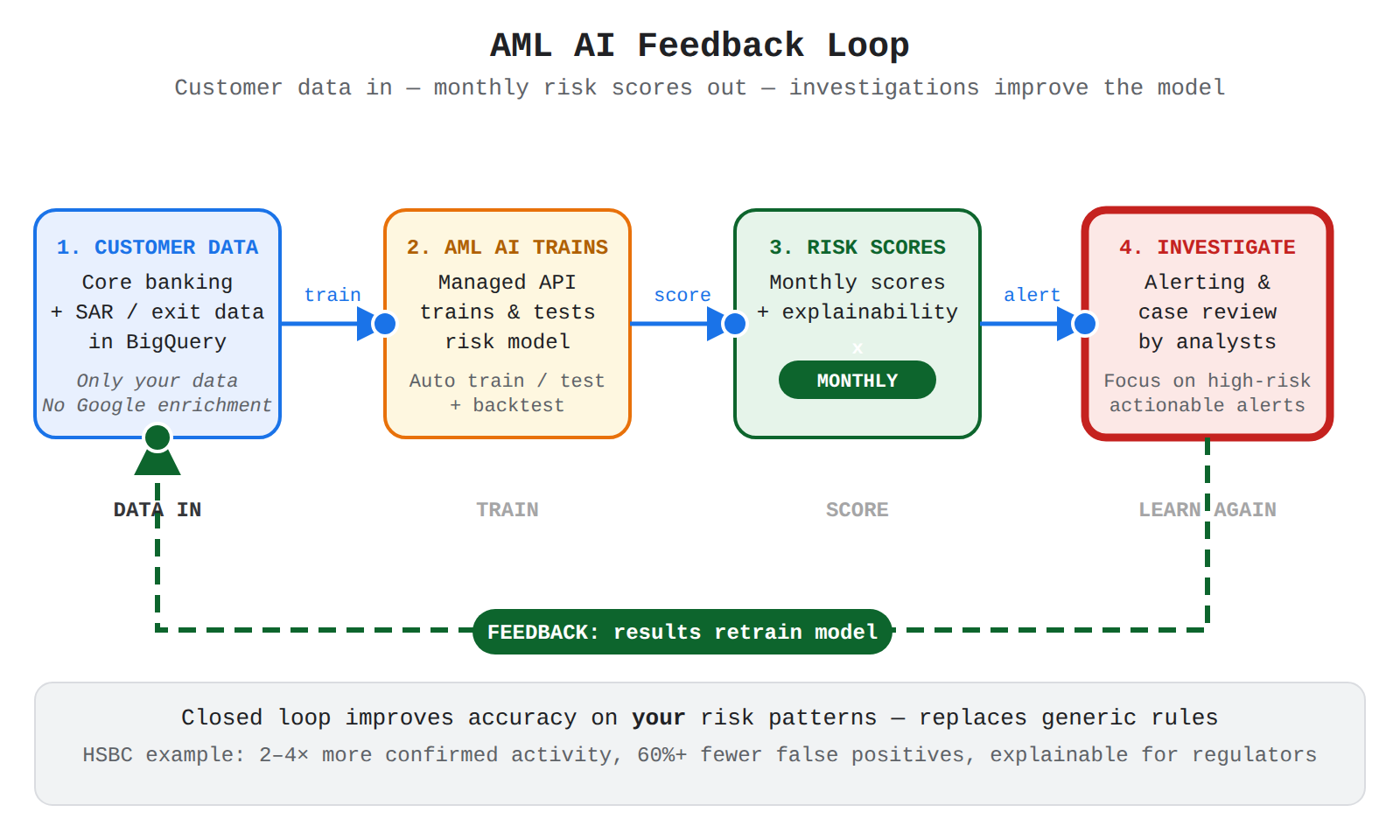
A four-step flow showing customer banking data training AML AI, producing monthly risk scores with explainability, driving alerting and investigation, with results feeding back to improve the model.
AML AI uses no data other than what the customer provides; Google does not enrich the datasets with its own data. Accuracy and coverage therefore depend on the quality and completeness of the data supplied according to the AML AI schema, and on the volume and quality of customer exit or suspicious activity report (SAR) data available for training. The product supports specific financial products and excludes others:
| Banking type | Supported products | Not supported |
|---|---|---|
| Retail | Checking or current accounts, savings, credit cards, mortgages, personal loans | Brokerage, trading, cryptocurrency, insurance |
| Commercial | Cash accounts, loans, lines of credit, direct payments from customers | Capital markets, trade finance, foreign exchange |
The business case for a specialized model like AML AI is measurable. HSBC enhanced its financial crime unit using this approach and reported nearly two to four times more confirmed suspicious activity, elimination of over 60% of false positives, and lower operational costs from focusing investigation time only on high-risk, actionable alerts. These results show how a model tuned to one institution's data can outperform generic monitoring on both detection and cost.
Explainability, Security, and Compliance as Differentiators
Explainability, security, and compliance determine whether a custom AI solution can be trusted and used in a regulated environment. AML AI is designed to meet model governance requirements and to be explainable to analysts, risk managers, auditors, and regulators, which is what makes its outputs auditable and usable in compliance reviews. When explainability alone is not enough, organizations can separate the decision-making steps in a value stream and use AI to automate only the non-decision steps, since some processes require human intervention for regulatory reasons such as GDPR Article 22. For generative AI workloads, transparency is achieved through techniques like citations to sources, grounding, and retrieval-augmented generation (RAG).
Security and regulatory compliance in financial services must be of a high standard to avoid losing clients and damaging brand reputation. Organizations should confirm that the products they intend to use meet the security, resilience, and compliance requirements of every jurisdiction where they operate, working with Google Cloud account teams, risk teams, and product teams to do so. The highest business value often comes from technology innovations such as generative AI and managed services like Spanner, so teams should not discard these options based on blanket assumptions about operational risk.
Connecting AI Performance to Business Value
Connecting AI performance to business value means linking each technology initiative to business objectives and key results (OKRs), such as increasing revenue or profit, reducing costs, or mitigating risk more efficiently. Performance optimization should be measured at the system level, looking beyond conventional separations such as change-the-bank versus run-the-bank budgets or front-office versus back-office silos. In this view, a specialized AI solution moves from a technical achievement to a source of competitive advantage only when its metrics map to business outcomes.
The payoff appears in concrete operational gains. Google Cloud helped the risk management and technology teams of a global systemically important financial institution (G-SIFI) collaborate with front-office quantitative analysts on a solution that performed risk analytics calculations such as XVA in minutes instead of hours or days. That speed helped the organization meet compliance requirements and enabled traders to have higher-quality client conversations, potentially offering tighter spreads, firmer liquidity, and more cost-effective hedging.
Exam tip: AML AI uses only the data the customer provides — Google does not enrich it — so accuracy depends entirely on the quality and completeness of the customer's own data and SAR records.
Key Facts
- Pre-trained APIs let developers add image recognition, speech-to-text, translation, and document processing to applications with an API call and without building models from scratch.
- AutoML in Vertex AI builds custom models from an organization's own labeled data when a pre-trained API is not accurate enough and the team wants higher accuracy without extensive coding.
- Custom training provides the highest control over algorithms, hyperparameters, and explainability, while pre-trained APIs require no training data and AutoML requires sufficient labeled proprietary data.
- Anti Money Laundering AI (AML AI) trains only on the customer's own banking and suspicious activity report data to generate monthly risk scores with explainability output for alerting and investigation.
- HSBC using AML AI reported two to four times more confirmed suspicious activity and elimination of over 60% of false positives by focusing investigations on high-risk alerts.
Frequently Asked Questions
When should I use AutoML in Vertex AI instead of a Google Cloud pre-trained API or custom training?
Use a pre-trained API such as Document AI, Vision AI, Natural Language API, or Video Intelligence API when general accuracy is enough because it needs no training data and requires the lowest effort. If it is not accurate enough and sufficient labeled proprietary data is available, use AutoML in Vertex AI for higher accuracy without extensive coding or use custom training when you need the highest control over algorithms, hyperparameters, and explainability features.
What is Google Cloud Anti Money Laundering AI (AML AI) and how does it work?
Anti Money Laundering AI (AML AI) is a Google Cloud API that trains only on a customer’s own core banking data and suspicious activity information to generate monthly risk scores with explainability output for alerting and investigation. Investigation results are fed back into AML AI so models improve over time, and HSBC reported nearly two to four times more confirmed suspicious activity and elimination of over 60% of false positives with lower operational costs.
How do Google Cloud pre-trained APIs create business value for common AI tasks?
Google Cloud pre-trained APIs let developers add capabilities like image analysis, text analysis, speech-to-text, video analysis, document processing, conversational interfaces, and general-purpose AI with an API call without building models from scratch. Because the models are already trained on vast datasets and Google manages the underlying model, a standard application team can launch features in days instead of spending months collecting data and training models while reducing the need for specialized data science expertise.
Sample Question
A specialized financial services firm wants to automatically categorize incoming customer inquiries that contain industry-specific financial terminology. Standard general-purpose AI models fail to capture the firm's niche vocabulary accurately, but the organization lacks an in-house team of machine learning engineers to write complex algorithms from scratch.
Which Google Cloud capability should the organization use to build a high-accuracy, custom model tailored to their proprietary business data?
AutoML
Rule-based heuristic filtering scripts
Default pre-trained AI APIs
Custom model training with open-source frameworks
How learners score on this domain
Last updated