Fundamental
Prepare and test your skills

Fundamental
Prepare and test your skills
Explainable and Responsible AI on Google Cloud
Bias mitigation and fairness strategies are the practices and controls that keep automated systems from producing unfair or discriminatory outcomes. Bias mitigation addresses two entry points for unfairness: the data used to train and evaluate models, and the algorithms and governance processes built around those models. Google Cloud pairs a governed machine learning environment that reports Gemini Enterprise Agent Platform (opens in a new tab) fairness metrics and explainability with ethics policies, security controls, and data governance that improves data quality and limits access to sensitive data.
Sources of Bias in Data and Algorithms
Sources of bias in data and algorithms are problems in training data and weaknesses in how models and their surrounding processes are designed and governed. On the data side, models produce unfair results when they are not trained on the most relevant and valuable data, when data quality is poor, and when data is duplicated and managed inconsistently. On the algorithm and process side, bias persists when teams cannot see how a model reaches its output and when no clear ethics or security policies govern development and deployment. Reducing bias therefore requires both better data feeding the model and stronger measurement, transparency, and governance around the model itself.
Fairness Metrics and Explainability in a Governed ML Environment
Fairness metrics and explainability in a governed ML environment are built-in checks that show how a model decides and whether its outcomes are fair. Gemini Enterprise Agent Platform is the environment for developing and deploying machine learning models securely and under governance. It provides model explainability, which shows how a model reaches its decisions, and fairness metrics, which give teams a measurable way to check whether outcomes are fair across groups. Because these features live inside the governed environment, fairness checks happen as part of the model lifecycle rather than as an afterthought.
Governance Policies and Frameworks for Responsible AI
Governance policies and frameworks for responsible AI are the rules that require security, ethics, and risk management during AI development and deployment. The Secure AI Framework (SAIF) (opens in a new tab) provides a practical approach for addressing the security and risk concerns of AI systems, and organizations align their AI programs with its elements. A data governance framework adds defined policies, procedures, and roles that manage data throughout its lifecycle, which improves data quality, enhances security, improves utilization, and reduces redundancy. Each of those improvements lowers the chance that poor, duplicated, or unmanaged data will skew model behavior.
Data Governance Controls That Reduce Bias
Data governance controls that reduce bias are the policies, procedures, roles, and Cloud services that manage data quality, access, and protection across the data lifecycle. Google Cloud implements that layer through several related services:
- Knowledge Catalog is an intelligent data fabric that unifies distributed data and automates governance without consolidating datasets in one place, using logical data lakes and zones, Google Groups and catalog roles for access, and auto data quality to streamline quality checks.
- Knowledge Catalog metadata automatically ingests metadata from supported Google Cloud sources, uses custom entries for sources outside Google Cloud, enriches technical metadata with business metadata through aspects, and uses permissions to control which data scientists and practitioners can search and use assets.
- BigQuery sharing lets organizations exchange data assets efficiently and securely through data exchanges that hold curated assets as listings and data clean rooms that manage access to sensitive data during joint AI and ML work with external teams.
- Sensitive Data Protection (opens in a new tab) identifies, classifies, and protects sensitive data, including financial information, which helps meet privacy regulations such as GDPR and CCPA.
Together, these controls improve the relevance and quality of training data while preventing unauthorized or unsafe use of sensitive data.
Measuring and Monitoring Fairness After Deployment
Measuring and monitoring fairness after deployment is how teams confirm that fairness strategies keep working as conditions change. Evaluation metrics differ by the type of AI being assessed:
Fairness Monitoring Cycle in 4 Steps
Process Flow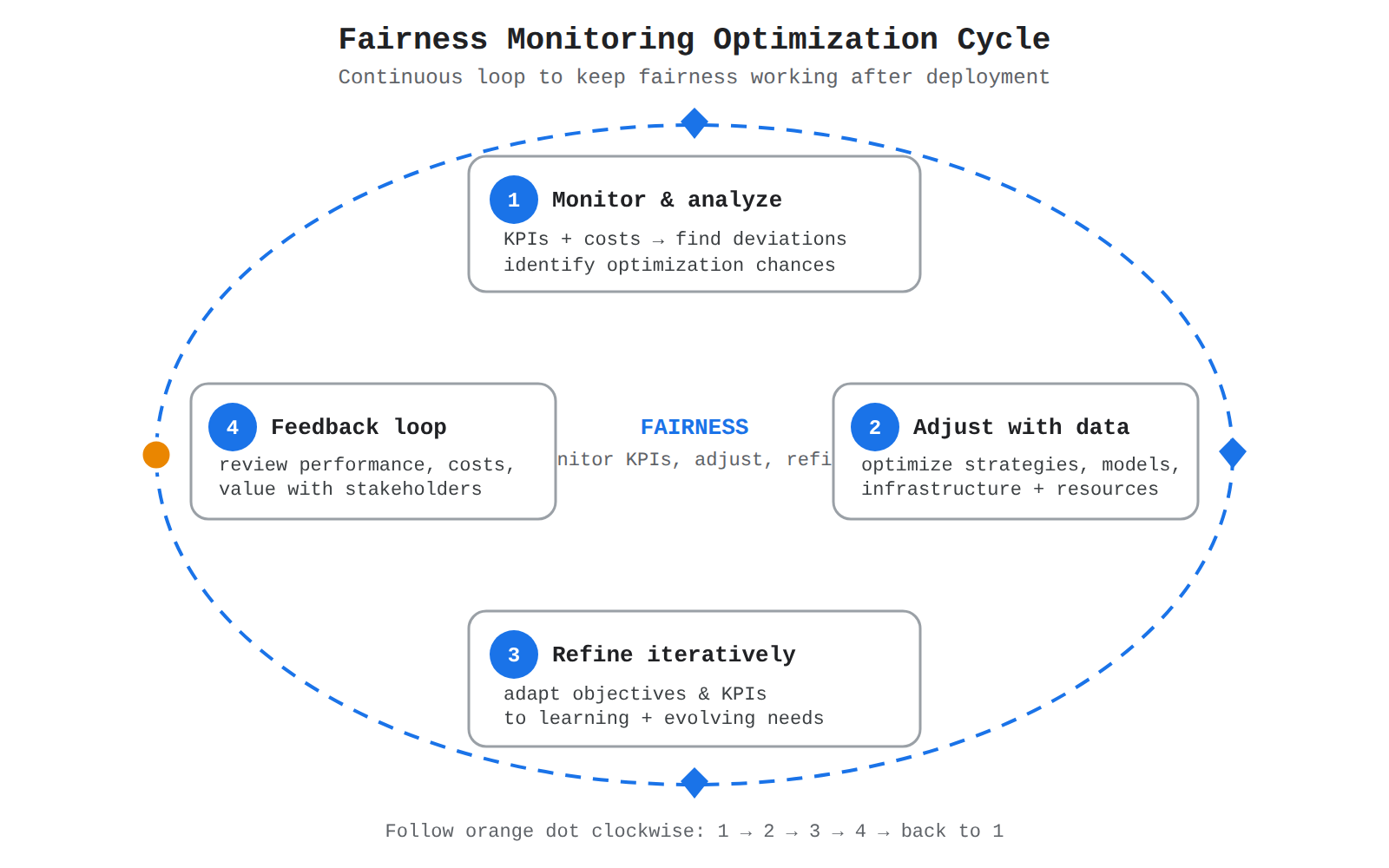
Four steps arranged in a clockwise cycle: monitor and analyze, adjust with data, refine iteratively, and feedback loop. An orange dot travels around an outer dashed loop showing the order, with each step highlighting in sequence 1 to 4.
- Predictive AI is measured by accuracy and precision.
- Generative AI is measured by adoption, satisfaction, and content quality.
- Computer vision AI is measured by accuracy.
Monitoring continues through an iterative optimization cycle that runs in a fixed order:
- Monitor continuously and analyze data: monitor KPIs and costs to identify deviations and opportunities for optimization.
- Make data-driven adjustments: optimize strategies, models, infrastructure, and resource allocation based on data insights.
- Refine iteratively: adapt business objectives and KPIs based on what was learned and on evolving needs.
- Establish a feedback loop: review performance, costs, and value with stakeholders to inform ongoing optimization and future planning.
Exam tip: Fairness metrics and model explainability come from the governed ML environment, while data quality, access control, and sensitive-data protection come from the data governance layer.
Explainability in model transparency is the ability to show in human-understandable terms why a machine learning model made a specific prediction. A model takes input data and produces an inference, and explainability adds an explanation that connects that inference back to the inputs and behavior that shaped it. This connection is the foundation of responsible AI because it makes automated decisions trustworthy, ethical, and open to review.
What Vertex Explainable AI Provides
Vertex Explainable AI (opens in a new tab) is a feature of Vertex AI that provides tools and capabilities to understand and interpret inferences made by machine learning models. The feature works alongside a deployed model, so when the model produces a prediction for a new input, Vertex Explainable AI also produces information that helps a person interpret that result. This turns a closed prediction into a transparent decision where the model, the inference, and the explanation are available together for review.
Vertex Explainable AI: Input to Trust
Process FlowA left-to-right process flow from Input Data through Deployed Model and Inference to Vertex Explainable AI and Transparent Decision, which then leads to Trust and Compliance outcomes.
Feature Importance and Model Behavior
Feature importance and model behavior are the two main insights that make a prediction interpretable. Feature importance shows which input features had the most influence on a specific inference, so a reviewer can see what the model weighed most heavily when it moved from inputs to output. Model behavior describes how the model generally responds to different inputs, so patterns across many inferences can be checked for consistency and fairness. Together, feature importance for a single decision and behavior across many decisions let teams confirm that the model is reasoning from relevant data rather than from noise or bias.
How Transparency Builds Trust and Supports Compliance
Transparent decision-making is the practice of giving stakeholders a clear, human-interpretable justification for each important model prediction. When a lender, doctor, or customer can see why a model approved, denied, or flagged a case, the decision moves from blind trust in automation to informed trust based on evidence. That same explanation also supports regulatory compliance because auditors and regulators can trace how inferences were reached and verify that decisions were consistent and accountable.
Google's AI principles and ethical frameworks are requirements for building AI that is socially beneficial, safe, and trustworthy. Google Cloud turns those requirements into practical architecture guidance that helps teams plan, design, build, and deploy AI and machine learning (ML) applications with governance, security, and real-world grounding. The guidance is organized by workload — agentic AI, generative AI, ML operations, and AI infrastructure — so teams can find help that matches their needs.
Types of Architecture Guidance
Types of architecture guidance in Google Cloud are prescriptive resources for planning and designing cloud systems for AI. The guidance is divided into four peer types that work together across the full lifecycle from planning to deployment:
- Design guides provide prescriptive, cross-product guidance to help plan and design cloud architecture.
- Reference architectures provide detailed architecture examples and design recommendations for specific workloads.
- Use cases provide high-level architecture examples to solve specific business problems.
- Deployment guides provide step-by-step instructions or code to deploy a specific architecture.
Design guides come first when choosing components and patterns, reference architectures show what a complete solution looks like, use cases connect the design to a business problem, and deployment guides show how to build it. Together they create a governed path from raw ideas and data silos to tested AI systems.
Exam tip: A design guide helps choose components and patterns for an AI system, while a reference architecture shows a detailed example such as a multi-agent or single-agent system.
Building Trusted Agentic AI Systems
Trusted agentic AI systems are AI applications that solve open-ended problems through autonomous planning and multi-step workflows while staying grounded in accurate, real-world data. Agentic AI applications (opens in a new tab) depend on architecture components, design patterns, and private connections between agents, subagents, and tools. Grounding in contextual data from sources such as Google Maps Platform and Google Calendar helps agents act on real-world facts instead of guessing, which supports effectiveness and trust.
Google Cloud provides starting guidance that includes choosing architecture components, choosing a design pattern, and examples such as a multi-agent AI system and a single-agent system using the Agent Development Kit and Cloud Run. Related patterns also address safety and governance, including private networking for multi-agent apps, secure data environments that protect sensitive datasets against accidental exposure and malicious exfiltration, and a highly governed, secure pipeline from raw data silos to AI-driven actions. A multi-agent system for security operations shows how investigation and triage workflows can be orchestrated, while bidirectional multimodal streaming supports technical guidance with automated safety monitoring.
Developing Generative AI Applications Responsibly
Generative AI applications are systems that create summaries, uncover hidden correlations, or generate new content from data and models. Generative AI on Google Cloud depends on careful choices of models and infrastructure plus controlled deployment and operation. Retrieval-augmented generation (RAG) connects a generative model to trusted data sources, so answers are grounded in retrievable facts and vector stores such as AlloyDB for PostgreSQL.
Starting guidance includes deploying and operating generative AI applications, choosing models and infrastructure, and reference architectures for generative AI with RAG. Infrastructure examples include RAG using Google Kubernetes Engine (GKE) with Cloud SQL and RAG using Agent Platform with AlloyDB. This structure keeps the model, the retrieval data, and the operating environment linked, which supports transparency about where answers come from and how the system is run.
Foundation of ML Operations and Infrastructure
Robust ML operations, often called MLOps, is the foundation for every AI initiative, from classification and regression models to complex generative and agentic systems. Machine learning operations (MLOps) provides the repeatable practices for building, testing, and running models in an enterprise. Best practices for implementing ML on Google Cloud, enterprise blueprints for generative AI and ML models, and examples such as vision analytics with Dataflow and Cloud Vision API show how data flows from ingestion and processing to model training and serving.
AI and ML infrastructure is the underlying compute, storage, and networking that determines the performance, cost, and scalability of AI workloads. Each stage of the ML lifecycle has unique requirements, so storage must be designed for AI and ML workloads in Google Cloud. Options include Cloud Storage FUSE to optimize performance of AI and ML workloads and Google Cloud Managed Lustre for high-performance needs. Choosing infrastructure that matches the lifecycle stage helps teams run models reliably without waste or unsafe shortcuts.
| Workload area | Primary goal | Starting guidance includes |
|---|---|---|
| Agentic AI | Autonomous planning and multi-step workflows grounded in real data | Choose components, choose design pattern, multi-agent and single-agent examples |
| Generative AI | Create summaries and new content with controlled operation | Deploy and operate applications, choose models and infrastructure, RAG architectures |
| ML operations | Repeatable foundation for classification, regression, and advanced models | ML best practices, enterprise blueprint, vision and federated learning examples |
| AI infrastructure | Performance, cost, and scalability for each lifecycle stage | Design storage for AI and ML, Cloud Storage FUSE, Managed Lustre |
The four areas connect in order: infrastructure supports data and compute, MLOps provides the operating foundation, and generative and agentic systems build on top with grounding, governance, and security controls.
Key Facts
- Bias mitigation and fairness strategies address both training data quality and algorithm transparency, using a governed ML environment for fairness metrics and explainability plus data governance for quality and access control.
- Vertex Explainable AI works alongside a deployed Vertex AI model to explain individual inferences through feature importance and overall model behavior.
- Transparent, human-interpretable justifications for model predictions build stakeholder trust and support regulatory compliance by making decisions traceable and accountable.
- Google Cloud architecture guidance includes design guides for choosing components, reference architectures for detailed workload examples, use cases for business problems, and deployment guides for building the architecture.
- Retrieval-augmented generation (RAG) grounds generative AI answers in trusted data sources and vector stores such as AlloyDB for PostgreSQL.
Frequently Asked Questions
How does Vertex Explainable AI make predictions from a Vertex AI model more transparent?
Vertex Explainable AI is a feature of Vertex AI that works alongside a deployed model to provide information that helps interpret each inference. It shows feature importance, which reveals which input features most influenced a specific prediction, and model behavior, which describes how the model generally responds to different inputs. Together these insights let reviewers confirm the model is reasoning from relevant data and support trust and regulatory compliance through traceable, human-interpretable justifications.
How do fairness metrics in Gemini Enterprise Agent Platform and data governance controls work together to reduce bias?
Fairness metrics and model explainability come from the governed machine learning environment, while data quality, access control, and sensitive-data protection come from the data governance layer. Gemini Enterprise Agent Platform provides model explainability and fairness metrics inside the model lifecycle to check whether outcomes are fair across groups. Knowledge Catalog, BigQuery sharing, and Sensitive Data Protection improve the relevance and quality of training data while controlling access to sensitive data, which lowers the chance that poor or unmanaged data will skew model behavior.
What is Retrieval-augmented generation (RAG) and how does it support responsible generative AI applications?
Retrieval-augmented generation (RAG) connects a generative model to trusted data sources so answers are grounded in retrievable facts and vector stores such as AlloyDB for PostgreSQL. This structure keeps the model, the retrieval data, and the operating environment linked. That linkage supports transparency about where answers come from and how the system is run.
Sample Question
A financial services institution is deploying a machine learning model to detect suspicious transactions. Because the institution operates in a strictly regulated industry, leadership has established the following requirements for the model:
- Provide transparent, human-interpretable justifications for how the model arrives at specific predictions.
- Identify potential biases hidden within the model's decision-making logic.
- Produce explainable outputs to build customer trust and support regulatory compliance.
Which Google Cloud capability should the institution use to meet these requirements?
Data lineage in Knowledge Catalog to track the movement and transformation of data
Cloud Logging to record an operational audit trail of system events and API calls
Differential privacy in BigQuery to add statistical noise during model training
Vertex Explainable AI to generate feature-based explanations for model predictions
How learners score on this domain
Last updated