Fundamental
Prepare and test your skills

Fundamental
Prepare and test your skills
Continuous Event Ingestion for Immediate Business Action
Free sample question with answers and detailed explanation below. The Cloud Digital Leader practice bank has an additional 3,070 practice questions.Try 10 free realistic questions: instant score, no credit card, and no account required.
A retail organization is replacing its nightly batch data exports with a real-time streaming pipeline on Google Cloud. The company wants to capture ongoing updates from its transactional databases to meet two primary business objectives:
- Operational security: Identify and block suspicious purchasing patterns before orders are fulfilled.
- Customer responsiveness: Deliver personalized marketing offers while shoppers are actively browsing the online store.
How does a real-time streaming analytics pipeline process data to achieve these business outcomes?
Explanations
It replaces continuous event histories with periodic static snapshots, calculating the current state of customer activity only at scheduled intervals.
It replaces continuous event histories with periodic static snapshots, calculating the current state of customer activity only at scheduled intervals.
What periodic snapshot processing does
Periodic snapshot processing is a data management technique where a system calculates and saves the state of a dataset at scheduled intervals. Instead of evaluating continuous streams of individual events as they occur, the system queries a static snapshot table that reflects the state of the business only up to the moment the last snapshot was generated.
Why it doesn't meet the requirement
Relying exclusively on periodic static snapshots without maintaining an ongoing event history fails to deliver true real-time data. If the retail organization only updates its calculations at scheduled intervals, any fraudulent transactions or customer browsing behaviors that occur after the latest snapshot remain invisible until the next interval runs, defeating the purpose of a real-time streaming pipeline.
Key characteristics and limitations
- Stale data windows: Querying only a snapshot table introduces latency because it ignores all events generated since the snapshot was taken.
- Lack of auditability: Discarding the continuous event stream history prevents security teams from auditing how a system reached a specific state.
- Inability to replay events: Without a historical log of events, teams cannot replay data to recover from system failures or test new application logic against production patterns.
- Incomplete state calculations: Up-to-the-second operational decisions require combining interval snapshots with the live history table of recent events.
This answer would be correct if
This option would be appropriate if the organization only needed periodic batch reporting or low-priority summary views where stale data from previous intervals was acceptable and immediate operational intervention was unnecessary.
Additional context
To achieve both efficiency and accuracy, cloud systems often implement a Lambda architecture. In this pattern, less critical views read from near-real-time snapshot tables, while critical real-time requests combine the latest snapshot with the live event history since that snapshot to calculate the exact current state.
It routes all events through a single centralized server to enforce strict message ordering, ensuring that analytical queries never encounter duplicate records.
It routes all events through a single centralized server to enforce strict message ordering, ensuring that analytical queries never encounter duplicate records.
What centralized FIFO message ordering is
A First-In, First-Out (FIFO) messaging model is a traditional architectural pattern in which a centralized processing system manages the exact sequence of incoming messages. In this design, a single coordinating system ensures that every event is processed in the strict chronological order in which it was created and attempts to prevent out-of-order execution.
Why it doesn't meet the requirement
Modern cloud-native streaming pipelines and event-driven architectures do not rely on a single centralized server to enforce strict message ordering, nor do they prevent duplicate messages by bottlenecking ingestion. Instead, services like Pub/Sub and Datastream use distributed processing systems to guarantee at-least-once delivery, meaning events may arrive out of order or more than once to preserve high availability and massive scalability.
Key characteristics and limitations
- Scalability bottlenecks: Scaling a centralized ordering system is typically limited to vertical scaling (adding resources to a single machine) rather than horizontal distribution.
- Single point of failure: If the central sequencing server experiences a reliability issue, the entire data pipeline is impacted.
- Retry congestion: When a single message fails in a strict FIFO model, all subsequent messages must wait and be re-sent in sequence, destroying low-latency responsiveness.
- Handling duplicates via metadata: Rather than bottlenecking ingestion, cloud streaming systems attach event metadata so downstream destinations can deduplicate and order records during analysis.
This answer would be correct if
This approach would only apply if the scenario described a legacy, on-premises messaging architecture with low data volumes where strict sequential execution on a single host was prioritized over cloud scalability and high availability.
Additional context
When an application genuinely requires ordered insights in a distributed cloud stream, subsystems apply aggregation and windowing techniques downstream or evaluate event metadata timestamps in BigQuery, rather than forcing the ingestion layer through a single server.
It automatically stops the entire ingestion pipeline whenever an unparseable message arrives, preventing invalid events from reaching downstream storage.
It automatically stops the entire ingestion pipeline whenever an unparseable message arrives, preventing invalid events from reaching downstream storage.
What pipeline ingestion halting and error handling do
Pipeline error handling governs how a streaming system reacts when it encounters malformed data, such as invalid characters or unparseable schemas. While administrators can manually stop stream ingestion via an API or web interface to fix a widespread configuration error, automated streaming pipelines are architected to isolate individual bad messages rather than shutting down the entire system.
Why it doesn't meet the requirement
A real-time streaming pipeline does not automatically halt all data ingestion across the organization whenever a single corrupted or unparseable message arrives. Stopping the entire pipeline for every bad event would cause severe operational downtime, leaving the retailer blind to active fraudulent transactions and halting live customer engagement workflows whenever a minor data formatting glitch occurred.
Key characteristics and limitations
- Unprocessed-message queues: Also known as dead-letter queues, these specialized topics automatically capture unacknowledged or errored messages without stopping the main data stream.
- Message acknowledgment and retries: In an event-driven architecture, the messaging service retries delivering an unacknowledged message until a predetermined timeout is reached.
- Isolated fault tolerance: Moving failed messages to a separate topic allows valid events to continue flowing at low latency while engineers inspect and reprocess the anomalous records separately.
- Manual operational controls: Completely stopping ingestion is an explicit administrative action reserved for systemic configuration errors, not an automatic reaction to a single invalid record.
This answer would be correct if
This statement would only be accurate if an administrator manually triggered a stop ingestion command through a management API or console after discovering a systemic configuration error that was corrupting all incoming tables.
Additional context
Using unprocessed-message queues preserves both system availability and data integrity. Operations teams can review isolated error messages to diagnose formatting bugs and later replay those corrected messages back into the pipeline without ever interrupting live business operations.
It continuously ingests and processes database changes as events arrive, providing low-latency insights for immediate anomaly detection and live customer engagement.
It continuously ingests and processes database changes as events arrive, providing low-latency insights for immediate anomaly detection and live customer engagement.
What real-time streaming analytics pipelines are
A real-time streaming analytics pipeline is a cloud data architecture designed to continuously ingest, process, and analyze data the moment it is generated. By combining change data capture (CDC) services like Datastream with stream processing engines like Dataflow, organizations can capture every data manipulation language (DML) change from transactional databases as an individual event and immediately route it to analytical destinations such as BigQuery or machine learning models.
How it meets the business objectives
- Operational security: As customers submit orders, database changes are ingested into streaming pipelines in real time. Dataflow analyzes these continuous event streams on the fly for fraud detection, anomaly detection, and security event processing, allowing the business to block suspicious transactions before fulfillment occurs.
- Customer responsiveness: Making data changes available in near real time powers artificial intelligence (AI) and machine learning (ML) applications. By feeding live behavioral insights back into production systems, the retailer can trigger dynamic marketing campaigns to increase engagement and prevent churn while the shopper is still active.
Real-Time Streaming Pipeline: Fraud + Offers
Process Flow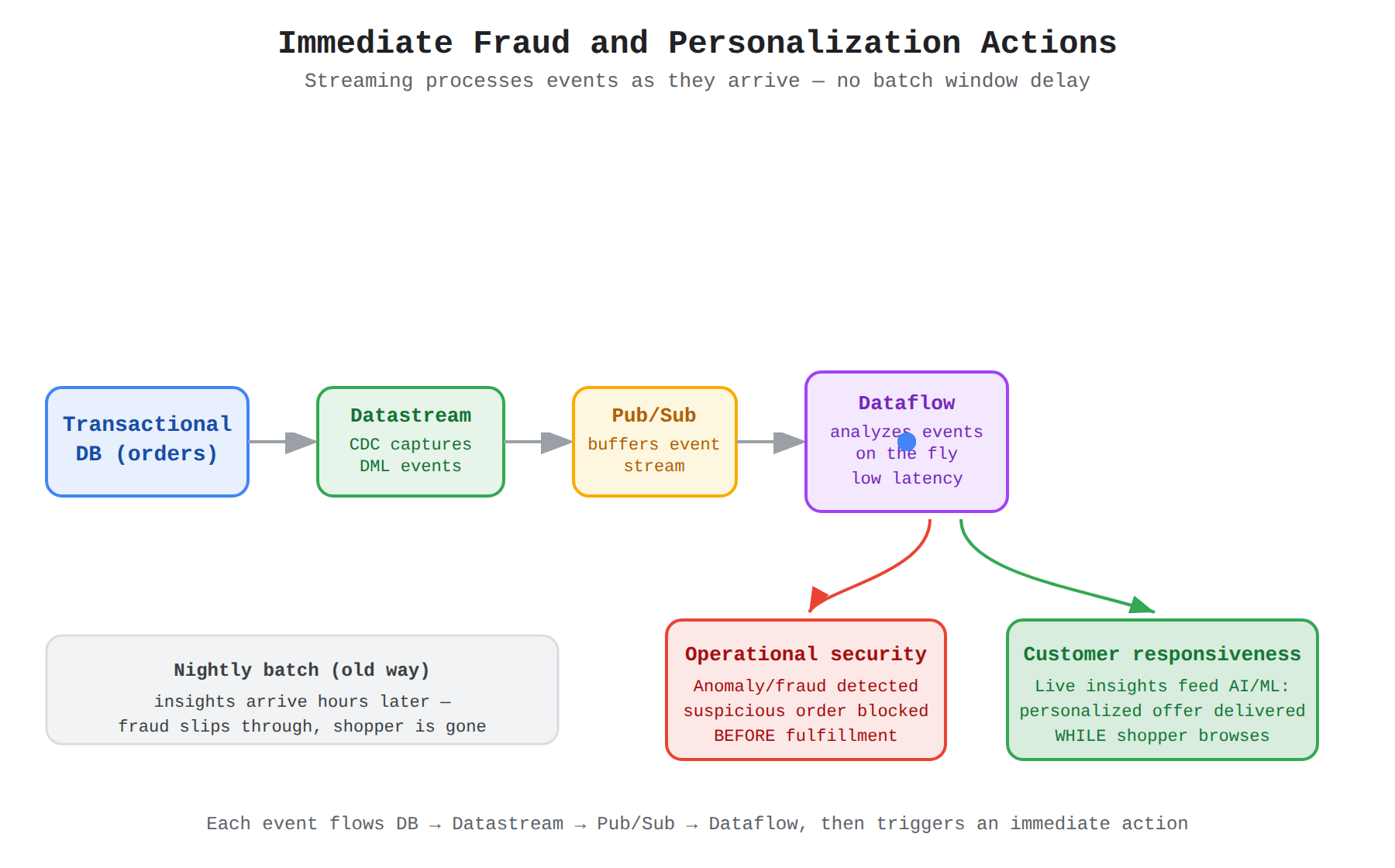
Key capabilities and business value
- Continuous event ingestion: Captures ongoing database modifications from write-ahead logs without waiting for scheduled batch windows.
- Serverless autoscaling: Automatically adjusts compute and ingestion resources as traffic volumes fluctuate, ensuring consistent low-latency insights.
- Unified data schemas: Converts source-specific database formats into a standardized representation so downstream analytics can consume data cohesively.
- Simultaneous historical and live replication: Backfills historical records alongside live CDC events to give analytical models complete context.
- Actionable materialized views: Transforms raw event streams into up-to-the-second state calculations that drive automated operational workflows.
Why this is optimal
Unlike traditional nightly batch jobs that only reveal insights hours after an event has occurred, a real-time streaming pipeline eliminates data lag. Transforming continuous data flows into immediate action maximizes operational efficiency, reduces financial losses from fraud, and captures revenue opportunities during live customer interactions.
Try 10 interactive questions like this one, free
Answer them yourself and get your score the moment you finish. No account needed.
Full access includes
- 3,070 practice questions across all 6 exam domains
- Every answer explained: why it is right, and why the others are not
- Scout, an AI tutor that answers your follow-up questions
- Readiness tracking by domain, so you know when to book the exam
Related free sample questions
Keep the momentum going with these hand-picked practice scenarios
FundamentalCloud Digital Leader
Pub/Sub Dataflow BigQuery Streaming Pipeline
Describe how streaming analytics in real-time makes data more useful and generates business value.
FundamentalCloud Digital Leader
Real-Time Visibility Business Value
Describe how streaming analytics in real-time makes data more useful and generates business value.
FundamentalCloud Digital Leader
Rehosting Lift and Shift Migration
Explain why modernization and migration to the cloud are important steps in an organization’s transformation journey, and how each application might have a different path.
FundamentalCloud Digital Leader
Google Purpose-Built Data Centers Efficiency
Describe the benefits of Google designing and building its own data centers, using purpose-built servers, networking, and custom security hardware / software.
FundamentalCloud Digital Leader
Document AI vs Speech-to-Text vs Vertex AI
Describe how the cloud unlocks business value from all types of data, including structured data and previously untapped unstructured data.
IntermediateProfessional Cloud Database Engineer
Cloud SQL Blue-Green Deployment
Manage upgrades for Google Cloud-managed databases
Last updated