Fundamental
Prepare and test your skills

Fundamental
Prepare and test your skills
Clean Training Data for Reliable Predictions
Free sample question with answers and detailed explanation below. The Cloud Digital Leader practice bank has an additional 3,070 practice questions.Try 10 free realistic questions: instant score, no credit card, and no account required.
A retail organization is training a machine learning model to predict customer purchasing behavior. To accelerate the project timeline, the team imports raw historical transaction records directly into the training pipeline without preparation. The dataset contains the following issues:
- Numerous missing values across key demographic columns
- Inconsistent spelling and abbreviations for product categories
- A feature column containing randomly assigned, unique transaction IDs for every row
When evaluating the trained model, the organization finds that its predictions are erratic and unreliable for guiding marketing decisions.
Which action should the team take to address the root cause of the model's poor performance?
Explanations
Switch from asynchronous batch inference to synchronous online inference to eliminate processing delays that degrade prediction accuracy
Switch from asynchronous batch inference to synchronous online inference to eliminate processing delays that degrade prediction accuracy
What Batch and Online Inference Are
Batch inference and online inference are the two primary methods for generating predictions from a deployed machine learning model. Batch inference processes a large volume of requests asynchronously and outputs results to a file or table, whereas online inference processes individual requests synchronously in real time via a REST API.
Why It Doesn't Meet the Requirement
The method used to request predictions in production has no effect on how well the model learned during training. Whether inferences are requested asynchronously in bulk or synchronously one at a time, a model trained on missing values, inconsistent text, and noisy identifier columns will produce the exact same erratic and unreliable predictions.
Key Characteristics and Limitations
- Identical model logic: Both batch inference and online inference rely on the same trained model weights and feature patterns.
- Throughput versus latency: Batch inference is optimized for high-volume, scheduled workloads (such as quarterly marketing campaigns), while online inference is optimized for low-latency, single-request application workflows.
- No data cleansing capability: Switching deployment endpoints does not clean corrupt training records or improve model evaluation metrics.
This Answer Would Be Correct If
- The model was already trained on high-quality, accurate data and demonstrated strong evaluation metrics, but the business needed to integrate real-time predictions directly into an interactive customer-facing web application that required immediate synchronous turnaround for each individual user action.
Additional Context
A common misconception is that deployment infrastructure or API latency affects the statistical quality of machine learning inferences. In reality, model quality is determined by the integrity, relevance, and completeness of the training dataset. Deploying a flawed model to a real-time endpoint simply delivers unreliable predictions faster.
Lower the classification score threshold during model evaluation to compensate for the missing demographic values and increase prediction confidence
Lower the classification score threshold during model evaluation to compensate for the missing demographic values and increase prediction confidence
What the Score Threshold Is
In classification models, each prediction is assigned a numeric confidence score that reflects the model's certainty that a predicted class is correct. The score threshold is the cutoff value used to convert that probability into a binary decision (such as "yes, the customer will purchase" or "no, they will not").
Why It Doesn't Meet the Requirement
Adjusting the score threshold only changes how the model's output probabilities are filtered after training; it cannot repair a model that was trained on erroneous, incomplete, or noisy data. Furthermore, lowering the score threshold does not increase prediction accuracy or confidence—instead, it causes the model to accept lower-confidence predictions as positive, which significantly increases the risk of misclassification and false positives.
Key Characteristics and Limitations
- Post-training adjustment: The score threshold is an evaluation and serving control that operates on inferences, not a data cleaning mechanism.
- Precision and recall trade-off: Lowering the threshold increases recall (capturing more positive cases) but reduces precision (introducing more false positives).
- Cannot fix noisy features: Threshold tuning cannot prevent a model from being misled by unique transaction IDs or inconsistent category spellings during training.
This Answer Would Be Correct If
- The underlying training data was already clean and accurate, and the business use case specifically required optimizing for high recall—such as detecting sensitive information in images where missing a true positive (false negative) is far more harmful than flagging a benign item (false positive).
Additional Context
When a model behaves unexpectedly or produces erratic confidence scores during evaluation, debugging the model requires inspecting and improving the training data rather than manipulating evaluation sliders. A threshold adjustment is only meaningful when the model's underlying probability estimates are built on high-quality, representative data.
Include the test dataset in the iterative training process so the neural network can adjust its weights to account for the unformatted transaction records
Include the test dataset in the iterative training process so the neural network can adjust its weights to account for the unformatted transaction records
What the Test Dataset Is
A test dataset (typically around 10% of the total dataset) is a completely separate slice of data held back from the model training process. Its primary purpose is to serve as an entirely new, unseen challenge once training is finished, providing an objective evaluation of how the machine learning model will perform on real-world data.
Why It Doesn't Meet the Requirement
Combining the test set with the training set violates fundamental machine learning evaluation principles and does not fix inaccurate, incomplete, or noisy data. Feeding more uncleaned, erroneous records into the neural network simply reinforces the Garbage In, Garbage Out (GIGO) problem, causing the model to memorize flawed patterns and random noise rather than learning valid business logic.
Key Characteristics and Limitations
- Strict separation: The test set is never involved in learning model parameters (weights) or tuning hyperparameters.
- Unbiased evaluation: Keeping test data isolated prevents data leakage across splits and measures true generalization.
- No impact on data quality: Merging data splits does not correct missing values, standardize inconsistent text formatting, or remove noisy identifier columns.
This Answer Would Be Correct If
- You should never include the test set directly in the training process to evaluate that same model. However, increasing the total volume of training examples would be appropriate if the dataset were already clean and accurate, and the model simply lacked enough diverse examples to meet recommended minimum row requirements.
Additional Context
Standard machine learning workflows divide data into three distinct subsets: the training set (to learn model weights), the validation set (to tune structural hyperparameters), and the test set (to evaluate final model performance). If a model performs poorly on the test set due to noisy or inconsistent features, teams must return to the data preparation phase to clean the dataset across all splits.
Clean the training dataset by resolving missing values, standardizing category text, and removing noisy unique identifier columns before retraining
Clean the training dataset by resolving missing values, standardizing category text, and removing noisy unique identifier columns before retraining
What Data Cleaning and Feature Preparation Is
Data preparation and data cleaning are foundational steps in the machine learning lifecycle that ensure the input dataset is accurate, complete, and consistent before model training begins. This practice directly addresses the Garbage In, Garbage Out (GIGO) principle, which states that a machine learning model is only as reliable as the quality of the data used to train it. When a model is fed flawed, incomplete, or noisy inputs, it cannot identify true underlying patterns, resulting in compromised performance and diminished business value.
Garbage In, Garbage Out in ML
Process Flow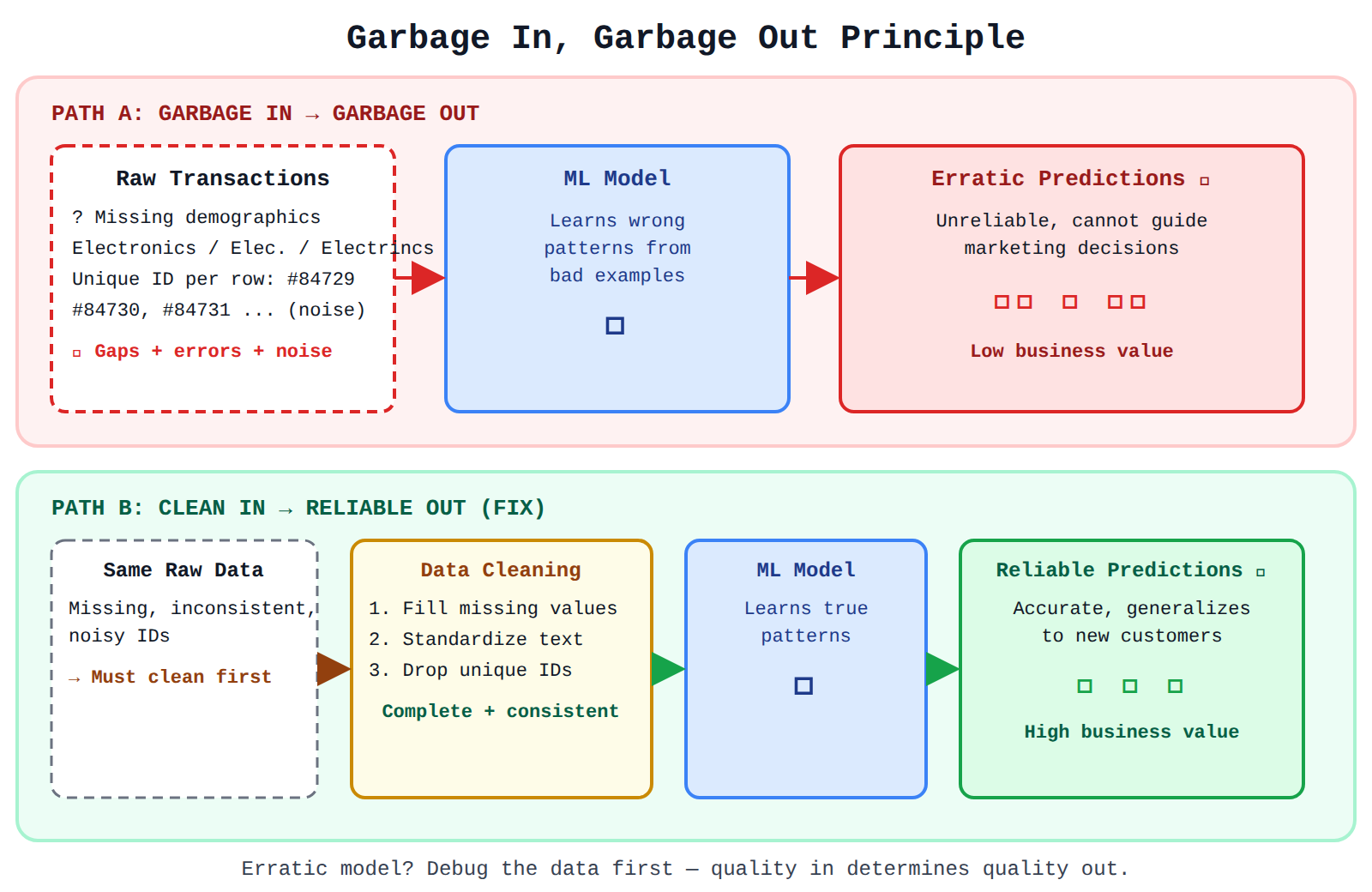
How It Meets the Scenario Requirements
- Resolving missing values: Addressing blank or incomplete demographic records ensures the model has sufficient signal across all rows, as a high volume of missing values significantly reduces the usefulness of a dataset.
- Standardizing inconsistent text: Correcting spelling errors, abbreviations, and formatting inconsistencies prevents the model from treating identical product categories as separate, unrelated attributes.
- Removing noisy features: Excluding randomly assigned unique transaction IDs eliminates statistical noise that can confuse the learning algorithm and prevent it from generalizing to new customer transactions.
Key Advantages and Capabilities
- Higher prediction accuracy: Clean, complete data enables the algorithm to learn genuine correlations between customer attributes and purchasing behavior.
- Improved model generalization: Removing irrelevant noise ensures the model performs reliably on unseen real-world data in production.
- Stronger business value: Reliable inferences give marketing teams trustworthy insights for targeting campaigns and allocating budgets.
- Faster model debugging: Because debugging an erratic model is primarily about debugging the data, fixing data integrity issues at the source resolves performance bottlenecks efficiently.
Why This Is Optimal
Machine learning algorithms cannot automatically distinguish between meaningful business patterns and data entry mistakes. Attempting to tune model evaluation settings or alter deployment architectures without fixing underlying data quality issues will still yield unreliable predictions. Cleaning the dataset directly eliminates the root cause of the poor model performance.
Try 10 interactive questions like this one, free
Answer them yourself and get your score the moment you finish. No account needed.
Full access includes
- 3,070 practice questions across all 6 exam domains
- Every answer explained: why it is right, and why the others are not
- Scout, an AI tutor that answers your follow-up questions
- Readiness tracking by domain, so you know when to book the exam
Related free sample questions
Keep the momentum going with these hand-picked practice scenarios
FundamentalCloud Digital Leader
Custom Machine Types with MIG Autoscaling
Discuss the business value of using Compute Engine to create and run virtual machines on Google’s infrastructure.
FundamentalCloud Digital Leader
Looker In-Database Architecture and Action Hub
Describe how Looker democratizes access to data by empowering individuals to self-serve business intelligence and create insights.
FundamentalCloud Digital Leader
Security Command Center CIEM
Discuss fundamental cloud security concepts.
FundamentalCloud Digital Leader
Google AI Principles Responsible AI Practices
Discuss the importance of explainable and responsible AI
FundamentalCloud Digital Leader
Compliance Resource Center
Describe how Google Cloud compliance resource center and Compliance Reports Manager support industry and regional compliance needs.
IntermediateProfessional Cloud Architect
BigQuery Long-Term Storage Automatic Transition
Choosing appropriate storage types (e.g., object, file, and databases)
Last updated