Fundamental
Prepare and test your skills

Fundamental
Prepare and test your skills
Right-Sized VMs with Elastic Instance Count
Free sample question with answers and detailed explanation below. The Cloud Digital Leader practice bank has an additional 3,070 practice questions.Try 10 free realistic questions: instant score, no credit card, and no account required.
A retail company is migrating its e-commerce platform to Compute Engine virtual machines (VMs). The leadership team needs an infrastructure solution that addresses two operational challenges:
- The application requires a specific ratio of vCPU to memory that does not align with standard predefined VM configurations.
- Customer traffic fluctuates unpredictably throughout the day and drops significantly overnight.
How does combining Compute Engine custom machine types with Managed Instance Group (MIG) autoscaling provide business value for this workload?
Explanations
It places capacity requests into a queue to wait until high-demand hardware accelerators become available before starting the workload.
It places capacity requests into a queue to wait until high-demand hardware accelerators become available before starting the workload.
What Time Flexibility and Queued Provisioning Are
Placing capacity requests into a queue to wait for scarce resources describes time flexibility powered by the Dynamic Workload Scheduler (DWS) and the flex-start provisioning model in Compute Engine. Instead of requiring immediate, on-demand VM creation, this approach queues requests until high-demand hardware—such as GPUs or TPUs—becomes available.
Why It Doesn't Meet the Requirements
- Unpredictable e-commerce traffic: A live customer-facing e-commerce platform requires immediate provisioning to handle sudden daytime traffic spikes. Waiting in a queue for capacity would cause severe delays and degraded user experience for active shoppers.
- Specific vCPU-to-memory ratio: Queued provisioning addresses when high-demand accelerator hardware is allocated rather than customizing the vCPU and memory ratios of general-purpose VMs.
Key Characteristics and Limitations
- Queued provisioning timeline: Resources are not provisioned immediately; workloads wait until all requested capacity is available.
- Single machine type focus: Time flexibility models generally support a single machine type rather than dynamically scaling across custom configurations.
- Incompatibility with machine type flexibility: In Compute Engine, time flexibility features cannot be combined with machine type flexibility in the same deployment.
This Answer Would Be Correct If
The scenario involved running AI/ML model training, fine-tuning, or large-scale batch processing jobs that require specialized hardware accelerators and have flexible start times rather than real-time customer traffic demands.
Additional Context
While time flexibility is an important dimension of infrastructure optimization in Google Cloud, interactive web applications rely on real-time horizontal autoscaling and right-sized machine types to maintain immediate availability during load spikes.
It maintains a fixed number of virtual machine instances at all times while automatically resizing the vCPU and memory of running VMs during brief, 60-second traffic spikes.
It maintains a fixed number of virtual machine instances at all times while automatically resizing the vCPU and memory of running VMs during brief, 60-second traffic spikes.
What Machine Type Recommendations (Rightsizing) Are
Compute Engine provides machine type recommendations (also known as rightsizing recommendations) to help optimize the vCPU and memory allocation of virtual machines based on historical usage data over the previous 8 days. Applying a machine type recommendation resizes the capacity of individual VM instances (vertical scaling) without changing the total number of instances in a group.
Why It Doesn't Meet the Requirements
- Fixed instance count limitation: Keeping the number of VM instances constant is the exact opposite of MIG autoscaling, which dynamically adds and removes VM instances (horizontal scaling) to handle fluctuating customer traffic.
- Inability to handle brief spikes: Machine type recommendations calculate average utilization over 60-second intervals across an 8-day window and do not dynamically resize running VMs in real time during sudden traffic surges.
Key Characteristics and Limitations
- Designed for non-autoscaled groups: Compute Engine machine type recommendations are specifically intended for workloads where the number of VM instances remains constant, such as software constrained by per-instance licensing.
- Requires VM restart for vertical resizing: Changing a VM's machine type (vCPU and memory) in Compute Engine is not a real-time reactive mechanism for brief spikes; horizontal autoscaling is the recommended solution for short usage spikes.
- 8-day historical analysis: The rightsizing algorithm evaluates 8 days of CPU and memory trends rather than reacting instantaneously to sub-minute load changes.
This Answer Would Be Correct If
The company was running a legacy workload tied to strict per-instance software licenses that prohibited adding more VM instances, and wanted to periodically right-size its existing VMs based on weekly utilization trends.
Additional Context
Understanding the distinction between vertical scaling (changing a VM's size via custom machine types or rightsizing recommendations) and horizontal autoscaling (changing the number of VMs in a MIG) is essential. Custom machine types establish the right baseline ratio for each VM, while MIG autoscaling varies the instance count in real time.
It eliminates the need to configure scaling rules by instantly scaling virtual machine instances down to zero when there is no application traffic.
It eliminates the need to configure scaling rules by instantly scaling virtual machine instances down to zero when there is no application traffic.
What Serverless Autoscaling to Zero Is
Instantly scaling compute resources without configuring fine-tuned scaling rules and automatically scaling down to zero instances during idle periods is the defining characteristic of serverless computing services, such as Cloud Run and Cloud Run functions. In a serverless model, the cloud provider abstracts away the underlying virtual machine infrastructure entirely.
Why It Doesn't Meet the Requirements
- Compute Engine VM migration: Compute Engine is an Infrastructure as a Service (IaaS) offering that runs persistent virtual machines. Compute Engine MIGs require administrators to define an autoscaling policy (such as target CPU utilization thresholds) and typically maintain at least a minimum number of running VMs to serve baseline traffic.
- VM initialization time: Virtual machines take time to boot and initialize applications, meaning they do not scale out from zero instantaneously like lightweight serverless containers.
Key Characteristics and Limitations
- Serverless vs. IaaS: Only serverless platforms like Cloud Run natively scale to zero out-of-the-box without requiring infrastructure management or scaling rule tuning.
- Autoscaling policies required in Compute Engine: To autoscale VMs in a Managed Instance Group (MIG), teams must configure specific metrics (such as
CPU utilization, load balancing capacity, or Cloud Monitoring metrics) and minimum/maximum instance limits. - Hardware customization: Serverless platforms offer limited hardware customization compared to Compute Engine custom machine types, which provide granular control over vCPU, memory, and disk configurations.
This Answer Would Be Correct If
The company was modernizing its application into stateless containers deployed on Cloud Run to achieve zero-configuration elasticity and zero cost during periods with no traffic.
Additional Context
Students often confuse the capabilities of IaaS autoscaling (Compute Engine MIGs) with serverless autoscaling (Cloud Run). While Compute Engine reduces cost during quiet periods by reducing the number of VMs, it requires explicit autoscaling policies and operates on VM instances rather than instant scale-to-zero execution environments.
It optimizes costs and performance by matching each VM's vCPU and memory to the workload's exact needs while automatically adding or removing VMs as traffic changes.
It optimizes costs and performance by matching each VM's vCPU and memory to the workload's exact needs while automatically adding or removing VMs as traffic changes.
What Custom Machine Types and MIG Autoscaling Are
Compute Engine custom machine types allow organizations to define the exact number of virtual CPUs (vCPUs) and the precise amount of memory required for an individual virtual machine (VM) instance. Managed Instance Group (MIG) autoscaling is an elastic infrastructure capability that dynamically adjusts the number of running VM instances in a group based on real-time load metrics, such as CPU utilization or load balancing serving capacity.
How It Meets the Requirements
- Specific vCPU-to-memory ratio: Rather than forcing the company to select an oversized predefined machine type just to get enough memory or CPU—which leads to paying for unused capacity—custom machine types align resource allocation precisely with the application's unique processing profile.
- Unpredictable traffic fluctuations: MIG autoscaling continuously monitors workload demand and automatically scales out (adds VM instances) during daytime traffic spikes to maintain responsiveness, and scales in (removes unused VM instances) overnight to eliminate wasteful spending.
Key Advantages and Capabilities
- Cost optimization: Prevents over-provisioning at both the individual VM level (via right-sized custom specs) and the fleet level (by terminating idle instances during low demand).
- Consistent application performance: Ensures sufficient compute capacity is provisioned automatically during unexpected surges so customer experience does not degrade.
- Reduced operational overhead: Eliminates the need for engineering teams to manually monitor traffic patterns and provision or deprovision servers around the clock.
- Right-sizing recommendations: Integrates with Compute Engine rightsizing recommendations, which analyze historical utilization to suggest optimal custom or standard vCPU and memory allocations.
Why This Is Optimal
Combining vertical right-sizing (through custom machine types) with horizontal elasticity (through MIG autoscaling) maximizes price-performance in an Infrastructure as a Service (IaaS) environment. The organization pays only for the exact hardware resources each instance needs and runs only the exact number of instances required by current customer demand.
Vertical Sizing Plus Horizontal Elasticity
Comparison Matrix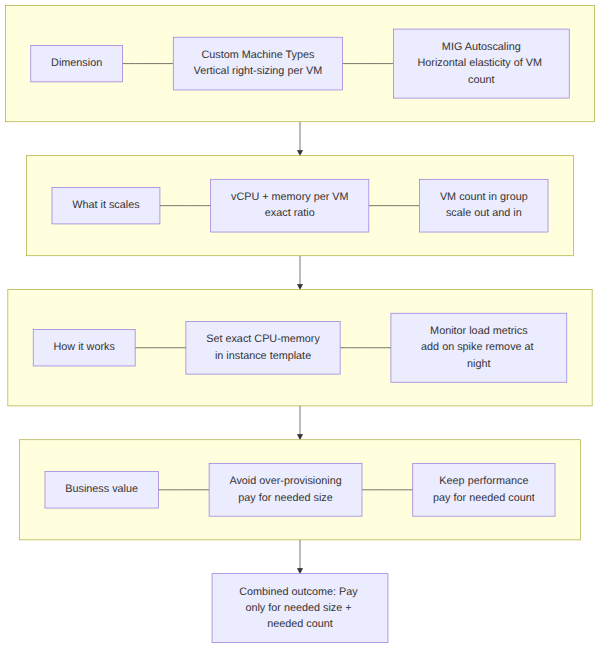
Try 10 interactive questions like this one, free
Answer them yourself and get your score the moment you finish. No account needed.
Full access includes
- 3,070 practice questions across all 6 exam domains
- Every answer explained: why it is right, and why the others are not
- Scout, an AI tutor that answers your follow-up questions
- Readiness tracking by domain, so you know when to book the exam
Related free sample questions
Keep the momentum going with these hand-picked practice scenarios
FundamentalCloud Digital Leader
Compute Engine Live Migration
Discuss the business value of using Compute Engine to create and run virtual machines on Google’s infrastructure.
FundamentalCloud Digital Leader
Multi-Host Cloud TPU Slices
Recognize TensorFlow as an end-to-end open source set of tools for building and training machine learning models and that Cloud Tensor Processing Unit (TPU) is Google’s proprietary hardware optimized for TensorFlow and ML performance.
FundamentalCloud Digital Leader
Data Governance Curation Capabilities
Explain how data governance is essential to a successful data journey.
FundamentalCloud Digital Leader
Apigee API Products and Rate Plans
Discuss the business value of using Apigee API Management.
FundamentalCloud Digital Leader
Cloud-First Hybrid Architecture with Apigee
Identify when private, hybrid, or multicloud infrastructures best apply to different business use cases.
AdvancedProfessional Cloud Network Engineer
Hub-and-Spoke NVA MIG Architecture
Planning the firewall strategy (e.g., VPC firewall rules, Cloud NGFW, hierarchical firewall rules, and third-party integration).
Last updated