Fundamental
Prepare and test your skills

Fundamental
Prepare and test your skills
IaaS Control Over OS and Hardware Accelerators
Free sample question with answers and detailed explanation below. The Cloud Digital Leader practice bank has an additional 3,070 practice questions.Try 10 free realistic questions: instant score, no credit card, and no account required.
A research organization is migrating its high-performance simulation workloads to Google Cloud. The organization's infrastructure architects have established the following technical and operational requirements:
- Environment customization: The engineering team must design custom environments from scratch and retain full administrative control over the guest operating system (OS), middleware, and software stack.
- Hardware flexibility: The workloads require configurable virtual machine (VM) instances with attached graphics processing units (GPUs) and tensor processing units (TPUs).
- Infrastructure offloading: Google Cloud must manage the physical data centers, servers, storage, networking, and virtualization layer.
Which cloud service model and management structure best supports these requirements?
Explanations
Infrastructure as a Service (IaaS), where Google manages the guest OS and middleware while the organization manages the underlying virtualization and physical servers
Infrastructure as a Service (IaaS), where Google manages the guest OS and middleware while the organization manages the underlying virtualization and physical servers
What this option describes
While this option correctly names Infrastructure as a Service (IaaS), it completely reverses the shared responsibility boundary between the customer and Google Cloud. It inaccurately states that Google manages the guest OS and middleware while the customer manages the underlying virtualization and physical servers.
Why it doesn't meet the requirements
- Inverted management responsibilities: In any public cloud environment, the cloud provider owns and operates the physical data centers. A customer migrating to Google Cloud never manages physical servers or the foundational virtualization hypervisor layer.
- Contradicts the organization's goals: The research organization specifically needs to offload physical servers, storage, networking, and virtualization to Google Cloud while retaining internal control over the guest OS, middleware, and applications.
Key characteristics and limitations
- Google's actual IaaS responsibility: In Google Cloud IaaS (such as Compute Engine), Google manages the underlying virtualization, servers, storage, and networking.
- The customer's actual IaaS responsibility: The customer is responsible for installing, patching, and configuring the guest OS, middleware, runtime, and applications.
- On-premises misconception: Managing physical servers and virtualization layers is a characteristic of maintaining a traditional on-premises data center, not consuming public cloud IaaS.
This answer would be correct if
This division of responsibility does not exist in standard cloud computing models. However, if the organization wanted to retain management of physical servers and virtualization hardware itself, it would need to maintain an on-premises data center rather than migrating to a public cloud IaaS solution.
Additional context
Understanding the exact boundary of the shared responsibility model is essential for cloud governance. In IaaS, the provider's responsibility stops at the virtualization layer, giving the customer complete authority over everything from the guest operating system upward.
Platform as a Service (PaaS), where Google manages the underlying infrastructure, OS, and runtime environments so the organization focuses only on running workloads
Platform as a Service (PaaS), where Google manages the underlying infrastructure, OS, and runtime environments so the organization focuses only on running workloads
What Platform as a Service (PaaS) is
Platform as a Service (PaaS) and managed compute platforms represent a higher level of abstraction on the cloud computing spectrum, offering a balance between developer agility and operational ease of use. In Google Cloud, managed platforms such as Cloud Run and App Engine handle the underlying servers, virtualization, operating system (OS), and runtime environments automatically so that engineering teams can focus exclusively on writing and deploying application code or containers.
Why it doesn't meet the requirements
- Lack of OS and middleware control: Because PaaS abstracts away the guest OS and underlying infrastructure, the organization's infrastructure architects cannot customize the operating system or manage low-level system middleware from scratch.
- Restricted hardware customization: Serverless and managed platforms abstract away raw virtual machine (VM) instances, preventing engineers from directly configuring raw VM or bare metal instances with custom OS kernels and low-level hardware settings.
Key characteristics and limitations
- High management abstraction: Google Cloud automatically handles OS patching, server provisioning, cluster management, and autoscaling.
- Developer velocity: Designed to accelerate application deployment for web applications, APIs, and event-driven microservices.
- Reduced infrastructure visibility: Customers trade away low-level OS and VM configuration control in exchange for reduced operational overhead.
- Workload focus: Preferred by application developers and data scientists who want to run code without managing servers.
This answer would be correct if
This option would be the right choice if the organization wanted to eliminate operational overhead by having Google Cloud manage the OS and runtime environments, allowing developers to deploy scalable, containerized web applications using a serverless platform like Cloud Run.
Additional context
When evaluating cloud models on the control versus abstraction spectrum, moving from IaaS toward PaaS reduces the administrative burden on internal IT staff, but it also removes the granular infrastructure control required by specialized systems engineers and infrastructure architects.
Software as a Service (SaaS), where Google manages the entire software stack, application logic, and underlying infrastructure for immediate end-user consumption
Software as a Service (SaaS), where Google manages the entire software stack, application logic, and underlying infrastructure for immediate end-user consumption
What Software as a Service (SaaS) is
Software as a Service (SaaS) sits at the far end of the abstraction spectrum, delivering complete, ready-to-use applications over the internet. In a SaaS model—such as Google Workspace or turnkey cloud-hosted software—the cloud provider manages the entire technology stack, including the physical hardware, virtualization, operating system (OS), middleware, runtime, and the application software itself. Customers simply access the software through a web browser or API and manage their own user access and data.
Why it doesn't meet the requirements
- No environment customization: In a SaaS model, the customer has zero access to the guest OS, middleware, or underlying software stack, making it impossible to design custom simulation environments from scratch.
- No infrastructure or VM access: End users cannot provision virtual machine (VM) instances, select machine series, or attach GPUs and TPUs to run proprietary simulation workloads.
Key characteristics and limitations
- Maximum abstraction: The cloud provider is responsible for all software updates, security patching, availability, and infrastructure scaling.
- Minimal technical overhead: Requires no infrastructure architects or platform engineers to maintain servers, operating systems, or application code.
- Standardized functionality: Built for common business functions (such as email, collaboration, or customer relationship management) rather than custom-engineered high performance computing (HPC) workloads.
This answer would be correct if
This option would be correct if the organization wanted to adopt a turnkey business application—such as cloud-based productivity and collaboration tools—where employees could immediately use the software without the IT team writing code, managing middleware, or provisioning virtual machines.
Additional context
While SaaS maximizes ease of use by offloading nearly all technical management to the provider, custom workloads that demand full control over the OS, networking, and software stack require raw VM instances delivered through an IaaS model like Compute Engine.
Infrastructure as a Service (IaaS), where the organization manages the OS, middleware, and applications while Google manages virtualization, servers, storage, and networking
Infrastructure as a Service (IaaS), where the organization manages the OS, middleware, and applications while Google manages virtualization, servers, storage, and networking
What Infrastructure as a Service (IaaS) is
Infrastructure as a Service (IaaS) is the cloud computing model that provides the highest degree of infrastructure control and the lowest level of management abstraction. Through Google Cloud offerings such as Compute Engine and Google Cloud VMware Engine, organizations provision virtualized computing resources—including processing power, memory, storage, and networking—directly on Google's global infrastructure. Under the shared responsibility model, Google manages the physical infrastructure and virtualization layer, while the customer remains responsible for configuring and maintaining everything inside the virtual machine.
IaaS Shared Responsibility on Compute Engine
Layered Stack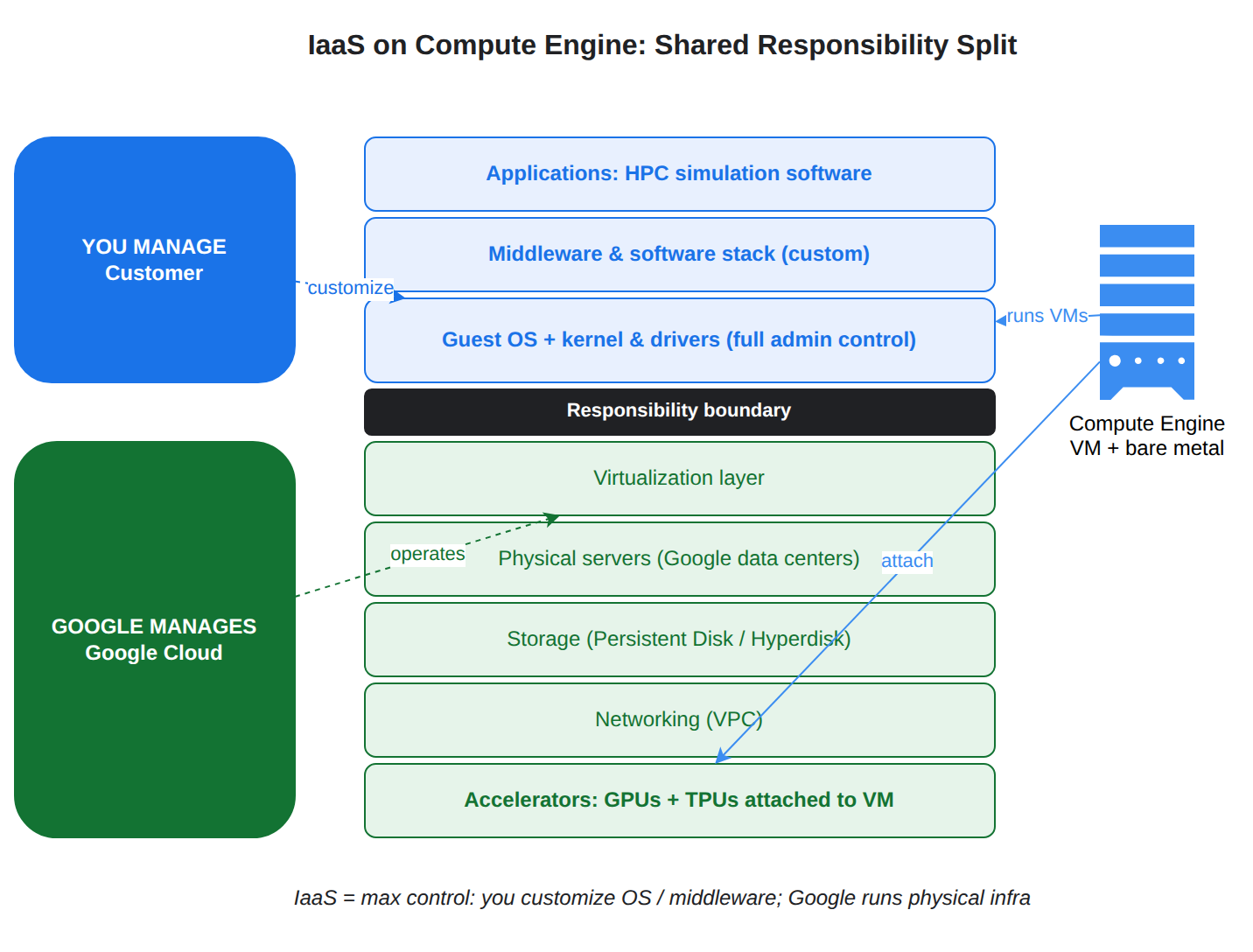
How it meets the requirements
- Environment customization: With IaaS, infrastructure architects and platform engineers retain complete administrative access to customize the guest operating system (OS), middleware, networking configurations, and application software stack from scratch.
- Hardware flexibility: Using Compute Engine, teams can select specific machine series and attach purpose-built hardware accelerators—such as graphics processing units (GPUs) or tensor processing units (TPUs)—directly to configurable VM or bare metal instances.
- Infrastructure offloading: Google Cloud handles all underlying physical servers, storage, networking, and virtualization, eliminating the need for the organization to procure or maintain on-premises data center hardware.
Key advantages and capabilities
- Maximum architectural control: Ideal for specialized high performance computing (HPC), artificial intelligence (AI), and custom legacy workloads that require fine-grained OS kernel tuning.
- Lift-and-shift readiness: Enables organizations to migrate existing workloads to the cloud without re-architecting their software stack.
- Flexible hardware configurations: Supports custom machine types, persistent storage options, and dedicated accelerators (GPUs and TPUs).
- Clear operational boundaries: Offloads physical hardware maintenance and facility security to Google while preserving full customer autonomy over the software environment.
Why this is optimal
Unlike Platform as a Service (PaaS) or Software as a Service (SaaS), which abstract away the operating system and underlying virtual machines, IaaS gives infrastructure architects the exact level of granular control required to configure custom guest OS environments, middleware dependencies, and attached hardware accelerators.
Try 10 interactive questions like this one, free
Answer them yourself and get your score the moment you finish. No account needed.
Full access includes
- 3,070 practice questions across all 6 exam domains
- Every answer explained: why it is right, and why the others are not
- Scout, an AI tutor that answers your follow-up questions
- Readiness tracking by domain, so you know when to book the exam
Related free sample questions
Keep the momentum going with these hand-picked practice scenarios
FundamentalCloud Digital Leader
PaaS Shared Responsibility Model
Discuss the benefits and tradeoffs of using infrastructure as a service (IaaS); platform as a service (PaaS); and software as a service (SaaS).
FundamentalCloud Digital Leader
Predictive ML vs Descriptive Analytics
Differentiate the capabilities of AI and ML from data analytics and business intelligence.
FundamentalCloud Digital Leader
Standardized APIs for Reusable Integration
Explain the business value of application programming interfaces (APIs).
FundamentalCloud Digital Leader
Cloud Modernization Competitive Advantage
Describe the implications and risks for organizations that do not adopt new technology.
FundamentalCloud Digital Leader
Data Governance Curation Capabilities
Explain how data governance is essential to a successful data journey.
AdvancedProfessional Cloud Network Engineer
Cross-Cloud Interconnect BGP ASN Requirements
Configuring Network Connectivity Center
Last updated